Nigella sativa L.
Summary
Nigella sativa or black cumin is native to Southern Europe, North Africa, and Southwest Asia, and has been widely cultivated across the Mediterranean to South Asia as one of the most valuable herbs in the history of world medicine. Dubbed the 'Herb from Paradise' by herbal experts and known as a potent remedy in Islamic tradition, its seeds are also popular as a cooking spice and source of essential oil, as well as a traditional medicine ingredient for headache, inflammation, diabetes, and digestive disorders.
Agroecology
Black cumin is a subtropical plant, also cultivable in temperate regions and at elevations higher than 1,500-2,500 m asl in tropical regions. Grows best in areas where the mean annual daytime temperature is in the range of 14-26°C, but can tolerate 5-30°C. This species prefers locations with mean annual rainfall in the range of 600-800 mm, but tolerates 400-1,000 mm. Its optimal growth is in a sunny position, with light, fertile soil texture, and a soil acidity (pH) in the range of 6.5-7.3, but can tolerate 6-8. Black cumin is usually found growing on roadsides and dump sites.
Morphology
- Roots a taproot, yellowish brown.
- Stem much-branched, subterete, ribbed, sometimes hollow when old, puberulent, light to dark green.
- Leaves alternate, blade thinly sublinear, finely divided, sparsely pilose, usually green but sometimes turning reddish brown. Petiole very widened at the base, light green, ribbed, puberulent.
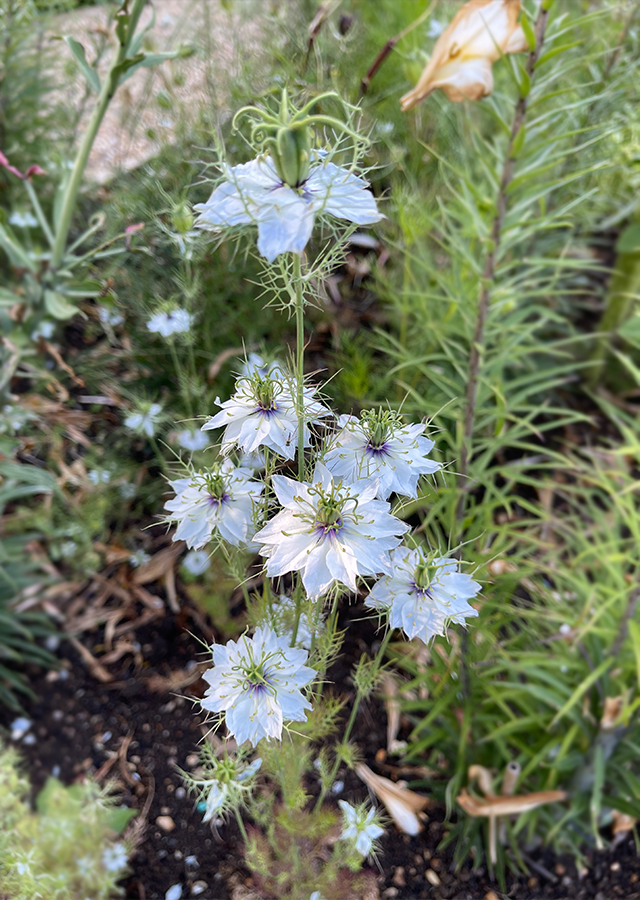
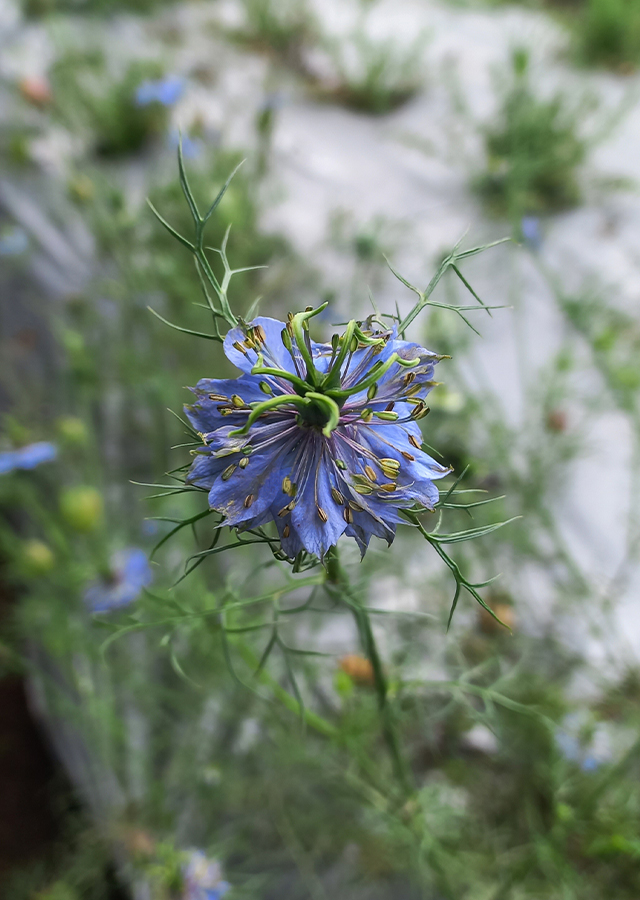
- Flowers solitary, appearing at the tip of the stem (terminal), puberulent, ribbed, coral-shaped. All flower parts are inserted on a pale yellow, fleshy, cone-shaped receptacle, appearing as an orange-brown ring below the fruit carpels. Sepals 5, petaloid, ovate, tip blunt, tapering at the base and becoming clawed (2-3 mm long), papillose to pilose, pale green when young, sometimes partially reddish, pale bluish-white inside when older. Petals (6-)8(-11), with a short claw, blade 2-lobed, the lobes covering the nectar pocket, tip bifid, greenish white with purple lines, purple at the base, white at the tip. Stamens in (6-)8(-10) groups, each with 3-7 stamens, each group forming a spiraloid line at the base of the flower, filaments linear, purplish blue to pale blue, anthers yellow. Pistil lobes consist of 3-7 white granular carpels, nearly fused at the base, forming a compound ovary with free stigmas.
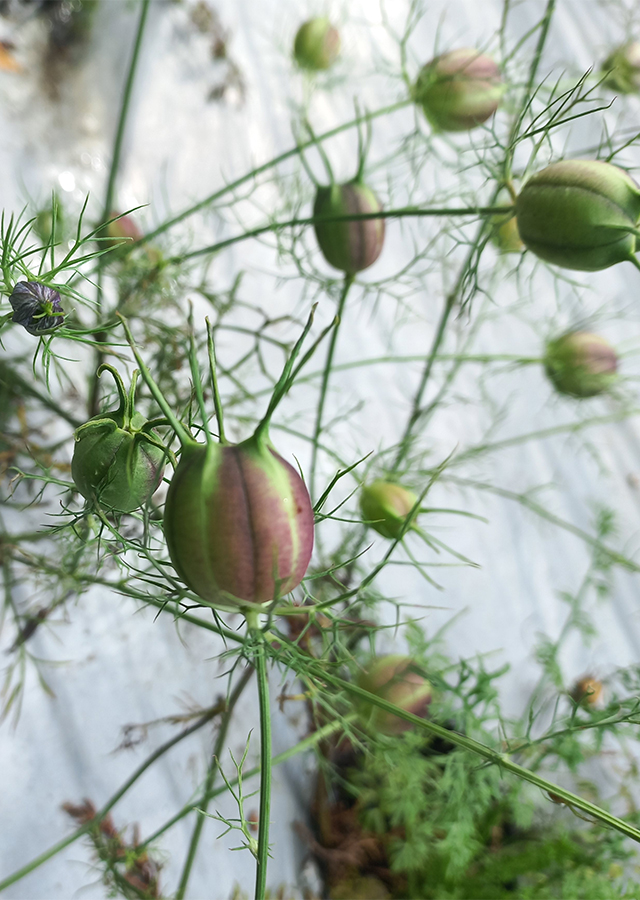
- Fruit a ribbed, oblong, tuberculate capsule, grayish green to brown when ripe, many-seeded, with a persistent stigma.
- Seeds small, 3(-4)-sided, obpyramidal, rugose-tuberculate, dark black with a white interior, somewhat fragrant and bitter tasting.
Cultivation
- Plant propagation through seed.
- In temperate regions, black cumin begins flowering about 100 days after sowing seed, with mature seed ready to harvest 50 days later. In warmer climates, flowering can begin 8-10 weeks after germination.
- Common planting spacing is (15-)25-40 cm.
Chemical Content
Essential oil (thymoquinone, thymohydroquinone, dithymoquinone, p-cymene, α-pinene, β-pinene, carvacrol, α-terpineol, trans-anethole, limonene, α-thujene), fatty acids (eicosenoic acid, linoleic acid, linolenic acid, myristic acid, oleic acid, palmitic acid, stearic acid), tannins, the alkaloid damascenine, nigellone, nigellimine, nigellimine-N-oxide and nigellicine, campesterol, stigmasterol, β-sitosterol, α-spinasterol, alkaloids, saponins, sterols, phenolic compounds.
Benefits
Treats headache, back pain, rheumatic pain, asthma and cough, stomachache and cramps, paralysis, infections, inflammation, hypertension, jaundice, malaria, relieves colds, bloating and colic, menstrual disorders, increases breast milk flow in nursing mothers, treats worm infestation (especially in children), diabetes, blisters, eczema, abscesses, hemorrhoids, orchitis, swollen joints, skin disorders (such as ringworm, eczema), baldness, heals snake bites and scorpion stings, helps drain pus, removes head lice, strengthens immune system function, induces abortion. Is anthelmintic, aphrodisiac, and carminative. Has antioxidant, antidiabetic, antimicrobial, antibacterial, and anticancer activity.
Simplisia
- Take an adequate amount of black cumin seeds.
- Dry under the sun.
- Grind using a blender until it becomes powder.
- Store in a clean, airtight container.
Local Names
Jinten hitam, Jinten ireng, Habbatussaudah.
Traditional Recipes
The following recipes reflect traditional knowledge passed down through generations, not a substitute for professional medical diagnosis or advice. Consult a healthcare provider before use.
1. Removes head lice
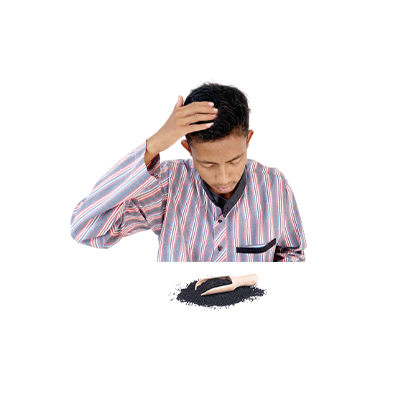
- Take dried black cumin seeds that have been ground into powder.
- Sprinkle an adequate amount of black cumin powder on the hair to remove lice from the hair.
Reference Sources
- Royal Botanic Gardens, Kew. Plants of the World Online: Nigella sativa L.. https://powo.science.kew.org/taxon/711687-1. 23-07-2022.
- Tropical Plants Database, Ken Fern. 2021. Nigella sativa. https://tropical.theferns.info/viewtropical.php?id=Nigella+sativa. 23-07-2022.
- Plant Resources of South-East Asia. 2020. Nigella sativa (PROSEA). https://uses.plantnet-project.org/en/Nigella_sativa_(PROSEA). 23-07-2022.
- Ebrahim M. Yimer et al. 2019. Nigella sativa L. (Black Cumin): A Promising Natural Remedy for Wide Range of Illnesses. Hindawi. Evidence-Based Complementary and Alternative Medicine. https://doi.org/10.1155/2019/1528635.
- Sultana S. et al. 2015. Nigella sativa: Monograph. Journal of Pharmacognosy and Phytochemistry, 4(4): 103-106.