Ocimum basilicum L.
Summary
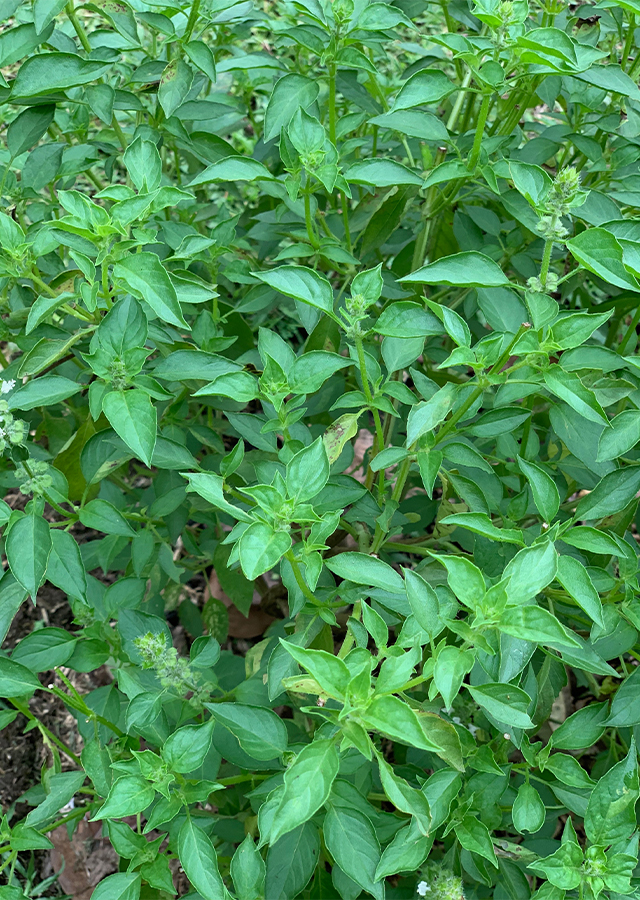
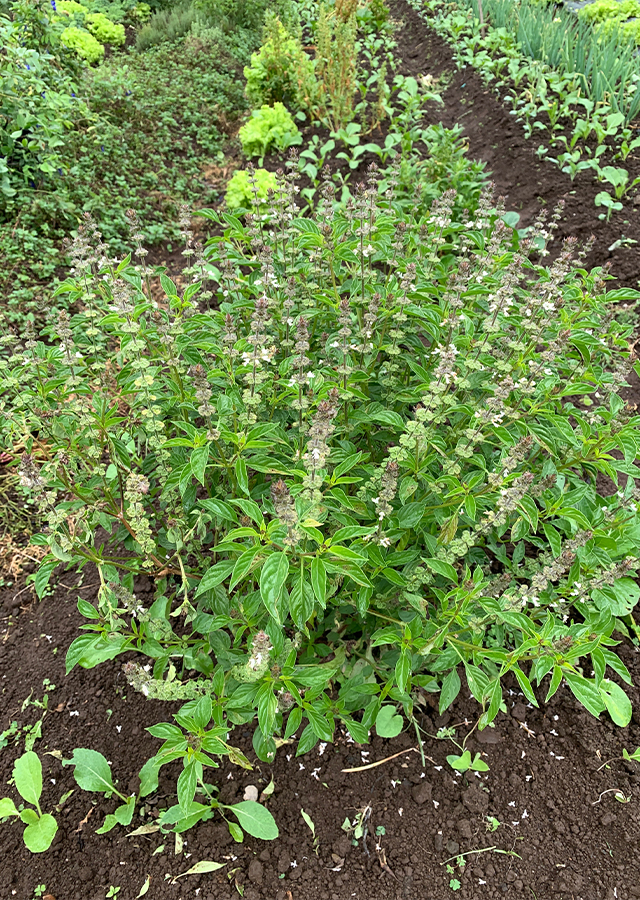
Kemangi or basil (Ocimum basilicum) is an annual herb up to 1 meter tall of the Lamiaceae family, originating from Asia, Africa, and South America, used as a medicinal and aromatic plant for centuries. Its distinctive leaves are an essential fresh vegetable in various Nusantara dishes, while its essential oil is used in cosmetics and soap. Kemangi is also believed to remove body odor and boost breast milk production.
Agroecology
Grows in areas at elevations of 400-1,100 m above sea level with an annual temperature of 18-27°C, fertile soil, rainfall 1,000-1,600 mm/year, well-drained soil and optimal pH 5.5-6.5. Requires direct sunlight (at least 5 hours) daily
Morphology
- Roots taproot.
- Stem upright, soft, many branches.
- Leaves single, spur or egg-shaped, upright and long, light green, distinctive smell, serrated edges.
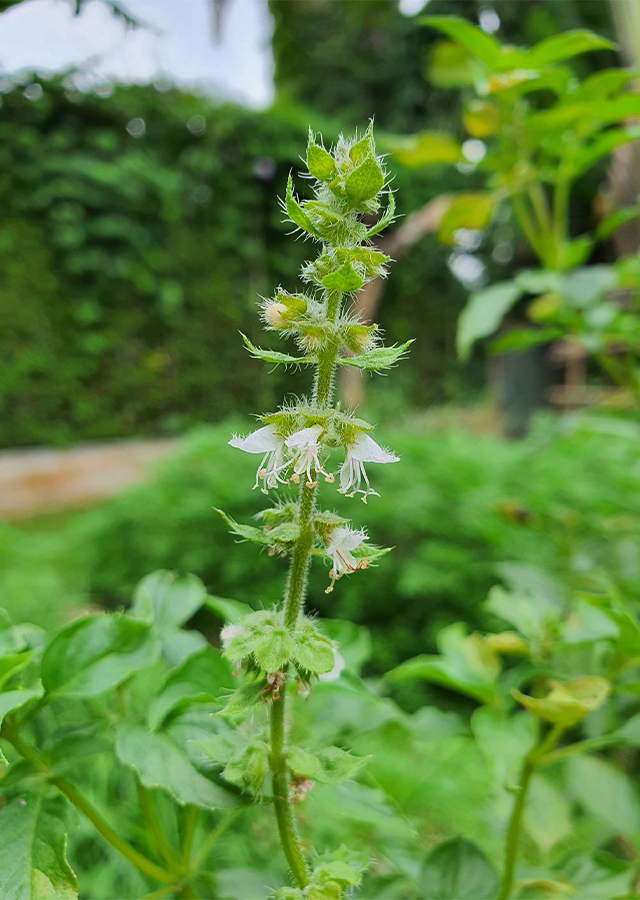
- Flowers small, white or purplish-white compound, arranged in an upright cluster, has 5 lip-shaped sepals.
- Seeds hard type, dark brown to black in color.
Cultivation
- Generative and vegetative propagation
- Generative: sow seedlings, once 5-8 cm tall transplant to the field. Seedlings are pruned to stimulate branching and growth.
- Stem cuttings: cut the stem section with 4-5 leaf pairs, below the fifth node from the tip. Roots grow within 3-4 weeks.
Chemical Content
Essential oils (methyl chavicol, linalool, β-caryophyllene, 1,8-cineole, eugenol, saponin glycosides, α-cubebene, geranyl acetate, (E)-β-ocimene, geraniol, δ-guaiene, α-terpineol, myrcene), terpenoid, alkaloid, flavonoid, tannin.
Benefits
Removes body and mouth odor, stimulates central nervous system activity, estrogen and androgen hormones, boosts immunity and breast milk production, dilates capillary vessels, coronary heart disease, prevents infertility.
Simplisia
- Select fresh and healthy kemangi leaves then wash with clean running water.
- Slice the leaves thinly and evenly vertically.
- Arrange the leaves in a clean container, then air-dry the leaves away from direct sunlight until evenly dry.
- Once dry, pack in a tightly closed or airtight plastic bag.
Local Names
Surawung (West Java), Kemanghi (Madura), Lufe-lufe (Ternate).
Traditional Recipes
The following recipes reflect traditional knowledge passed down through generations, not a substitute for professional medical diagnosis or advice. Consult a healthcare provider before use.
1. Coronary Heart Disease
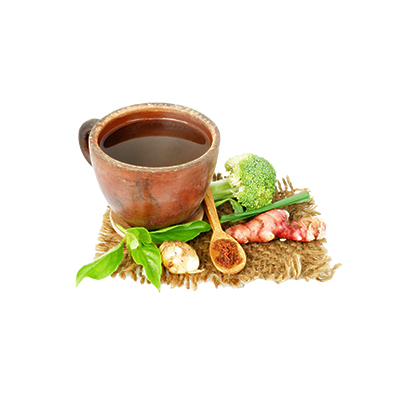
- Prepare 30 g kemangi leaves, 40 g broccoli, 1 finger-width red ginger, 30 g chives, and 20 g kencur.
- Wash all ingredients thoroughly then slice thinly. Boil the ingredients with 4 glasses of water until the decoction is reduced to 2 glasses, strain.
- Drink 3 times a day, 1/2 glass each time. Palm sugar can be added to taste.
Reference Sources
- Aldi Y, Dewi ON, Uthia R. 2016. Uji imunomodulator dan Jumlah sel leukosit dari ekstrak daun kemangi (Ocimum basilicum L.) pada mencit putih jantan. SCIENTIA Jurnal Farmasi dan Kesehatan 6(2): 139-147
- Khair-ul-Bariyah S, Ahmed D, Ikram M. 2012. Ocimum basilicum: a review on phytochemical and pharmacological studies. Pak. J. Chem. 2(2): 78-85
- Bilal A, Jahan N, Ahmed A, Bilal SN, Habib S, Hajra S. 2012. Phytochemical and pharmacological studies on Ocimum basilicum Linn – a review. Int. J. Cur. Res. Rev. 4(23): 73-83
- Harnafi H, Aziz M, Amrani S. 2009. Sweet basil (Ocimum basilicum L.) improves lipid metabolism in hypercholesterolemic rats. Journal of Clinical Nutrition and Metabolism 4: 181–186.
- Kadan S, Saad B, Sasson Y, Zaid H. 2016. In vitro evaluation of anti-diabetic activity and cytotoxicity of chemically analysed Ocimum basilicum extracts. Food Chemistry 196: 1066–1074.
- Kadhim MJ, Sosa AA, Hameed IH. 2016. Evaluation of anti-bacterial activity and bioactive chemical analysis of Ocimum basilicum using Fourier transform infrared (FT-IR) and gas chromatography-mass spectrometry (GC-MS) techniques. J. Pharmacognosy Phytother 8(6): 127-146
- Prosea. 2016. Ocimum basilicum. https://uses.plantnet-project.org/en/Ocimum_basilicum_ (PROSEA) 07-06-201
- Setani SD. 2014. Sifat antibakteri dari ekstrak daun kemangi (Ocimum basilicum L.) dan daun Tespong (Onanthe javanica D.C.). Skripsi. Fakultas Matematika dan Ilmu Pengetahuan Alam. Institut Pertanian Bogor. Bogor