Ophiopogon japonicus (Thunb.) Ker Gawl.
Summary
Ophiopogon japonicus or dwarf lilyturf is native to East Asia such as China, Japan, and Korea, as well as Vietnam, India, and the Philippines. Its genus name derives from Greek meaning 'snake's beard,' referring to its grass-like leaf tufts, often used as ornamental ground cover. Its edible root is often used as a ginseng substitute in China, and also serves as a traditional remedy for dry cough, insomnia, and reducing fever.
Agroecology
Dwarf lilyturf can be found growing in shaded places in lowlands and foothills, forests, mossy forests, dense thickets in ravines, moist shaded places on slopes and along rivers and cliffs. Grows well in full sun or partial shade in well-drained sandy loam soil. Dwarf lilyturf is sometimes grown as an ornamental for freshwater aquariums, but because it is not a true aquatic plant, it can live underwater for several months before dying. Although hardy to temperatures around 20°C when dormant in winter outdoors in normal soil, when kept fully submerged, it requires a water temperature of 18-25°C.
Morphology
- Roots aromatic stolons, sweet and mucilaginous, fibrous, large with tuberous roots. Stolons creeping and slender, roots fairly thick, usually with a tuberous portion near the middle or tip.
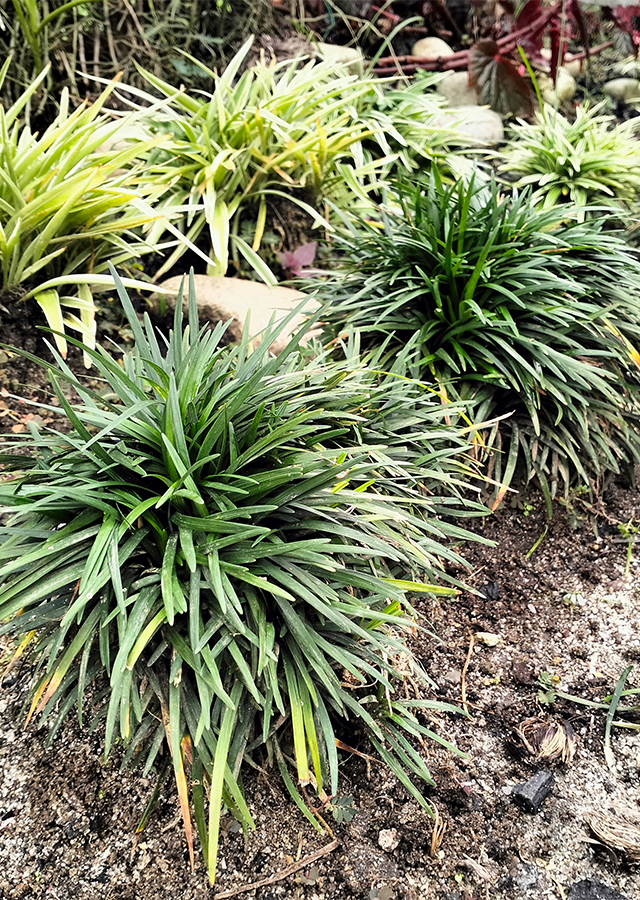
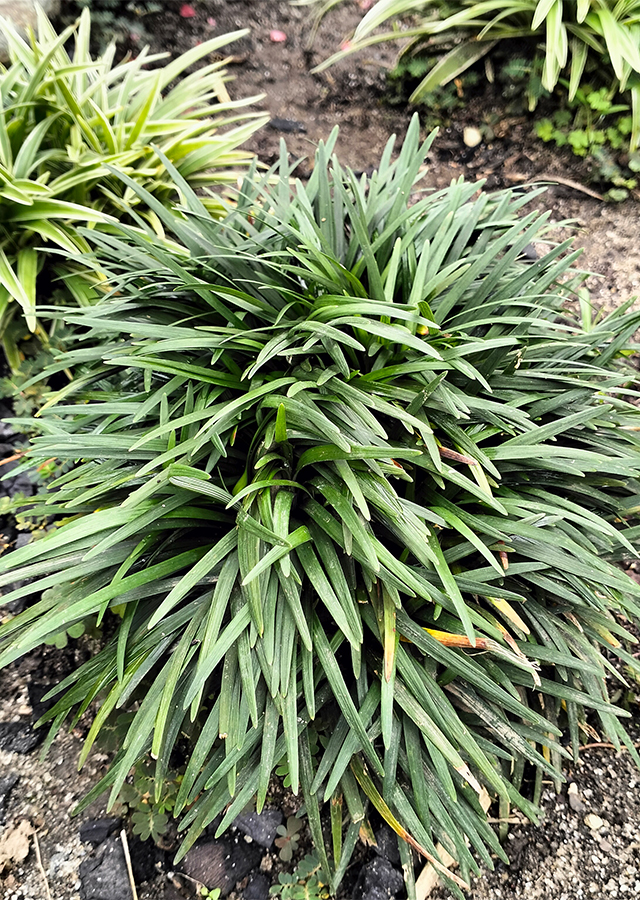
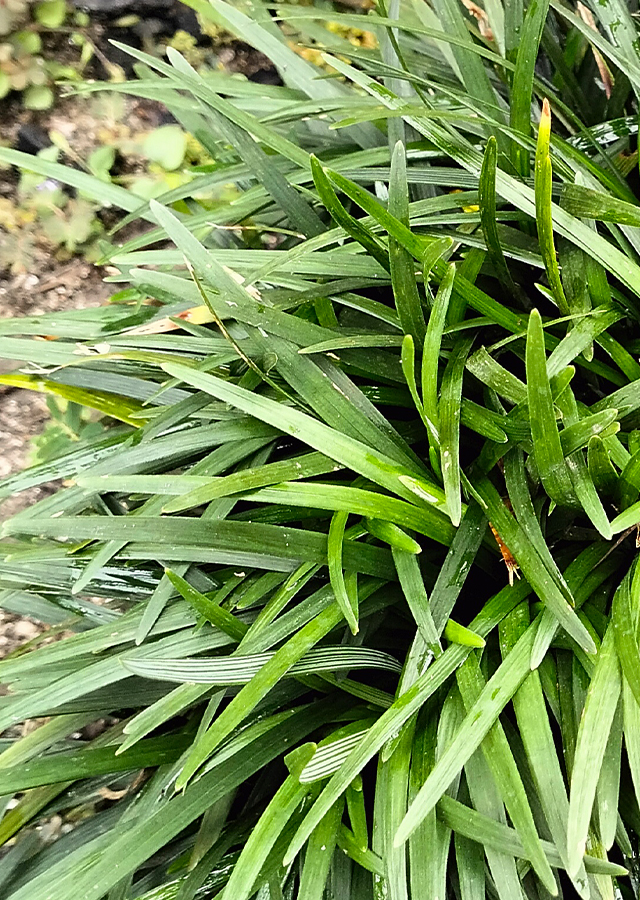
- Leaves simple, basal, sessile, linear, generally about 15-50 cm long and 2-4 mm wide, with 3-7 parallel veins, margin serrate. Leaves dark green above and pale grayish below.
- Flowers solitary or paired, usually pendant-like, pedicel 3-4 mm. Tepals 6-lobed, white or pale purple, lanceolate shaped, about 5 mm long and 2 mm wide. Filaments very short, anthers about 2.5-3 mm long and lanceolate. Style narrowly conical, medium-thick, widening at the base. Inflorescence appears in the leaf axils, 1-20 cm long, with a few to more than 10 flowers with white lanceolate bracts.
- Fruit a blue-black berry, subglobose to ellipsoid-globose, pea-sized, 5-9 mm in diameter.
Cultivation
Plant propagation through seed and clump division.
Chemical Content
Homoisoflavonoids (ophiopogonanone C, ophiopogonanone D, ophiopogonone C, ophiopogonanone E, and ophiopogonanone F), sesquiterpene glycoside (ophioside A), monoterpene glycoside (ophiopogonol), spirostans (ophiogenin), ophiopogonol, essential oil, steroidal saponins.
Benefits
A sedative remedy, treats dry cough, sore throat, insomnia, diabetes, constipation, diphtheria, cardiovascular disease-related disorders, helps heal mouth ulcers, stimulates breast milk in nursing mothers, reduces fever. Has antiseptic and anti-inflammatory activity.
Local Names
Bunga bakung kerdil.
Traditional Recipes
The following recipes reflect traditional knowledge passed down through generations, not a substitute for professional medical diagnosis or advice. Consult a healthcare provider before use.

1. Treats dry cough
- Prepare an adequate amount of dwarf lilyturf root and wash until clean.
- Boil until it boils.
- Let it cool to warm/cold.
- Strain then drink.
Reference Sources
- Health Benefits Times. 2021. Health benefits of Ophiopogon (Mondo Grass). https://www.healthbenefitstimes.com/ophiopogon/. 11-01-2023.
- Royal Botanic Garden, Kew. Plants of the world Online: Ophiopogon japonicus (Thunb.) Ker Gawl. https://powo.science.kew.org/taxon/urn:lsid:ipni.org:names:429781-1#synonyms. 11-01-2023.
- Lan, Shen, et al. 2013. Chemical constituents from the fibrous root of Ophiopogon japonicus, and their effect on tube formation in human myocardial microvascular endothelial cells. Fitoterapia, Vol.85: pg 57-63.
- Missouri Botanical Garden. Ophiopogon japonicus 'Gyoku-ryu'. https://www.missouribotanicalgarden.org/PlantFinder/PlantFinderDetails.aspx?kempercode=s960. 11-01-2023.
- Flora & Fauna Web. Ophiopogon japonicus (Thunb.) Ker Gawl. https://www.nparks.gov.sg/florafaunaweb/flora/8/5/8542. 11-01-2023.
- Stuartxchange. 2019. Philippine Medicinal Plants: Mondo grass. http://www.stuartxchange.org/MondoGrass.html. 11-01-2023.