Opuntia cochenillifera (L.) Mill.
Summary
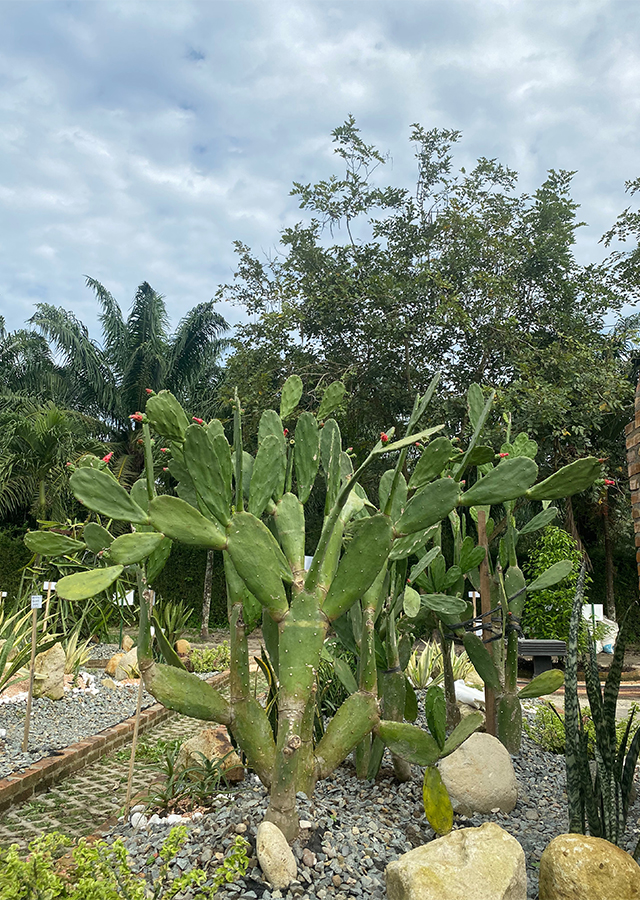
Kaktus centong (Opuntia cochenillifera) is a thorny succulent up to 4-5 meters tall of the Cactaceae family, originating from southern Mexico and now spread worldwide. Its flat pads can be cooked as a vegetable, while its fruit is eaten fresh. Traditionally, kaktus centong is also believed to relieve rheumatism, diarrhea, and help control blood sugar.
Agroecology
Kaktus centong is found in both dry and humid areas such as mountain valleys, dry forests, savanna, sandy soil at elevations between 0-1,500 m above sea level. Average annual temperature (-)2-35 °C and average rainfall 430-1,500 mm/year.
Morphology
- Roots taproot, branching.
- Stem mostly spineless and 20 cm in diameter.
- Leaves single-bladed, short-stalked, and large sized, thorny.
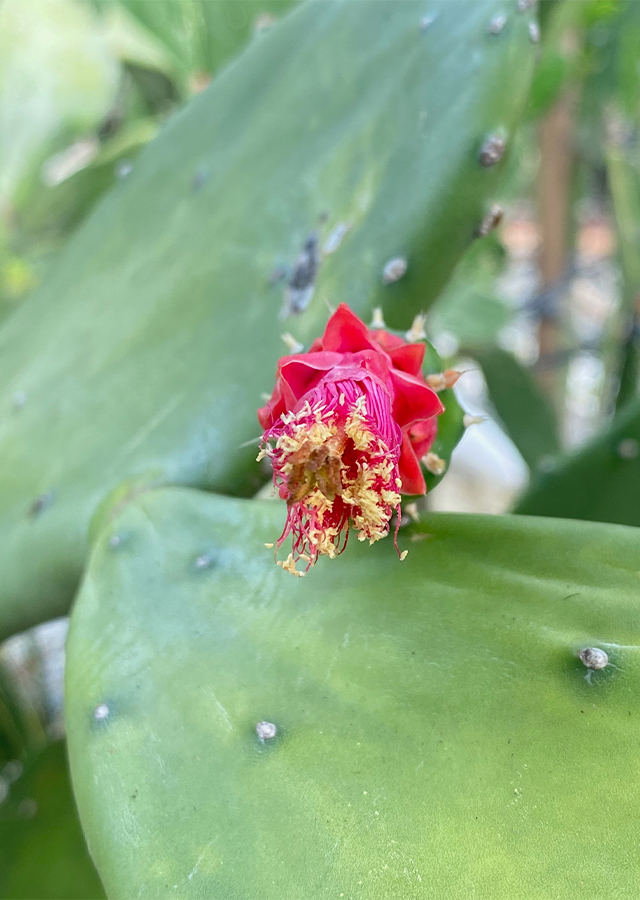
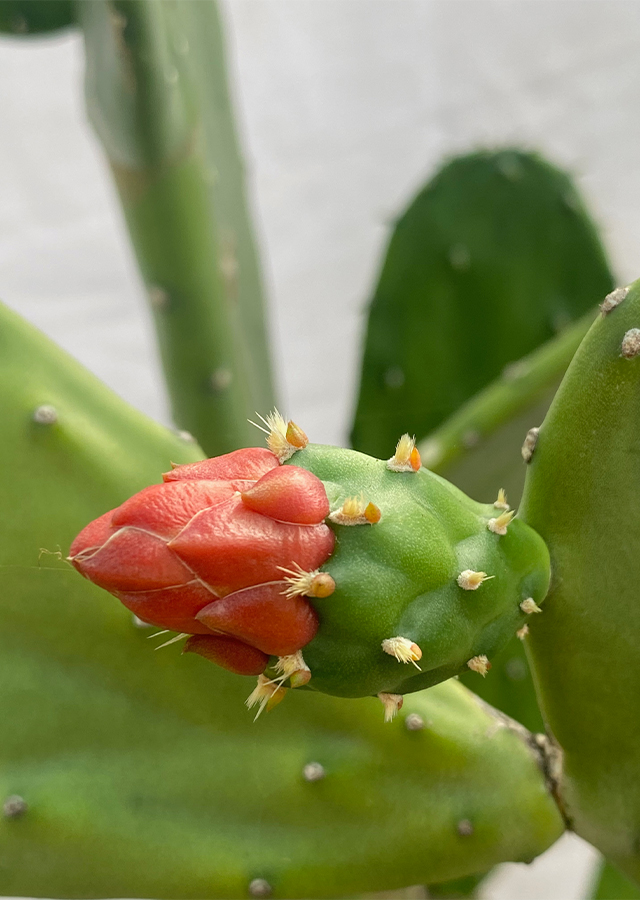
- Flowers arranged solitarily and appear to have many sepals. The petals have many red-colored lobes. Sized 4-7 cm, inner tepals protruding, pink stamens, and white pistil.
- Fruit oblong shaped sized 25-40 x 20-25 mm.
- Seeds grayish-brown with a length of 3-5 mm and width 1.5-3 mm.
Cultivation
- Propagated generatively (by seed) or vegetatively (cuttings), best done in the dry season.
- Pad pieces can be planted directly. Excessive watering causes the plant to rot.
Chemical Content
Polyphenols, betalain, tocopherol, alkaloids, tannins, steroids, flavonoids, terpene/steroid.
Benefits
Treats rheumatism, diarrhea, ear and tooth pain, aids digestion, reduces cancer risk, helps control blood sugar, and acts as an anti-inflammatory.
Simplisia
- Clean the fruit and cactus stem with running water then chop.
- After that, dry the fresh material under shade for several days.
- Once dry, grind and store the material in an airtight container.
Local Names
Bak buga (Aceh), Tentong (Java)
Traditional Recipes
The following recipes reflect traditional knowledge passed down through generations, not a substitute for professional medical diagnosis or advice. Consult a healthcare provider before use.
1. Relieving Pain and Swelling
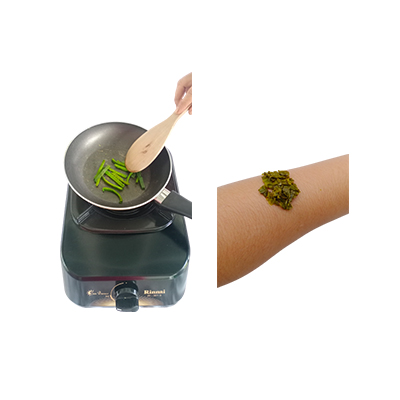
- Collect an adequate amount of kaktus centong stem.
- Clean the material with running water then slice the stem and roast for a while.
- Pound until mashed and apply to the affected area.
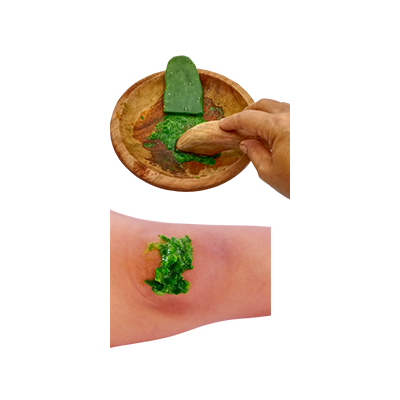
2. Rheumatism
- Prepare an adequate amount of kaktus centong stem.
- Clean the material with running water, grind into a paste.
- Apply to the affected area.
Reference Sources
- CABI. (No date). Invasive Species Compendium. Opuntia cochenillifera. https://www.cabi.org/isc/datasheet/115966. 16-02-2021.
- Fern, Ken. (2019). Useful Tropical Plants. Opuntia cochenillifera. http://tropical.theferns.info/viewtropical.php?id=Opuntia+cochenillifera. 16-02-2021.
- Flowers of India. (No date). Opuntia cochenillifera. http://www.flowersofindia.net/catalog/slides/Cochineal%20Cactus.html. 16-02-2021.
- Hindawi. (2017). Opuntia cochenillifera. https://www.hindawi.com/journals/jchem/2017/4301901/. 16-02-2021.
- Invasive Species Specialist Group. (2009). Opuntia cochenillifera. http://www.iucngisd.org/gisd/species.php?sc=1425. 16-02-2021.
- StuartXchange. (2019). Philippine Medicinal Plants. Opuntia cochenillifera. http://www.stuartxchange.org/Dilang-baka.html. 16-02-2021.