Pandanus tectorius Parkinson ex Du Roi
Summary
Pandan duri (Pandanus tectorius) is a tree up to 14 meters tall from the Pandanaceae family that originates from the Pacific, the Philippines, and parts of Indonesia. Its fruit is processed into juice, jam, or flour, while its leaves are woven into traditional roofs, mats, and bags. All parts of pandan duri are traditionally used as medicine in India and the Philippines, from strengthening gums to relieving asthma.
Agroecology
Pandan duri is a lowland plant that can naturally be found in tropical and subtropical coastal areas, especially on sandy and rocky beaches, coral terraces, including brackish areas in saline soil, peat swamps. In the wild, this species is rarely found at elevations above 20 m asl, but is now widely cultivated at elevations up to 600 m asl. This species prefers humid and subhumid environments, with warm to hot temperatures throughout the year, where average annual temperature ranges between 24-28 °C, average temperature of the hottest month is 28-36 °C and the coldest month is 17-25 °C with average annual rainfall varying in the range of 1,500-4,000 mm without a dry season or a short dry season of 2-3 months. Pandan duri is tolerant of waterlogging and drought so it can grow in dry and waterlogged soil. This plant prefers a position with full sun, and is mostly found in open areas, but can also grow in shade (30-50%), and will not tolerate shade above 70%. Grows well in soil with sandy, moist, well-drained soil texture. This species is also fairly tolerant of fire (low-medium intensity), salt, and wind.
Morphology
- Roots develop many aerial roots and support roots from the lower part of the stem or side branches.
- Stem upright, branched, covered with sharp cone-shaped thorns, bark grayish-brown or reddish, smooth or scaly, with characteristic wavy leaf scars and rows of thorns.
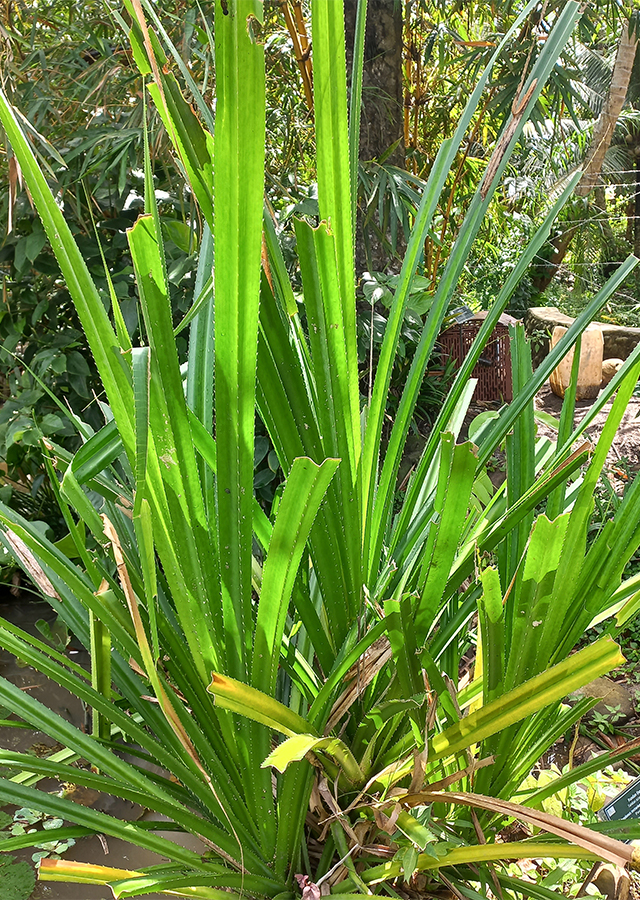
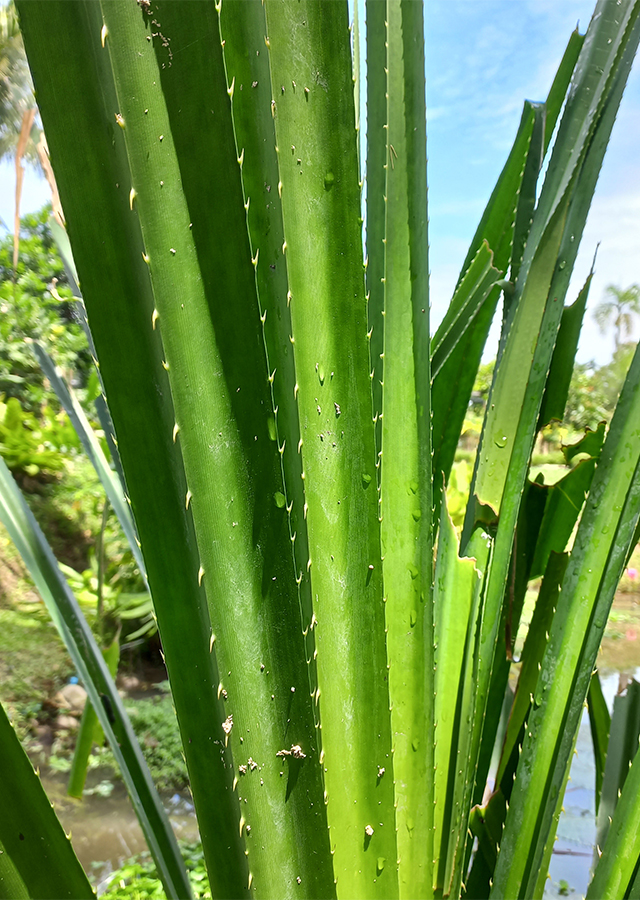
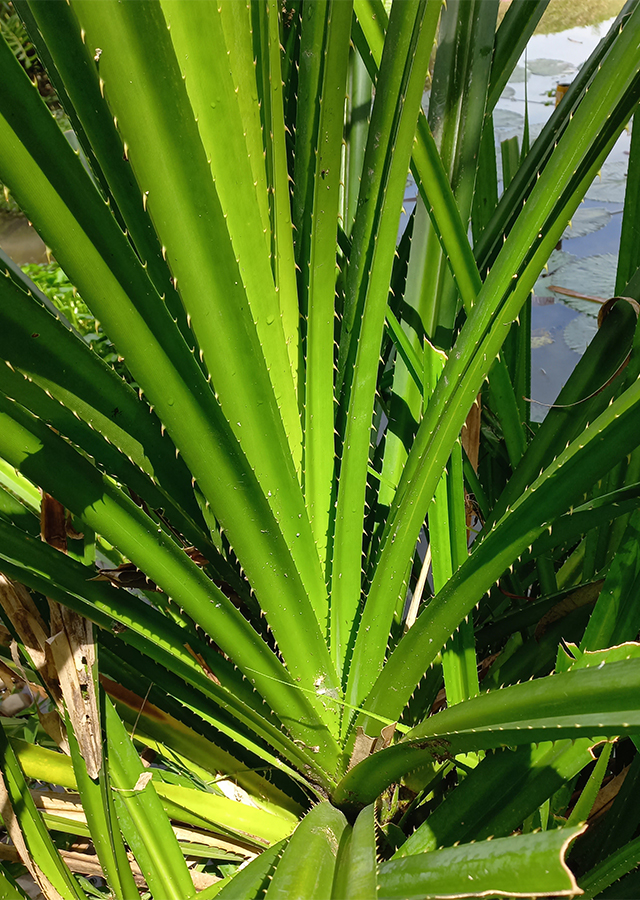
- Leaves dark green, linear shape, long and straight, about 4-8 cm wide and 80-180 cm long, with many thorns along the edge and underside of the midrib. Leaves are folded, have a 'V' cross-section, and are arranged spirally in clusters at branch tips.
- Flowers dioecious, bearing male and female flowers on separate plants. Male flowers small, white, fragrant, pendant-like, arranged in racemes or branching in clusters, with a large striking white bract, and only last about one day. Female flowers pendulous, borne on a globose to subglobose flowering head.
- Fruit a compound fruit resembling a pineapple, ovate-oblong, angular, fibrous, fleshy. Consisting of 40-200 wedge-shaped fleshy 'keys', green and turning orange when ripe.
- Seeds reddish-brown, obovoid, ellipsoid or oblong shape.
Cultivation
- Propagation can be done generatively (seeds) and vegetatively (rooted branch or stem cuttings).
- To speed up germination, before sowing soak seeded fruit in cold tap water for 5 days, changing the water daily. Viable seeds will float. Germination takes about 2 months.
- Propagation by cuttings, select and cut a stem with support roots, and the leaf crown is trimmed but not cut, then the cutting is inserted diagonally into the planting medium.
- Pandan duri plants arising from seed propagation tend to begin flowering at about 15 years of age, while plants from cuttings begin flowering much earlier, at 6 years of age, often 3-4 years.
Chemical Content
Essential oil (diterpene, d-linalool, phenylethyl acetate, citral, phenylethyl alcohol ester, ester of phthalic acid, fatty acids, steroptene), alkaloid, glycoside, isoprene esters, tannin, phytosterol, saponin, phenolic compounds (pandanusphenol A and B), amino acids, terpenoid, flavonoid, steroid, pandanusin A, furanocoumarin, coumarins, monoglyceride, monosaccharide.
Benefits
Strengthens gums, treats headaches, earaches, joint inflammation, stomach cramps, arthritis, boils, hemorrhoids, colds, hepatitis, dysuria, asthma, cancer, filariasis, vaginal discharge, leprosy, smallpox, scabies, syphilis, prevents miscarriage, relieves pain and speeds wound healing, addresses abnormal menstrual bleeding after childbirth, infant jaundice, colic and restlessness, relieves vomiting, induces infertility, a sedative, has diuretic, aphrodisiac, and cardiotonic (strengthening heart performance) properties.
Local Names
Pandan pudak, Pandang.
Traditional Recipes
The following recipes reflect traditional knowledge passed down through generations, not a substitute for professional medical diagnosis or advice. Consult a healthcare provider before use.
1. Boils
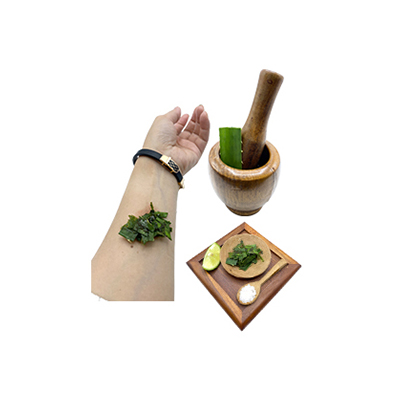
- Prepare pandan duri leaves as needed and wash until clean.
- Mash into a paste.
- Add salt and lime juice as needed.
- Apply the paste to the boil.
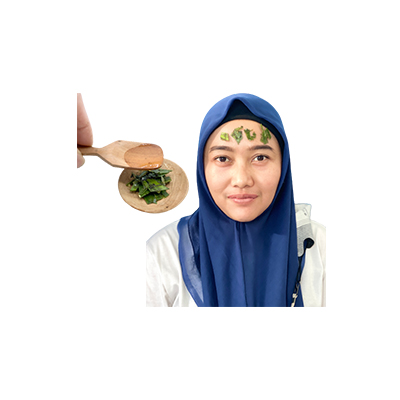
2. Dizziness
- Take fresh pandan duri leaves and wash until clean.
- Mash the leaves into a paste and add a little oil.
- Apply as a poultice on the forehead.
Reference Sources
- Flora Fauna Web. 2021. Pandanus tectorius Parkinson. https://www.nparks.gov.sg/florafaunaweb/flora/5/2/5242. 31-10-2021.
- Stuartxchange. 2018. Philippine Medicinal Plants: Pandan. http://www.stuartxchange.org/Pandan.html. 31-10-2021.
- CAB International. 2021. Invasive Species Compendium: Pandanus tectorius (screw pine). https://www.cabi.org/isc/datasheet/38447#toPictures 31-10-2021.
- Royal Botanic Gardens. 2021. Plants of the World Online: Pandanus tectorius Parkinson ex Du Roi. http://powo.science.kew.org/taxon/urn:lsid:ipni.org:names:895770-1. 31-10-2021.
- Useful Tropical Plants Database. 2021. Pandanus tectorius. http://tropical.theferns.info/viewtropical.php?id=Pandanus+tectorius. 31-10-2021.