Passiflora ligularis Juss.
Summary
Sweet granadilla (Passiflora ligularis) is a climbing plant 4-20 meters long from the Passifloraceae family native to the Andes mountains of South America. Its fruit is an important commodity in its native region, while its beautiful flowers are used in the perfume industry. Sweet granadilla is traditionally believed to speed up wound healing and act as a sedative.
Agroecology
Sweet granadilla is found mainly in tropical and subtropical regions where the natural vegetation is some type of mesic or moist forest, especially tropical highland forest, at elevations between 800-3,000 m asl in tropical regions and down to sea level in subtropical regions. This plant is not suitable for cultivation in tropical lowlands. It grows best in areas where the mean annual daytime temperature is in the range of 22-26°C, but can tolerate 16-31°C, and mean annual rainfall in the range of 1,000-1,200 mm, but tolerates 650-2,500 mm. This plant prefers light soils ranging from sandy loam to clay loam with medium to high organic matter content, moist but well-drained, and a sheltered position in partial shade or full sun. This passionfruit dislikes very acidic or very alkaline soil conditions, with a preferred soil pH range of 6-7, but can tolerate 5.1-7.5.
Morphology
- Roots taproot.
- Stem green when young, turning brownish with age, bearing green tendrils, cylindrical, jointed, grooved, soft but woody at the base, hairless.
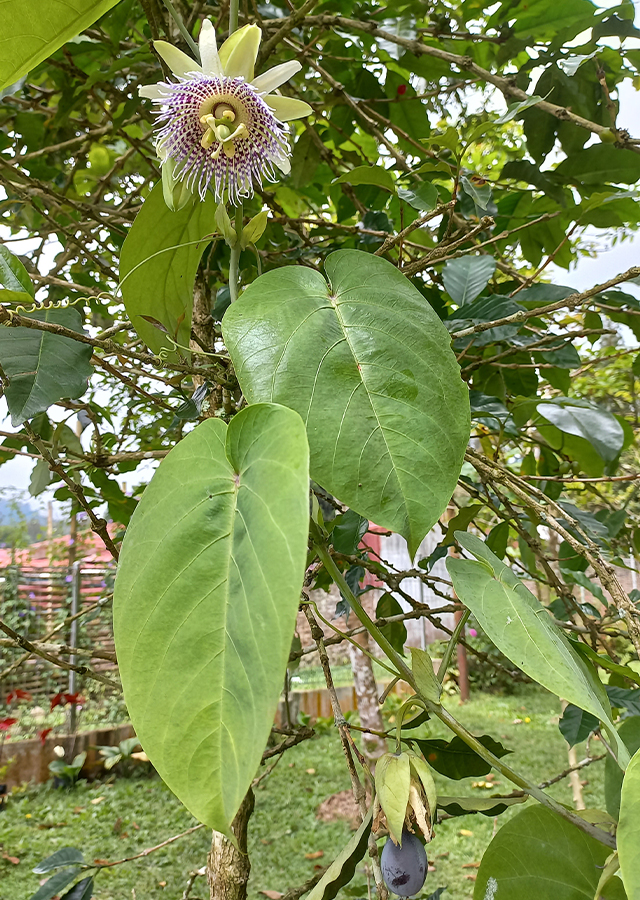
- Leaves simple, alternate, heart-shaped, apex pointed, margins entire, veins pinnate, leaf surface smooth and green.
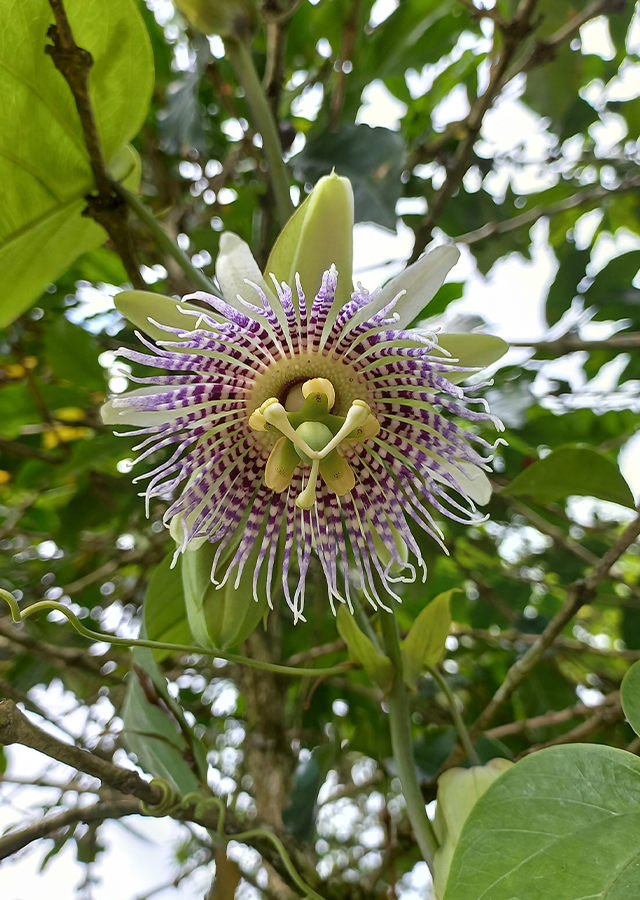
- Flowers perfect (hermaphrodite), solitary, large, and fragrant. Corolla consisting of numerous straight, thread-like filaments varying in color from purple to white. Sepals number 5, consisting of two layers varying in color, green on the outer layer, white on the inner layer. Stamens number five and pistils number 3. Bracts number 3.
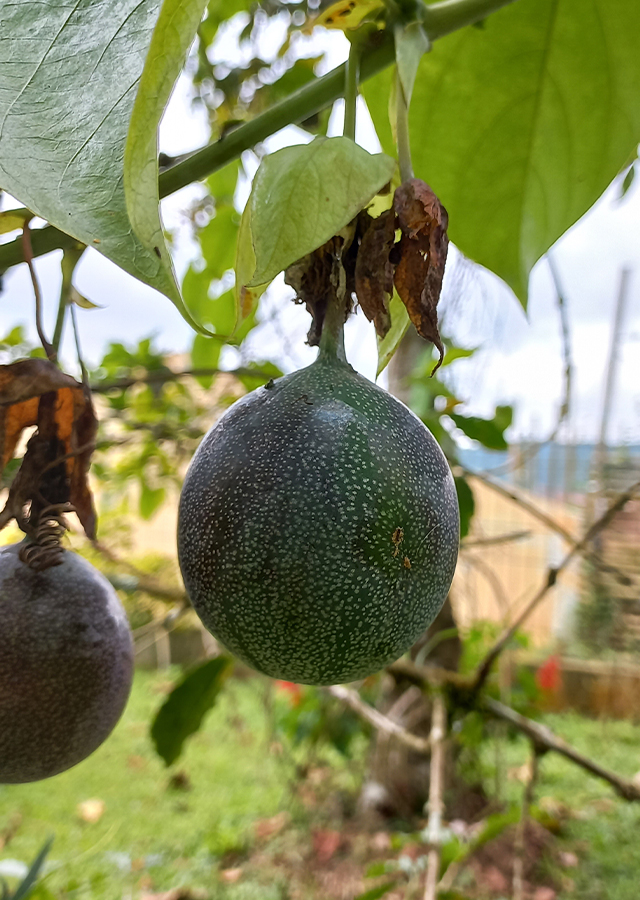
- Fruit round-oblong to oval, yellow, with thick rind, funiculus (seed stalk) yellowish white, pulp whitish, juice white and sweet-tasting. Larger in size than Passiflora edulis.
- Seeds elliptical, flat, black, wrapped in an aril, numerous per fruit (250-350 seeds per fruit).
Cultivation
- Propagation is done generatively (seed) or vegetatively (shoot cuttings, branch cuttings).
- Fresh seeds germinate within 10-20 days.
- Branch or stem cuttings are taken from a superior mother plant that has been producing fruit for at least 1 year and has a diameter of 1 cm. The stem or branch is cut into 25 cm lengths (containing 3-4 buds). Cuttings are planted upright to a depth of 5 cm in polybags and covered with a hood. Once the cuttings have sprouted and rooted, the hood is removed. Seedlings from cuttings are intensively tended until 3-4 months old.
Chemical Content
Passiflorine, essential oil (heptacosane, squalene, pentadecanal, and ionol).
Benefits
Speeds up wound healing, an effective sedative, treats intermittent fever, skin inflammation and erysipelas (acute infection of the skin and underlying tissue), has antispasmodic and sleep-inducing effects, and is diuretic and anthelmintic.
Simplisia
- Prepare an adequate amount of sweet granadilla leaves, wash clean with running water.
- Dry under the sun or with an oven at 40°C until the moisture content reaches 10%.
- Grind using a blender until it becomes powder.
- Store in a clean, airtight container.
Local Names
Markisa konyal (West Java).
Traditional Recipes
The following recipes reflect traditional knowledge passed down through generations, not a substitute for professional medical diagnosis or advice. Consult a healthcare provider before use.
1. Fever
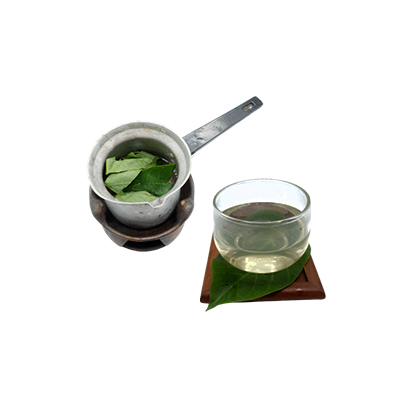
- Take an adequate amount of fresh sweet granadilla leaves and wash until clean.
- Boil with water until it boils.
- Let it cool to warm/cold.
- Strain then drink 3 times a day to induce sweating so the fever goes down.
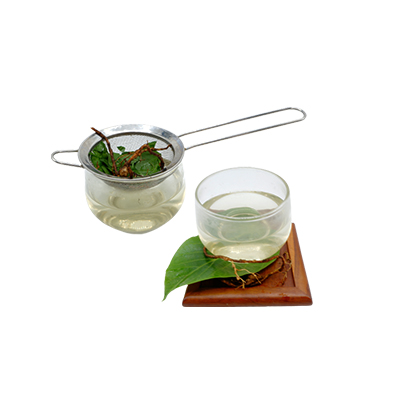
2. Sedative
- Prepare an adequate amount of fresh sweet granadilla leaves and roots and wash until clean.
- Boil with water until it boils.
- Let it cool to warm/cold.
- Strain then drink.
Reference Sources
- Royal Botanic Gardens. 2021. Plants of the World Online: Passiflora ligularis Juss. http://www.plantsoftheworldonline.org/taxon/urn:lsid:ipni.org:names:675142-1. 12-11-2021.
- CAB International. 2021. Invasive Species Compendium: Passiflora ligularis (sweet granadilla). https://www.cabi.org/isc/datasheet/116173#touses. 12-11-2021.
- Useful Tropical Plants Database. 2021. Passiflora ligularis. https://tropical.theferns.info/viewtropical.php?id=Passiflora+ligularis. 12-11-2021.
- Siregar A. E. H., Gultom T. 2018. KARAKTERISASI MORFOLOGI MARKISA (PASSIFLORA) DI KABUPATEN KARO SUMATERA UTARA. Prosiding Seminar Nasional Biologi dan Pembelajarannya. Universitas Negeri Medan.
- Guaranda I. A. C. et. al. 2015. Chemical composition of essential oils of shells, juice and seeds of Passiflora ligularis Juss from Ecuador. Emirates Journal of Food and Agriculture, 27(8): 650-653. doi: 10.9755/ejfa.2015.04.039.