Persicaria hydropiper (L.) Delarbre
Summary
Persicaria hydropiper or water pepper is a common weed widely distributed across temperate and tropical regions of Asia, Europe, North Africa, and Australia. Its distinctive pungent taste makes it used as a pepper substitute and seasoning in Japanese, Chinese, and Southeast Asian cuisine, while also having a long history as a medicinal plant thanks to its astringent properties useful for addressing bleeding, diarrhea, and skin problems. In China, this plant even ranked in the top 20 of a survey of potential antifertility remedies, besides also being used as a traditional fabric dye and fish poison.
Agroecology
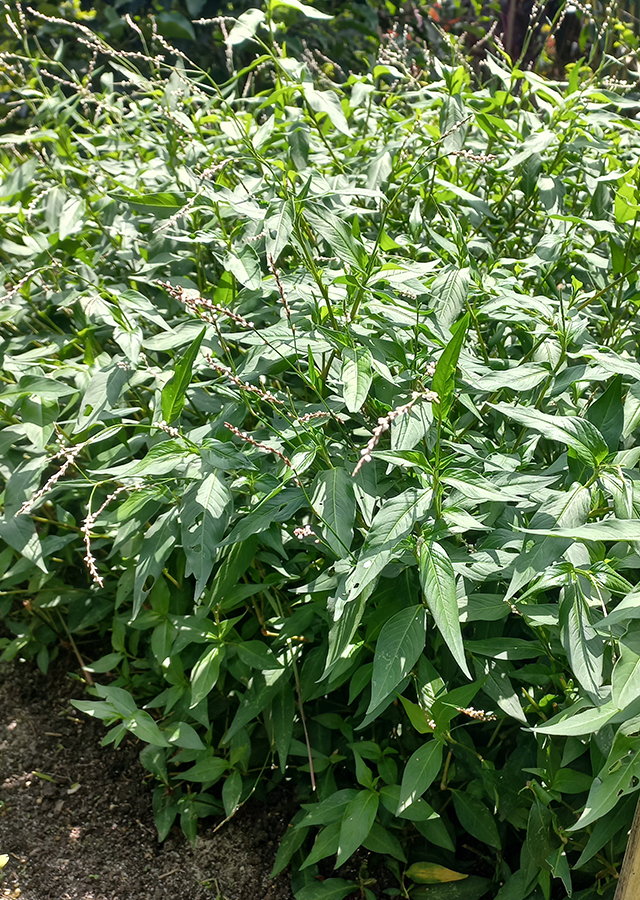
Water pepper is a widely distributed plant, found growing from cold temperate zones to tropical regions. It is often found growing in open wet places, poorly drained agricultural land, old rice paddies, along rivers, riverbanks, marshes, poorly drained basins, from sea level up to elevations of 1,500 m asl. Grows in shallow water, wet or moist soil. This species prefers sunny locations and dislikes shade. Grows well in most soils including silt, peat, loam, and sand. Although this plant can tolerate various pH levels, water pepper generally grows better in more acidic situations.
Morphology
- Roots a taproot, tufted or shortly creeping.
- Stem upright, much-branched, usually branching toward the tip. Rooting from the lower nodes, nodes swollen, green to red or light brown, and above each node surrounded by a cylindrical membranous ochrea 0.5-1 cm long with a hairy fringe. Stem surface smooth and hairless or glabrous.
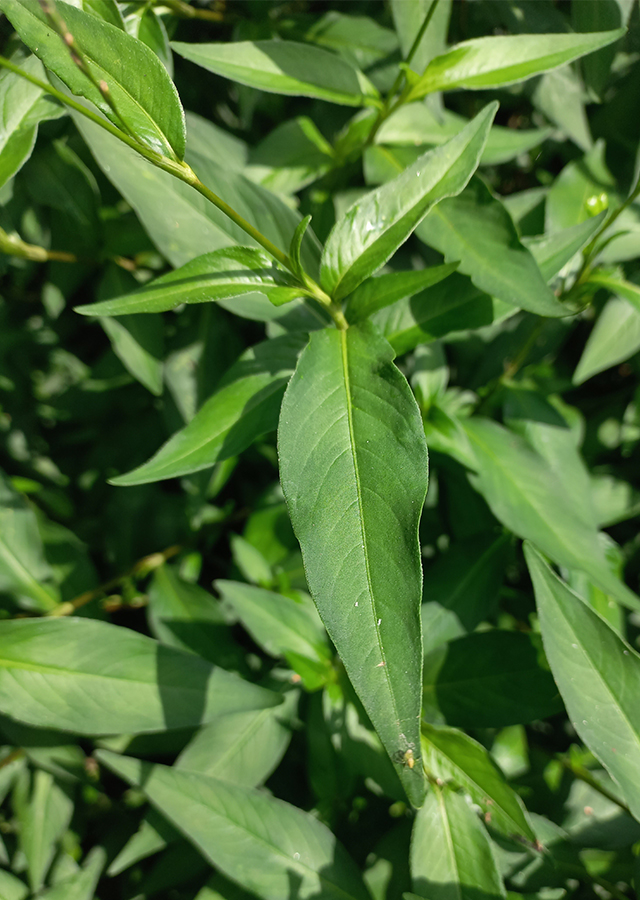
- Leaves simple, alternate, with a short petiole tapering into a finely glandular-hairy blade 4-10 cm long. Emerging leaves are rolled downward at the margins. The modified stipules known as ochreae sheathe the stem above the junction of the stem and petiole. Blade lanceolate or oblong-lanceolate, hairless, base cuneate, tip acute to acuminate, margin finely ciliated.
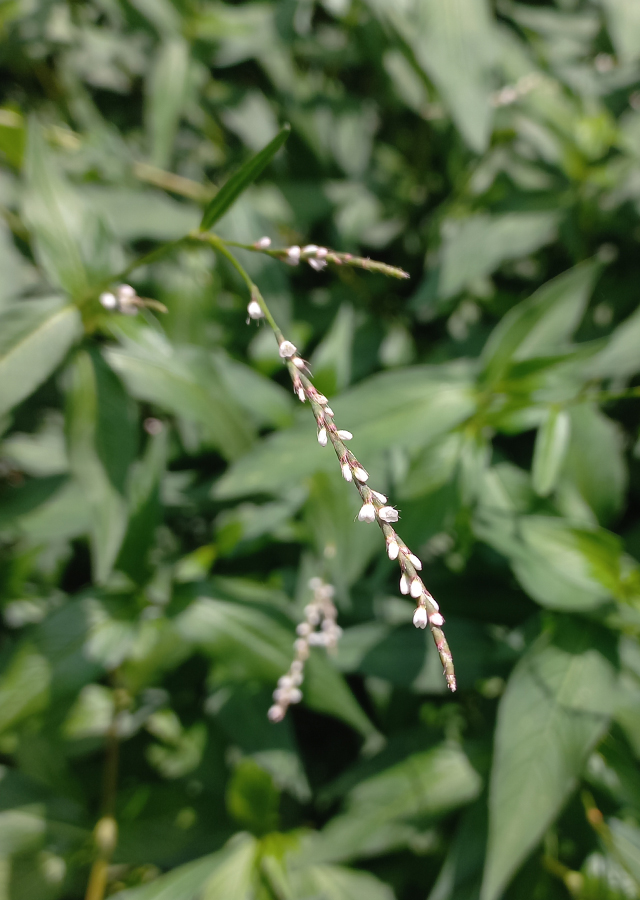
- Flowers have a greenish proximal and white or pink distal perianth, tepals obovate, 6-8 stamens, and 2-3 styles. Inflorescence upright, occurring at the tips of all branches and in the upper leaf axils. Each is a slender spike (often nodding) of green to pink flowers, the outer surface covered with dark glands.
- Fruit an achene, 2-3 sided, 2-3 mm long, blackish brown, remaining enclosed within the dried flower.
Cultivation
Plant propagation is mainly through seed, and can also occur through broken stems (where the stem can root at its nodes and grow into a new plant).
Chemical Content
Polygonic acid, tannins, essential oil, malic acid, phytosterin, oxymethyl-anthraquinone, alkaloid compounds, flavonoids (catechin, epicatechin, hyperin, isoquercitrin, isorhamnetin, kaempferol, quercetin, quercitrin, rhamnazin, rutin), saponins, terpenoids, steroids, a new drimane-type sesquiterpenoid (3β-angeloyloxy-7-epifutronolide), polygonumate, six known drimane-type sesquiterpenes (dendocarbin L, (+)winterin, (+)fuegin, changweikangic acid A, futronolide, and 7-ketoisodrimenin), phenylpropanoid esters (including hydropiperosides A and B, and vanicosides A, B, E), phenolic acids (caffeic acid, chlorogenic acid, and ρ-coumaric acid).
Benefits
Stops bleeding and treats wounds, skin problems (itching, scabies, ringworm, boils), diarrhea, dysentery, dyspepsia, gastritis, headache, menstrual pain, excessive menstrual bleeding, uterine disorders, regulates menstrual irregularity, lung problems, uterine bleeding, treats diabetes, insomnia, depression (as a sedative) and neurodegenerative diseases, rheumatism, gout, addresses swelling and inflammation, snake and dog bites, loss of appetite, dandruff problems, fights cancer, controls fertility, terminates pregnancy (if consumed continuously causes permanent infertility), a poultice and toothache remedy. Is carminative, diuretic, stimulant, anthelmintic, emmenagogue, antioxidant, antibacterial, anti-inflammatory, and anticancer.
Simplisia
- Prepare an adequate amount of fresh water pepper root, wash clean with running water.
- Dry under the sun or with an oven at 40°C until the moisture content reaches 10%.
- Grind using a blender until it becomes powder.
- Store in a clean, airtight container.
Local Names
Si tuba sawah (Sumatra), Cacabean (Sunda).
Traditional Recipes
The following recipes reflect traditional knowledge passed down through generations, not a substitute for professional medical diagnosis or advice. Consult a healthcare provider before use.
1. Toothache
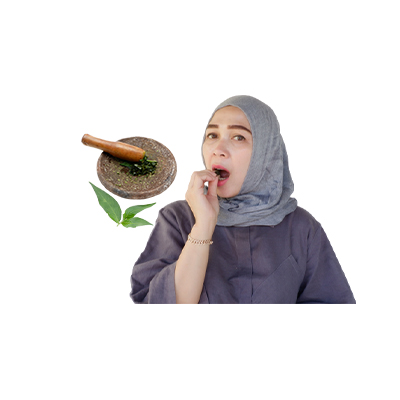
- Prepare an adequate amount of water pepper leaves and wash until clean.
- Grind until it becomes a paste.
- Apply the leaf paste as a poultice on the aching tooth.
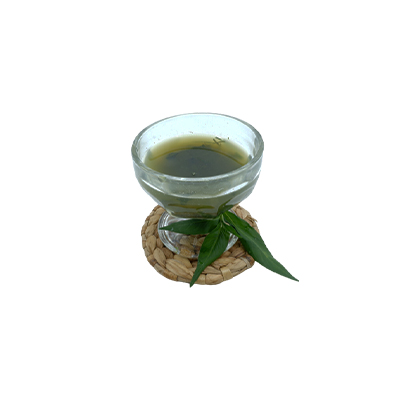
2. Treats menstrual pain
- Take an adequate amount of water pepper leaves and wash until clean.
- Blend with a little water.
- Strain then drink to treat menstrual pain.
Reference Sources
- Royal Botanic Gardens, Kew. Plants of the World Online: Persicaria hydropiper (L.) Delarbre. https://powo.science.kew.org/taxon/urn:lsid:ipni.org:names:77069479-1. 13-08-2022.
- Plant Resources of South-East Asia. 2016. Persicaria hydropiper (PROSEA). https://uses.plantnet-project.org/en/Persicaria_hydropiper_(PROSEA). 13-08-2022.
- Tropical Plants Database, Ken Fern. 2021. Persicaria hydropiper. http://tropical.theferns.info/viewtropical.php?id=Persicaria+hydropiper&redir=Polygonum+hydropiper. 13-08-2022.
- Stuartxchange. 2020. Philippine Medicinal Plants: Persicaria hydropiper (L.) Delarbre. http://www.stuartxchange.org/Buding. 13-08-2022.
- CAB International. 2022. Invasive Spesies Compendium: Polygonum hydropiper (marsh pepper). https://www.cabi.org/isc/datasheet/42688#toPictures.
- Huq A. K. M. M., Jamal J. A., Stanslas J. 2014. Ethnobotanical, Phytochemical, Pharmacological, and Toxicological Aspects of Persicaria hydropiper (L.) Delarbre. Hindawi Publishing Corporation. Evidence-Based Complementary and Alternative Medicine
Volume 2014. http://dx.doi.org/10.1155/2014/782830.