Petroselinum crispum (Mill.) Fuss
Summary
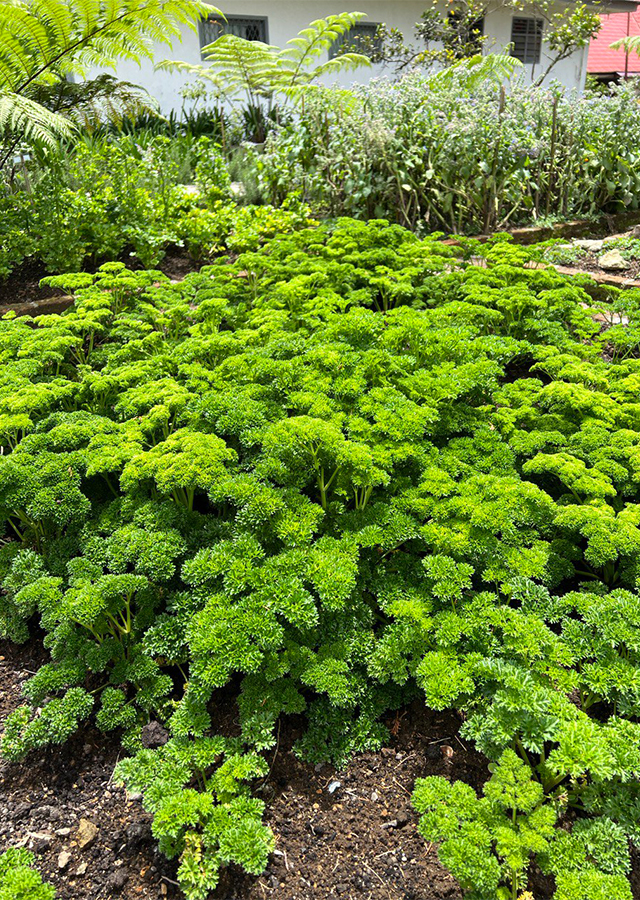
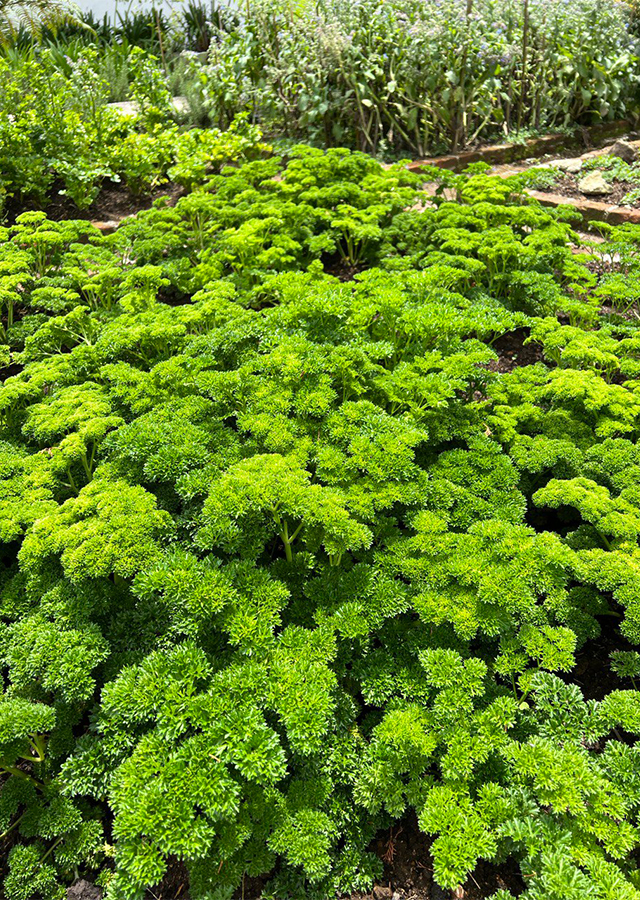
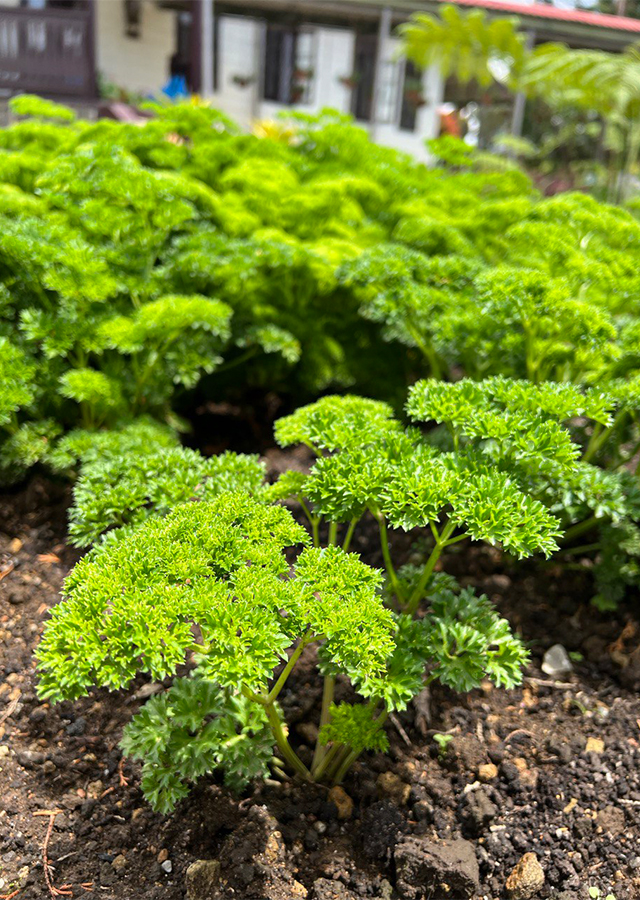
Parsley (Petroselinum crispum) is a biennial herb about 30-60 cm tall from the Apiaceae family believed to be native to Sardinia, the Mediterranean, cultivated since the 3rd century BC. In ancient times, the Greeks and Romans valued parsley for its medicinal properties long before it was used as a cooking seasoning. Parsley is traditionally used as a diuretic in Turkey and a gastritis remedy in Peru.
Agroecology
Parsley is a plant of the temperate zone, but can also be cultivated in subtropical and tropical regions. Parsley, especially the more upright form, grows fairly well in tropical lowlands, though the plant generally does better at elevations above 600 m. Grows best in areas where the mean annual daytime temperature is in the range of 11-20°C, but can tolerate 7-28°C. When dormant, the plant can survive at temperatures down to about -5°C, but young plants can be severely damaged at 0°C. Parsley prefers mean annual rainfall in the range of 900-1,500 mm, but tolerates 300-2,800 mm. Prefers moist, well-drained soil in sun or partial shade. High temperatures can affect growth, so light shade often helps. Prefers light soil that is not too light or acidic, growing poorly in mildly acidic soil. Tolerant of moderate salt levels in the soil. Prefers a pH in the range of 6-7.5, tolerating 5.3-8.3.
Morphology
- Roots a taproot, slender, fibrous, white and sometimes thickened.
- Stem cylindrical, grooved and hollow.
- Leaves alternately arranged, 1-3 pinnately compound, dark green, glossy, flat or curled and sheathed at the base. Petiole longest on the lower leaves. Pinnae long-stalked, with obovate-cuneate to finely linear leaflets, divided into acute segments. Higher leaves are gradually less divided while the topmost leaves consist of only a few acute segments.
- Flowers, the inflorescence is a terminal or axillary compound umbel. 1-3 somewhat short foliolate bracts. There are 3 to 15 secondary rays (pedicels) 2 to 5 mm long. The flowers are small, yellowish green and bisexual. Sepals indistinct. The corolla consists of 5 petals, sub-orbicular to obovate, up to 1 mm x 0.5 mm in size and submarginate with an inflexed apical lobe. There are 5 stamens. The pistil has an inferior ovary and has 2 carpels, each carpel having a thickened stylopodium, style, and spherical stigma.
- Fruit is a schizocarp, 2 to 3 mm long, ovate shaped and splitting into 2 mericarps when ripe, each with 5 narrow ribs.
- Seeds ovate, 2 to 3 mm long, with the remains of the style protruding at the tip.
Cultivation
Propagation can be done using seed. Sow seeds in a container or nursery bed and plant out when about 10 cm tall. Germination usually occurs within about 7 days at 25°C, though it can take 4-6 weeks. Germination time can be reduced by soaking the seed for 12 hours in hot water allowed to cool quickly, but be careful not to make it too hot and cook the seed. Seeds remain viable in normal storage for 2-3 years.
Chemical Content
Flavonoid and phenolic compounds, mainly apiin, apigenin, and 6-acetylapiin, essential oil including myristicin and apiole, and coumarins.
Benefits
This plant is used as a diuretic in Turkey and as a carminative and remedy for gastritis in Peru. P. crispum leaves have been used as an antitussive and diuretic and also in treating kidney stones, hemorrhoids, digestive disorders, blurred vision and dermatitis, treats bleeding, hypertension, hyperlipidemia, liver disorders and diabetes, skin diseases, arterial hypertension, heart disease, lower back pain, eczema, nosebleeds, treating amenorrhea, dysmenorrhea, prostatitis, bad breath, anemia, hypertension, hyperuricemia, constipation, odontalgia, pain, baldness, inducing abortion, insect bites, treating urinary tract diseases, and managing fluid retention.
Simplisia
- Prepare an adequate amount of fresh parsley leaves, wash clean with running water then drain.
- Dry under the sun or with an oven at 40°C until the moisture content reaches 10%.
- Grind using a blender until it becomes powder.
- Store in a clean, airtight container.
Local Names
Patraseli, Parsley, Potrasoli.
Traditional Recipes
The following recipes reflect traditional knowledge passed down through generations, not a substitute for professional medical diagnosis or advice. Consult a healthcare provider before use.
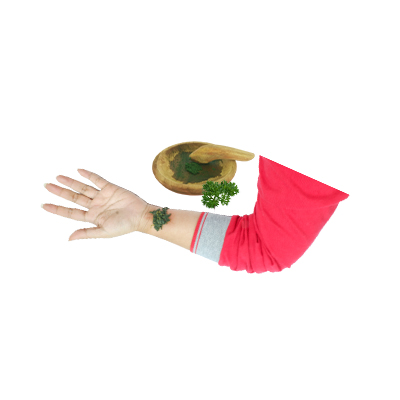
1. Relieves bites and stings
- Prepare an adequate amount of fresh parsley leaves and wash until clean.
- Grind until it becomes a paste.
- Apply the leaf paste to the skin affected by the bite or sting.
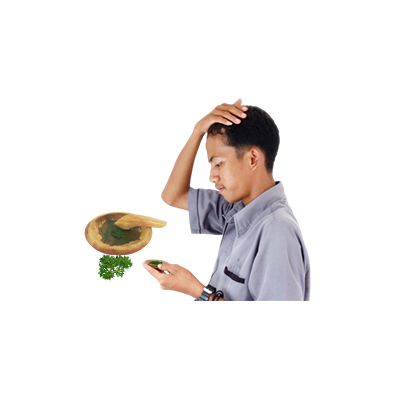
2. Prevents hair loss
- Prepare an adequate amount of fresh parsley leaves and wash until clean.
- Grind until it becomes a paste.
- Squeeze and take the liquid.
- Apply to the scalp to prevent hair loss.
Reference Sources
- Royal Botanic Gardens. 2021. Plants of the World Online: Petroselinum crispum (Mill.) Fuss. https://powo.science.kew.org/taxon/urn:lsid:ipni.org:names:60442790-2. 11-02-2022.
- Natural Medicinal Herb. Parsley, Petroselinum crispum. http://www.naturalmedicinalherbs.net/herbs/p/petroselinum-crispum=parsley.php. 11-02-2022.
- Missouri Botanical Garden. Petroselinum crispum. https://www.missouribotanicalgarden.org/PlantFinder/PlantFinderDetails.aspx?taxonid=276060. 11-02-2022.
- Useful Tropical Plants Database. 2021. Petroselinum crispum. https://tropical.theferns.info/viewtropical.php?id=Petroselinum+crispum. 11-02-2022.
- Nabila. 2018. Penetapan Kadar Kalsium, Kalium, magnesium dan Zink dari Daun Peterseli (Petroselinum crispum Mill.) Secara Spektrofotometri Serapan Atom. Skripsi. Program Studi Sarjana Farmasi. Universitas Sumatera Utara. Medan.
- Christian Agyare, Theresa Appiah, Yaw Duah Boakye, John Antwi Apenteng. 2017. Petroselinum crispum: A review. https://www.researchgate.net/publication/312689368_Petroselinum_crispum_A_Review. 11-02-2022.