Phymatosorus scolopendria (Burm.f.) Pic.Serm.
Summary
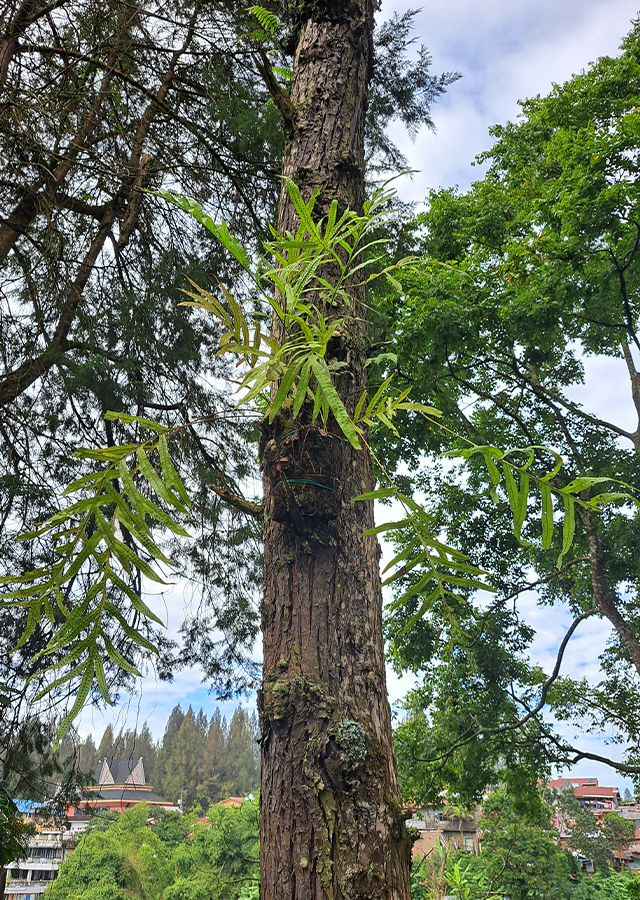
Phymatosorus scolopendria or paku wangi (fragrant fern) is widely distributed from Australia and Polynesia to Asia, Madagascar, and Africa, including throughout the Indonesian archipelago. Its distinctive leaf shape and drought resistance make this fern popular as an architectural ornamental, while in Malaysia and Hawaii its leaves are used to scent clothing and coconut oil. In various countries, paku wangi is also a traditional medicine ingredient, including as a postpartum tonic and stomach inflammation reliever.
Agroecology
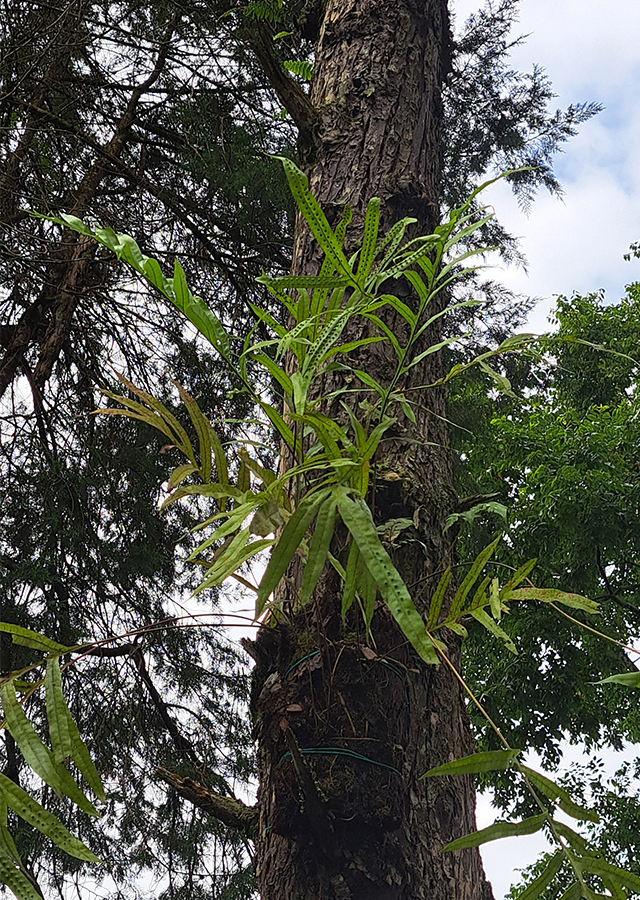
P. scolopendria has the ability to live epiphytically, terrestrially, and lithophytically. Epiphytically, this species generally lives on old trees in open areas and oil palm trunks on plantations. It is also found living in primary rainforest, agricultural land, secondary rainforest, coastal forest, disturbed areas, and coastlines (coastal cliffs, rocky beaches). Terrestrially, it is found living in soil at the edge of ponds, root crevices, flat ground. However, this species rarely lives in soil. It is more often found in leaf litter and mossy rocks or at the base of branching of trees or shrubs high above ground level. Sometimes this species is also found growing in open areas at forest edges and can live in lowlands at sea level up to elevations of 2,100 m asl. This species is tolerant of short-term drought, but will do better if planted in consistently moist conditions. This species is easy to cultivate and also has broad tolerance to various habitat types and elevations.
Morphology
- Rhizome creeping, wide, 7-8 cm thick, terete, white and waxy, internodes 1-9 cm, roots sparse to dense. Rhizome scales peltate, sometimes falsely peltate, sparse to dense, dense to spreading, ovate or triangular in outline, base margin torn, tip acute.
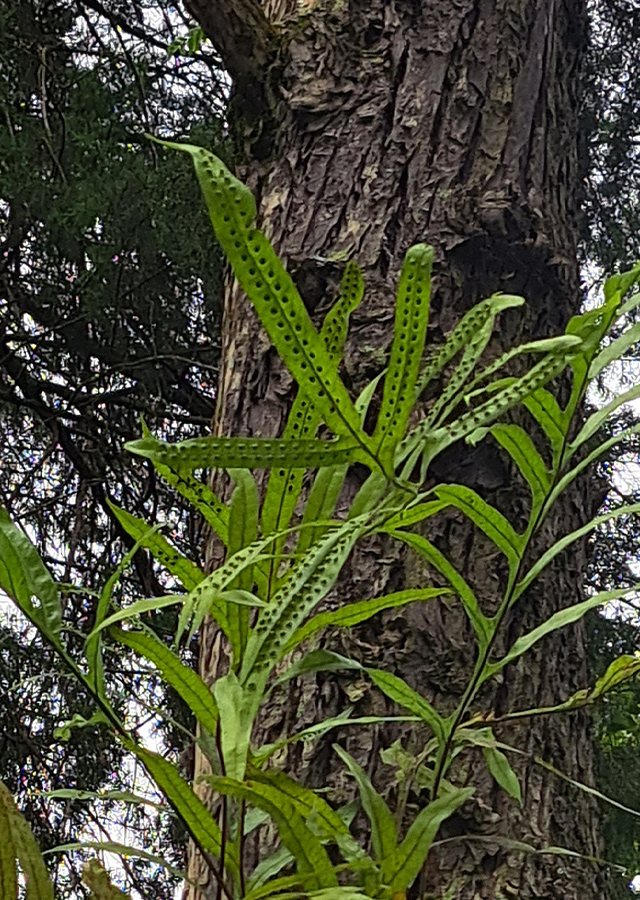
- Leaves one or two forms, simple or pinnately lobed, leaf pinnatifid, petiolate, shiny green, margin entire to slightly wavy, tip acuminate. Pinnately lobed leaves have a petiole about 5-55 cm long with a thickness of 0.8-7.0 mm, leaf blade elliptic to ovate in outline, widest from the lower to middle part, with 1-10 lobes on each side, the longest lobe at position 1-2 from the base, the upper lobes at an angle of 35-50° to the lobe axis, the terminal lobe longer than the upper lateral lobes near the base. Leaf veins more or less sunken and inconspicuous or conspicuous, more or less straight or wavy, branching in pairs near the margin or middle, or each midrib areola forming two lateral veins, forming several rows of evenly sized areolae or one conspicuous row. The veins within are more or less sunken or inconspicuous, sometimes more conspicuous, netting variably, forming a dense network with smaller areolae, free veinlets single or forking once. Sori very large, separate, round or elliptic, orange-brown, deeply sunken, scattered on the abaxial leaf surface, appearing as protrusions on the upper (adaxial) surface, 1-3 rows between the midrib and margin, one sorus inside, or only outside, in each areola of the main midrib, present over the entire leaf blade surface or absent at the basal part.
Cultivation
- Plant propagation can be done with spores as well as rhizome cuttings.
- Propagation with spores is done by scattering spores on sterilized medium and storing it in a relatively moist location. Sporophytes are transplanted in groups when they reach a height of 1 cm and transplanted again individually once they reach a height of more than 3 cm. Meanwhile, propagation through rhizome cuttings must be planted at a depth of no more than 5 cm in well-drained soil or attached to a fern root board. The plant must then be kept in bright shade and a warm location.
- Germination of P. scolopendria generally begins with the formation of a heart-shaped prothallus, the gametophyte. In the sporophyte phase, the leaves are generally lobed.
- Generally, P. scolopendria grown from spores can have its leaves harvested after 2-3 years, while if grown from its rhizome, harvesting may be done when the plant is 6 months old after planting.
Chemical Content
Glycyrrhizin, saponin, coumarin, ecdysone, 20-hydroxyecdysone, makisterone A and C, inokosterone, amasterone A, small amounts of poststerone and 24,28-diepi-cyasterone.
Benefits
Treats boils, wounds, abscesses, chronic diarrhea, as a laxative, filariasis in infants, headache, body aches, stomachache, gastric inflammation, joint inflammation, a massage oil to induce fluid discharge after childbirth (postpartum tonic), breast swelling related to breastfeeding, postpartum depression, relieves inflammation of the nasal mucous membrane.
Local Names
Paku ular (Jakarta), Paku cacing (Sunda), Sakat hitam (Melayu), Pakis keriting.
Traditional Recipes
The following recipes reflect traditional knowledge passed down through generations, not a substitute for professional medical diagnosis or advice. Consult a healthcare provider before use.
1. Relieves inflammation of the nasal mucous membrane
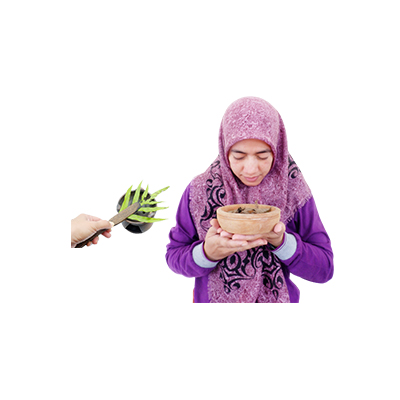
- Take an adequate amount of fresh paku wangi plant.
- Heat over a fire.
- Inhale the smoke to relieve inflammation of the nasal mucous membrane.
2. Boils
- Take an adequate amount of fresh paku wangi plant.
- Grind until it becomes a paste.
- Apply the leaf paste as a poultice on the boil.
Reference Sources
- Royal Botanic Gardens, Kew. Plants of the World Online: Phymatosorus scolopendria (Burm.f.) Pic.Serm. https://powo.science.kew.org/taxon/urn:lsid:ipni.org:names:17448130-1. 20-08-2022.
- Praptosuwiryo T. N. 2013. Mengenal Microsorum scolopendria (Burm. F.) Copel (Polypodiaceae) - Paku liar di Kebun Raya Bogor. Warta Kebun Raya 12(1), Mei 2013.
- Stuartxchange. 2018. Philippine Medicinal Plants: Serpent fern. http://www.stuartxchange.org/SerpentFern. 20-08-2022.
- Flora Fauna Web. 2021. Microsorum scolopendria. https://www.nparks.gov.sg/florafaunaweb/flora/1/5/1560. 0-08-2022.
- Plant Resources of South-East Asia. 2016. Microsorum (PROSEA). https://uses.plantnet-project.org/en/Microsorum_(PROSEA). 20-08-2022.