Physalis peruviana L.
Summary
Physalis peruviana or Peruvian groundcherry grows naturally in the tropical highlands of Colombia, Chile, Ecuador, and Peru, and has been widely cultivated across various continents over the last two centuries, with the largest commercial production now in South Africa, Australia, and New Zealand. Its fruit, rich in vitamins A, C, and B-complex, is commonly consumed fresh or processed into jam and cakes, while in traditional Peruvian medicine this plant is used to treat the eye condition pterygium, and in Taiwan it is a popular folk remedy for cancer.
Agroecology
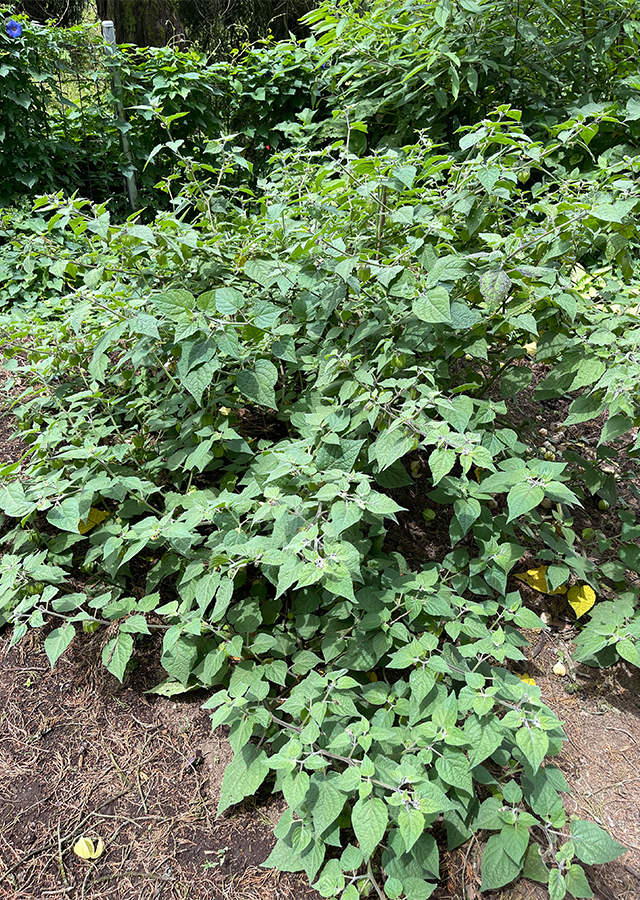
The habitat of Physalis peruviana or Peruvian groundcherry is generally found in coastal and disturbed areas, and also found growing in forests, forest edges, river borders, gardens, and cultivated areas. In Indonesia, this species is found at elevations ranging from 700-2,300 m asl, but grows best above 1,500 m asl. Other sources say that in tropical regions, elevations above 800 m asl provide optimal growth with better yields. Peruvian groundcherry grows best in areas where the mean annual temperature is in the range of 16-25°C, although it can tolerate 10-32°C, and prefers mean annual rainfall in the range of 1,500-2,300 mm, with a tolerance of 800-4,300 mm. Grows well in full sun as well as under partial shade. Able to grow in various well-drained soils (with pH in the range of 4.5 to 8.2), but grows best in sandy to rocky soil, rich in humus but able to tolerate poor soil. Peruvian groundcherry dislikes clay, heavy, or overly wet soil. This species is tolerant of light frost.
Morphology
- Roots fibrous.
- Stem with an unpleasant aroma, branching. Branches angular, ribbed, spreading, sometimes tinged purple or light violet, softly densely hairy. The stem becomes more or less woody (soft), especially at the base. Lower stem creeping, densely puberulent.
- Leaves simple, unifoliate, solitary or geminate, green, later turning yellow and falling after the fruit ripens, petiole 0.5-5.5 cm long, somewhat sheathing at the base. Blade broadly ovate to heart-shaped, tip acuminate or pointed, margin entire to sinuate-dentate or dentate, sometimes with a few blunt lobes, some teeth unequal. Leaf blade has a velvety texture. Asymmetrically paired at each node (alternate leaf arrangement).
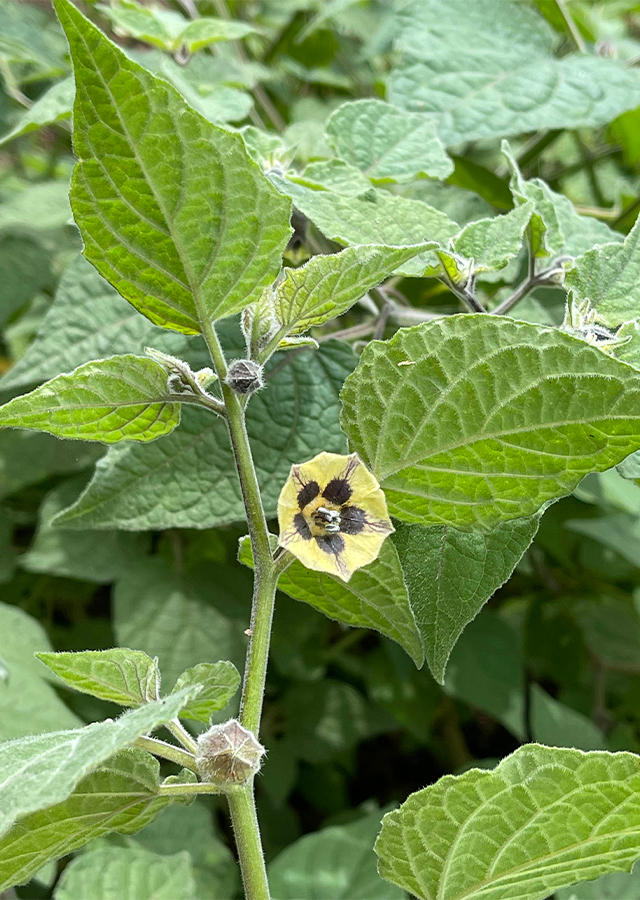
- Flowers bisexual, solitary, axillary, upright to nodding, hairy, bell-shaped, corolla yellow with distinct purplish-brown spots in the flower throat, slightly 5-lobed, densely puberulent especially near the base. Surrounded by a purplish-green, hairy, prominently veined calyx, toothed or 5-lobed, fused at the base with a triangular tip. The flowers are solitary and appear in the leaf axils. When the flower falls, the pale brown calyx will enlarge and enclose the fruit. Style purple, straight or slightly curved upward. Stamens included or slightly protruding, subequal, filaments purple, attached to the corolla tube near the base, equipped with a few hairs. Anthers bluish to purplish-red. Flower stalk densely covered with fine hairs.
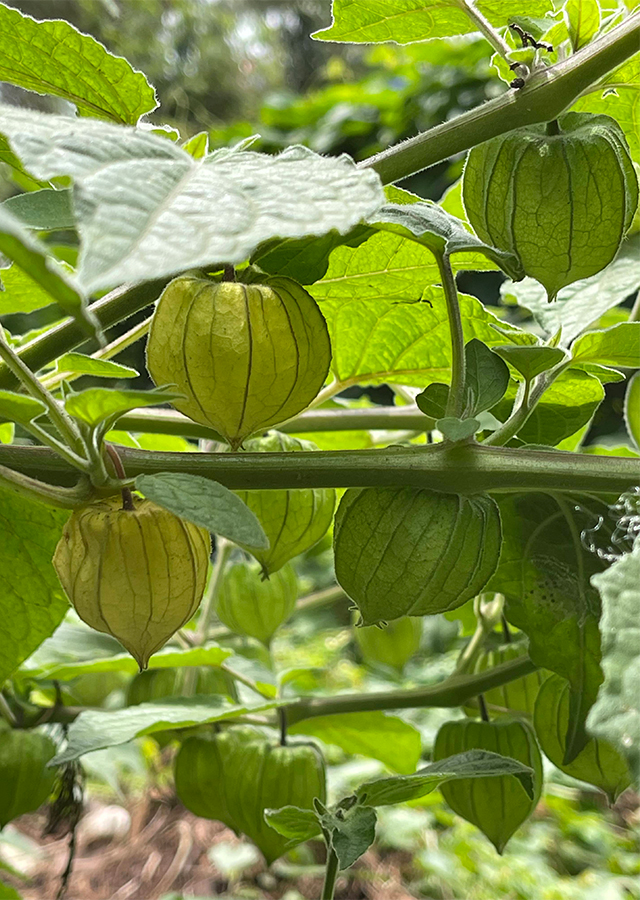
- Fruit a berry, globose with a smooth, glossy skin, fruit green turning golden or yellow to orange when ripe, flesh juicy, containing 100-300 seeds, flesh color golden-yellow to orange. Has a slightly sour and sweet taste with a grape-like tartness. Each enclosed in a husk-like bladder that becomes thin when ripe.
- Seeds numerous per fruit, small, flat, yellowish, embedded in the juicy fruit flesh, ovoid shaped, sometimes reniform, reticulate-foveate throughout.
Cultivation
- Reproduces naturally by seed but can be artificially propagated by stem cuttings treated with rooting hormone.
- Recommended plant spacing ranges from 0.9 m × 0.45 m to 1.8 m × 0.9 m (2.5-0.6 plants/m²), mainly depending on labor cost and desired harvest duration. Wider spacing produces larger berries.
Chemical Content
Phytosterols, oleic acid, linoleic acid, palmitic acid, stearic acid, withanolides, physalins, rutin, myricetin, kaempferol, alkaloids, phenols, saponins, tannins, glycosides, 11 terpene compounds (six monoterpenoids and five sesquiterpenes), 11 esters, two phenolic compounds, two aldehydes, two ketones, and one lactone.
Benefits
Treats inflammation, jaundice, pterygium (an eye disorder marked by the appearance of a pinkish, flesh-like membrane on the conjunctiva), an anthelmintic, relieves stomach disorders in children, treats cancer, diabetes, diarrhea, malaria, asthma, hepatitis, dermatitis, leukemia, rheumatism, glaucoma, improves vision, protects the liver and kidneys against fibrosis, maintains the immune system, maintains bone health and digestive health, improves cognitive ability, memory, focus, and concentration skills. Has antioxidant, antipyretic, anticancer, anti-inflammatory, diuretic, and anthelmintic activity.
Simplisia
- Prepare an adequate amount of Peruvian groundcherry leaves, wash clean with running water then drain.
- Dry under the sun or with an oven at 40°C until the moisture content reaches 10%.
- Store in a clean, airtight container.
Local Names
Ciplukan gede, Cecendet badak.
Traditional Recipes
The following recipes reflect traditional knowledge passed down through generations, not a substitute for professional medical diagnosis or advice. Consult a healthcare provider before use.
1. Anthelmintic
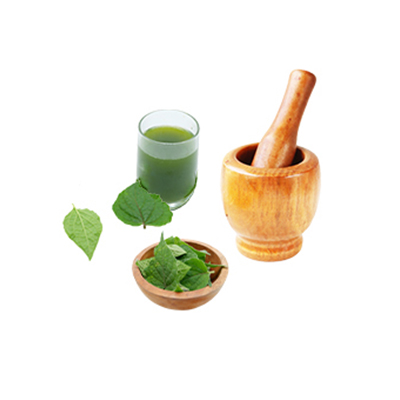
- Take an adequate amount of Peruvian groundcherry leaves and wash until clean.
- Grind until it becomes a paste.
- Squeeze the leaf paste to extract the liquid.
- Drink as an anthelmintic and for intestinal complaints.
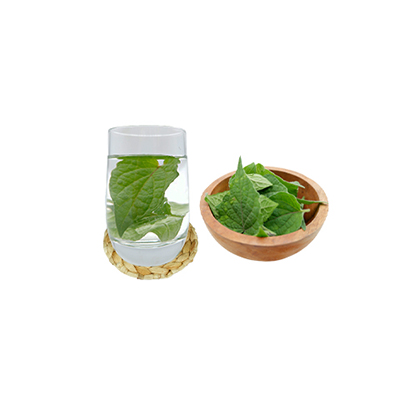
2. Relieves stomach disorders in children
- Take an adequate amount of Peruvian groundcherry leaves and wash until clean.
- Soak the leaves and wait for a while.
- Strain then drink.
Reference Sources
- Royal Botanic Gardens, Kew. Plants of the World Online: Physalis peruviana L.. https://powo.science.kew.org/taxon/urn:lsid:ipni.org:names:195473-2. 20-06-2022.
- Flora Fauna Web. 2021. Physalis peruviana L.. https://www.nparks.gov.sg/florafaunaweb/flora/6/7/6742. 20-06-2022.
- Stuartxchange. 2019. Philippine Medicinal Plants: Lobo-lobohan. http://www.stuartxchange.org/Lobo-lobohan.html. 20-06-2022.
- Tropical Plants Database, Ken Fern. 2021. Physalis peruviana. https://tropical.theferns.info/viewtropical.php?id=Physalis+peruviana. 20-06-2022.
- Plant Resources of South-East Asia. 2016. Physalis peruviana (PROSEA). https://uses.plantnet-project.org/en/Physalis_peruviana_(PROSEA). 20-06-2022.
- CAB International. 2022. Invasive Species Compendium: Physalis peruviana (Cape gooseberry). https://www.cabi.org/isc/datasheet/40713#tosummaryOfInvasiveness. 20-06-2022.
- HealthBenefitstimes.com. Physalis Facts and Health benefits. https://www.healthbenefitstimes.com/physalis/. 20-06-2022.
- WebMD. 2022. Health Benefits of Physalis. https://www.webmd.com/diet/health-benefits-physalis.20-06-2022.