Plantago lanceolata L.
Summary
Plantago lanceolata or ribwort plantain is native to Europe, North Africa, and West-South Asia, now widely distributed as far as the Americas, Australia, and Japan. Its leaves can be eaten as a vegetable, mucilage from its seed coat is used as a thickener in the ice cream and cosmetics industries, while traditionally this plant is used to treat wounds, itching, diarrhea, and various inflammations of the respiratory and digestive tracts thanks to its astringent and anti-inflammatory properties.
Agroecology
Ribwort plantain is a common weed of cultivated land and grasslands in temperate to subtropical regions, also spreading into tropical regions, where this species is mainly found at moderate to higher elevations. This plant is also commonly found growing on roadsides and wastelands with neutral or basic soil, on a wider range of soil types than some close relatives (such as P. major and P. media), but is not found in the hottest and driest grasslands. Suitable climates include winter rainfall (temperate), year-round rainfall (temperate), summer rainfall (temperate), summer rainfall (sub-tropical) climates. Its growth succeeds in reasonably fertile soil in a sunny location, and also succeeds in very poor soil.
Morphology
- Roots a taproot.
- Stem wrinkled, rootstock short and thick, round, brown.
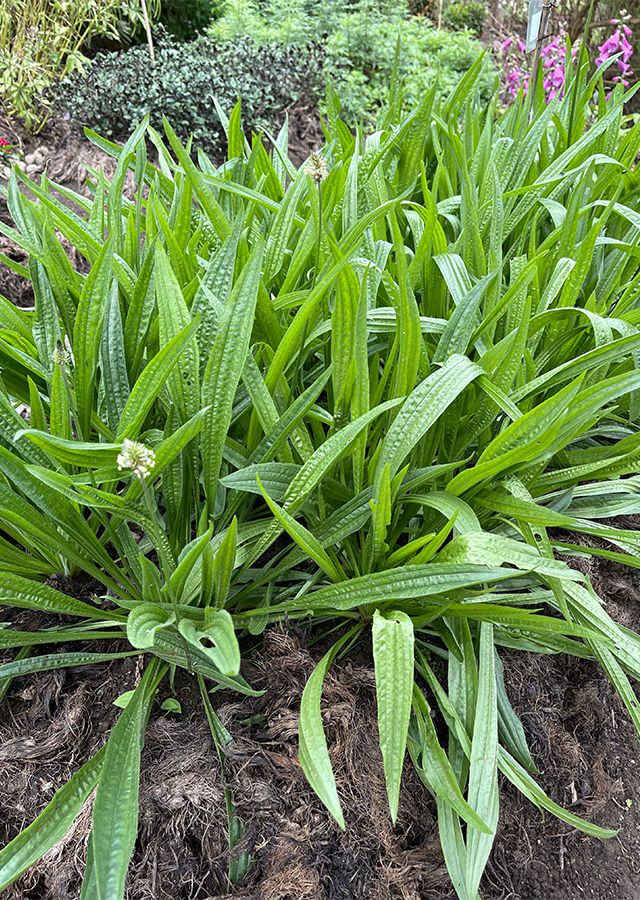
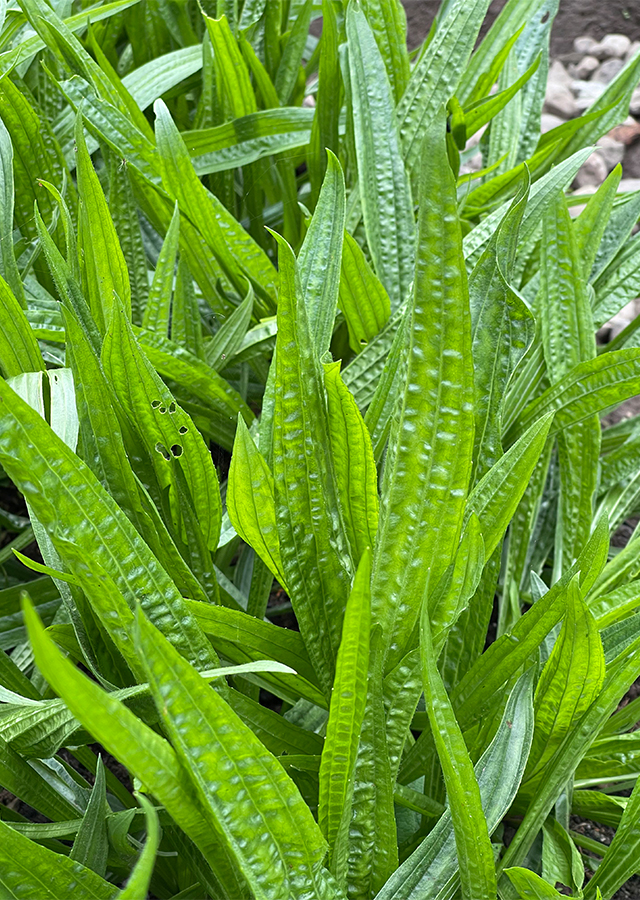
- Leaves in a basal rosette, spirally arranged, petiolate, rarely sessile, blade linear-lanceolate to narrowly ovate-elliptic, gradually narrowing to the petiole, margin entire or shallowly dentate, hairless, tip acute or acuminate.
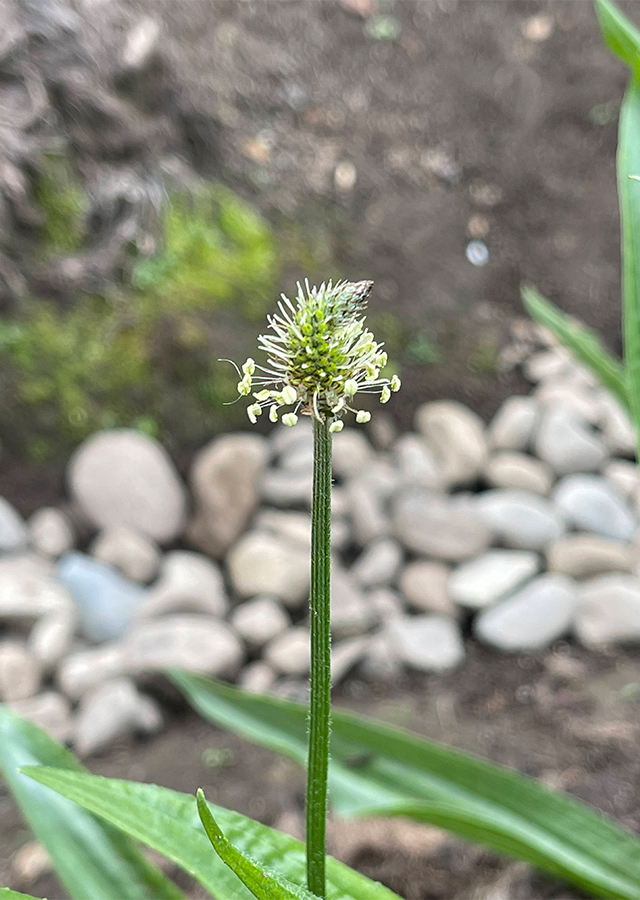
- Flowers bisexual, inconspicuous, corolla 4-lobed, tubular, nearly as long as the surrounding calyx. Corolla tube about 2-3 mm, hairless, corolla lobes lanceolate to ovate, pointed or tapering. Stamens 4, exserted, conspicuous, 3-5 mm long, anthers white with a yellowish tinge. Scape upright. Inflorescence spicate, spike cylindrical becoming round, reaching 4(-8) cm long.
- Fruit a capsule opening with an operculum, ovoid, one to two-seeded, splitting in the middle, with smooth boat-shaped seeds bearing a scar around the middle, brown, mucilaginous.
Cultivation
- Plant propagation is generative through seed. Optimal germination has been obtained at 21% soil moisture.
- Germination is best for seeds aged 1-6 years and at temperatures of 25-30°C.
- Seeds easily stick to animals or humans, promoting dispersal.
Chemical Content
Alkaloids, steroids, saponins, phenols, tannins, polysaccharides, caffeic acid derivatives (chlorogenic acid, neochlorogenic acid, plantamajoside, acteoside (verbascoside), syringic acid, and vanillic acid), flavonoids (apigenin, luteolin), iridoid glycosides (such as aucubin, catalpol, and asperuloside), terpenoids, coumarins.
Benefits
Treats itching, headache, heals wounds, stops blood flow and promotes repair of damaged tissue, addresses skin inflammation, insect stings, sunburn, boils, swelling, fever, diarrhea, dysentery, nausea, gastritis (inflammation of the stomach lining) and enteritis (inflammation of the small intestine and stomach), peptic ulcers, toothache, irritable bowel syndrome, hemorrhoids, cystitis (inflammation of the bladder due to infection), bronchitis, inflammation of the nasal mucosa, sinusitis, cough, colds, asthma, ophthalmia (eye inflammation), inflammation of the mouth and throat, rheumatism, helps detoxify the body, addresses rattlesnake bites, treatment of parasitic worms, a mouthwash for aphthae, treats fertility problems. Is astringent, demulcent, diuretic, mildly expectorant, laxative, hemostatic. Has antiviral, antibacterial, anti-inflammatory, and antioxidant activity.
Simplisia
- Prepare an adequate amount of ribwort plantain seeds, wash clean with running water then drain.
- Dry under the sun or with an oven at 40°C until the moisture content reaches 10%.
- Grind using a blender until it becomes powder.
- Store in a clean, airtight container.
Local Names
Mostor cina (Sulawesi), Suripandak (Jawa Timur), Daun otot-ototan.
Traditional Recipes
The following recipes reflect traditional knowledge passed down through generations, not a substitute for professional medical diagnosis or advice. Consult a healthcare provider before use.
1. Wounds
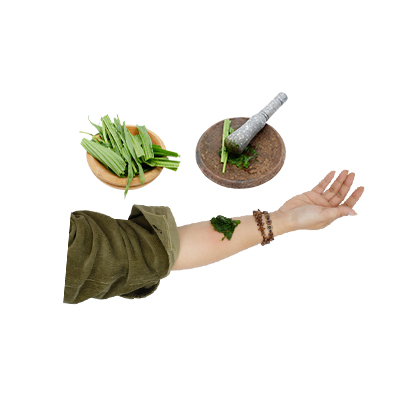
- Take an adequate amount of ribwort plantain leaves and wash until clean.
- Grind until it becomes a paste.
- Apply the leaf paste as a poultice on the wound to stop bleeding.
2. Eye infection
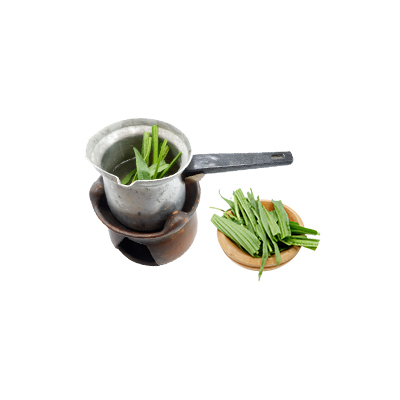
- Prepare an adequate amount of ribwort plantain leaves and wash until clean.
- Boil until it boils.
- Let it cool to warm/cold.
- Wash the eyes using the boiled water.
Reference Sources
- Royal Botanic Gardens, Kew. Plants of the World Online: Plantago lanceolata. https://powo.science.kew.org/taxon/urn:lsid:ipni.org:names:321285-2. 20-06-2022.
- CAB International. 2022. Invasive Species Compendium: Plantago lanceolata (ribwort plantain). https://www.cabi.org/isc/datasheet/41813#tosummaryOfInvasiveness. 20-06-2022.
- Tropical Plants Database, Ken Fern. 2021. Plantago lanceolata. http://tropical.theferns.info/viewtropical.php?id=Plantago+lanceolata. 20-06-2022.
- Plant Resources of South-East Asia. 2016. Plantago lanceolata (PROSEA). https://uses.plantnet-project.org/en/Plantago_lanceolata_(PROSEA). 20-06-2022.
- Stuartxchange. 2018. Philippine Medicinal Plants: Lanting-haba. http://www.stuartxchange.org/Lanting-haba.html. 20-06-2022.