Plerandra elegantissima (H.J.Veitch ex Mast.) Lowry, G.M.Plunkett & Frodin
Summary
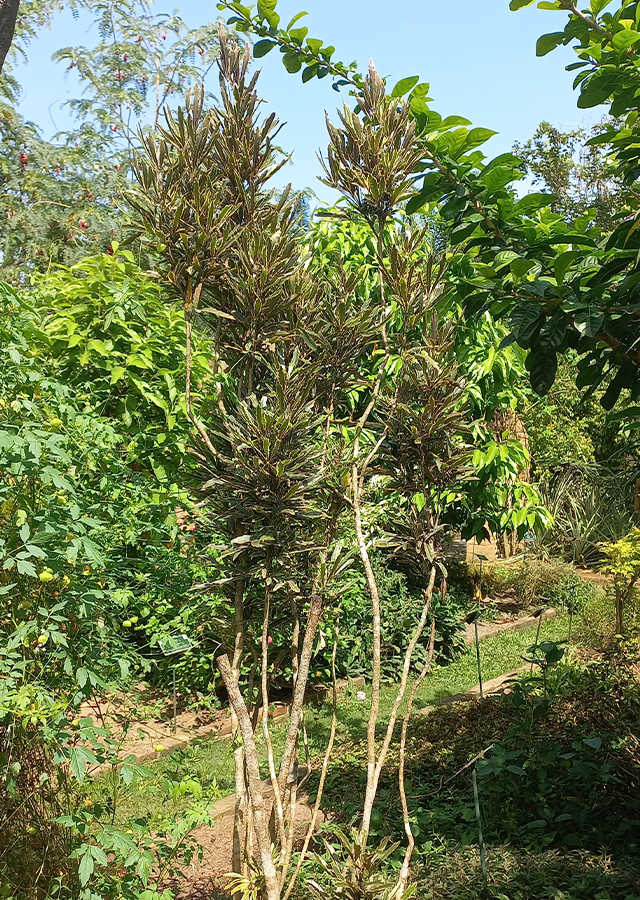
Spider aralia (Plerandra elegantissima) is a tree or shrub 8-15 meters tall from the Araliaceae family native to southwestern New Caledonia, now listed as endangered on the IUCN Red List. This plant is popular as an indoor and outdoor ornamental for its unique leaf shape. Research shows spider aralia has cytotoxic and antimicrobial activity that still needs further study.
Agroecology
Plerandra elegantissima can be found growing in thickets and moist lowland forests. This species can be cultivated in tropical and subtropical climates, requiring warm temperatures and high humidity, ideally between 60 and 85°F. Its growth requires 3-4 hours of direct sunlight, with bright indirect light or partial shade. The plant's water needs are moderate, where excessive watering can cause root rot. This species prefers nutrient-rich, well-drained soil, with a slightly acidic to neutral soil pH.
Morphology
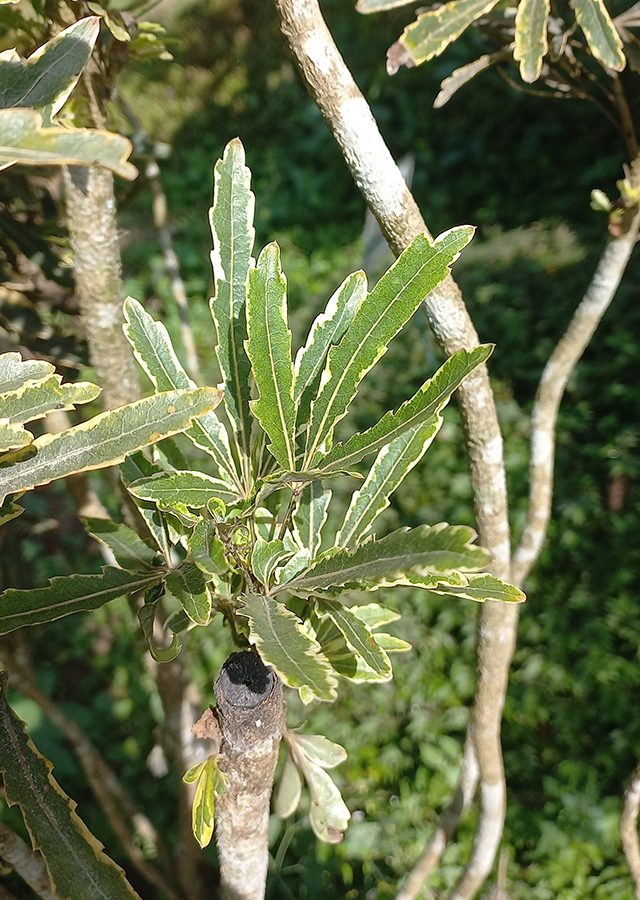
- Stem upright, stem and petioles dark green with white macule spots.
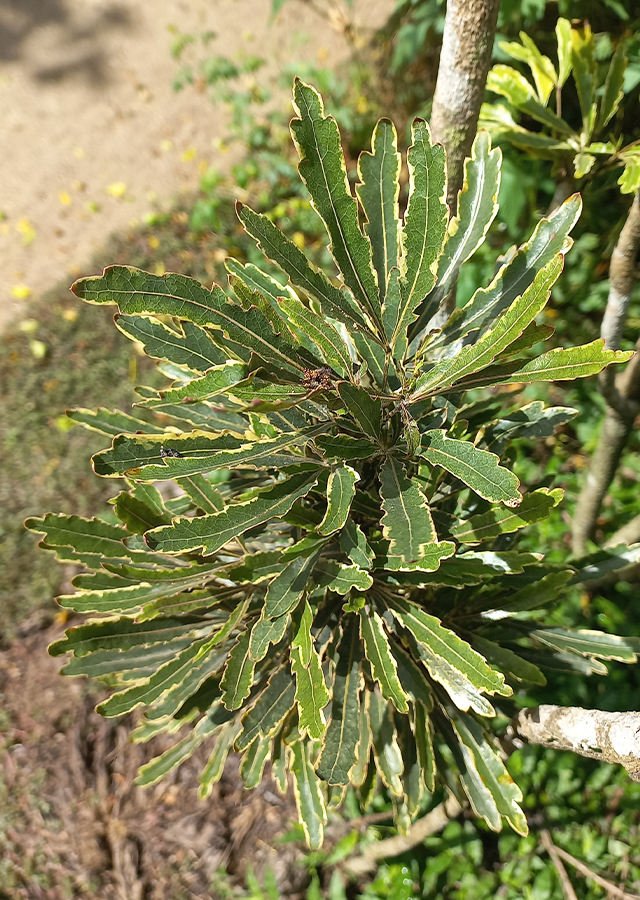
- Leaves alternate, palmately compound, formed by 7-12 nearly linear-oblong leaflets, narrow with coarse, irregularly toothed margins, leaflets petiolate. Initially purplish brown, later becoming glossy dark green. Central vein greenish white and prominent.
- Inflorescence compound, a terminal umbel with many small greenish-yellow pentamerous flowers.
- Fruit round, about 1 cm in diameter, blackish.
- Seeds pale yellow, usually 5-6 seeds per fruit.
Cultivation
- Propagation is generative using seed, where the seeds are first soaked in water for 2 days and placed shallowly in moist sandy clay soil, at a temperature of 24-26°C. Germination time is about 3-5 weeks.
- Propagation is also done vegetatively with stem cuttings. Cutting material comes from a stem cut to a length of at least 4 inches (10.16 cm). Remove the lower leaves and plant the stem cutting in soil. Cuttings may take several weeks to root. Once the cuttings have rooted, they can be transplanted to a permanent medium.
Chemical Content
Sulfated oleanane-type triterpenoid, five known oleanane-type saponins (echinocystic acid 3-O-β-D-glucopyranosyl-(1→3)-β-D-glucopyranosyl-(1→2)-α-L-arabinopyranoside, 28-O-α-L-rhamnopyranosyl-(1→4)-β-D-glucopyranosyl-(1→6)-β-D-glucopyranosyl ester, 3-O-β-D-glucopyranosyl-(1→2)-α-L-arabinopyranoside 28-O-α-L-rhamnopyranosyl-(1→4)-β-D-glucopyranosyl-(1→6)-β-D-glucopyranosyl ester, 3-O-α-L-arabinopyranoside, 28-O-α-L-rhamnopyranosyl-(1→4)-β-D-glucopyranosyl-(1→6)-β-D-glucopyranosyl ester, 3-O-α-L-arabinopyranoside, and oleanolic acid 3-O-sulfate).
Benefits
Studies show cytotoxic, anti-Leishmania, and antimicrobial activity. Further research is needed to confirm traditional medicinal use of this species.
Local Names
Informasi tidak ditemukan. Butuh penelusuran lebih lanjut.
Reference Sources
- Royal Botanic Gardens. Plants of the World online: Plerandra elegantissima (H.J.Veitch ex Mast.) Lowry, G.M.Plunkett & Frodin. https://powo.science.kew.org/taxon/urn:lsid:ipni.org:names:77131172-1. 19-03-2022.
- MONACO NATURE ENCYCLOPEDIA. Plerandra elegantissima. https://www.monaconatureencyclopedia.com/plerandra-elegantissima-2/?lang=en. 19-03-2022.
- Flora Fauna Web. 2022. Plerandra elegantissima (H.J.Veitch ex Mast.) Lowry et al. https://www.nparks.gov.sg/florafaunaweb/flora/2/4/2440. 19-03-2022.
- North Carolina, Extension Gardener. Plerandra elegantissima. https://plants.ces.ncsu.edu/plants/plerandra-elegantissima/. 19-03-2022.
- Tula. Plerandra elegantissima. https://tula.house/blogs/tulas-plant-library/plerandra-elegantissima. 19-03-2022.
- Wanas, A.S., et al. (2013). Bioactive Triterpene Saponins from the Leaves of Schefflera elegantissima. Natural Product Communications, 8(6):767-76. DOI: 10.1177/1934578X1300800621.