Pleurotus citrinopileatus Singer
Summary
Golden oyster mushroom (Pleurotus citrinopileatus) is a fungus from the Pleurotaceae family native to subtropical hardwood forests of eastern Russia, northern China, and Japan, commercially cultivated in North America starting around 2000. This short-shelf-life mushroom is rich in antioxidants and has potential for use in skin care products. Golden oyster mushroom is believed to help lower blood sugar and boost immunity.
Agroecology
Golden oyster mushroom is a decomposer fungus that feeds on hardwoods such as oak, beech, elm, and other hardwood plants. Its habitat is in areas with warm climates and hardwood forests beneath trees. In Indonesia, areas at elevations between 400-800 m asl and above 800 m asl are suitable for oyster mushroom cultivation. Golden oyster mushroom grows at room temperature and in warmer locations. Its need for sunlight is not great, but even at low intensity, sunlight is still needed for spore-hyphae-mycelium development. Without sunlight, formation is not optimal. Oyster mushroom growth also requires high humidity, ranging from 80-90%. If humidity is below 80% for several days, the fruiting body will become dry.
Morphology
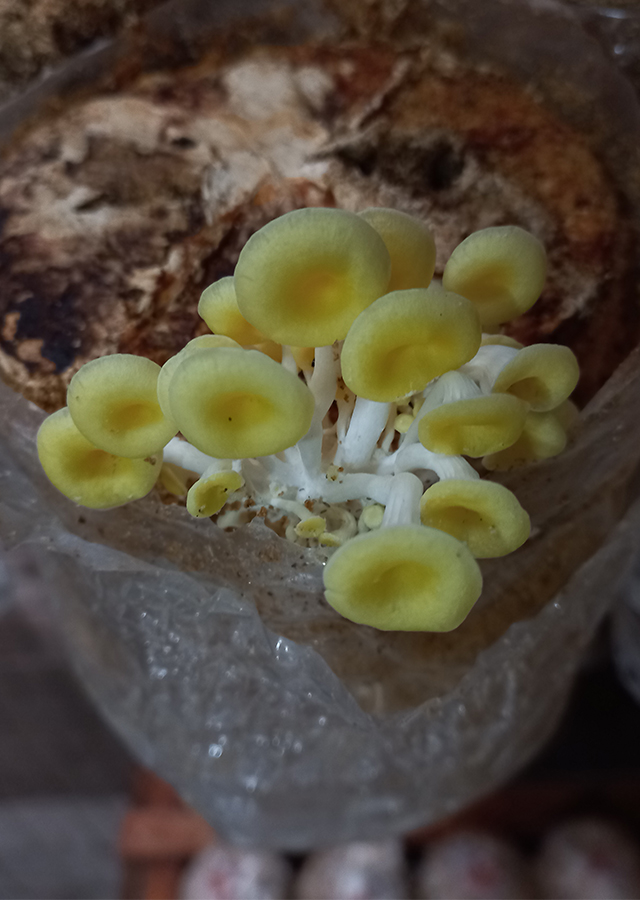
- Stipe cylindrical, short, white, often curved or bent, about 20-50 mm long and 2-8 mm in diameter, positioned not exactly in the center (asymmetric), but slightly to the side.
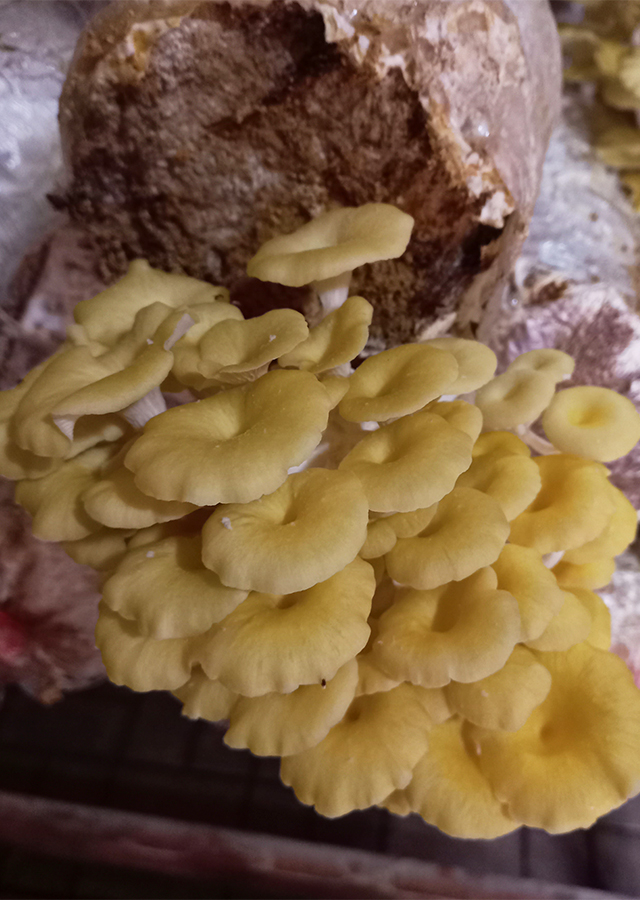
- Fruiting body small, growing in clusters, bright yellow to golden brown with a dry, velvety surface texture. Young caps are usually funnel-shaped and with age, the cap may fade to nearly whitish and become flatter in shape. Cap diameter ranges from 20-65 mm. Flesh thin and white, with a mild taste and no pungent odor.
- Gills white, closely spaced, and running down the stipe.
- Spores very small, light, cylindrical or elliptic in shape, smooth.
Cultivation
- Propagation is through spores and tissue culture. Spores are generally dispersed by wind and beetles.
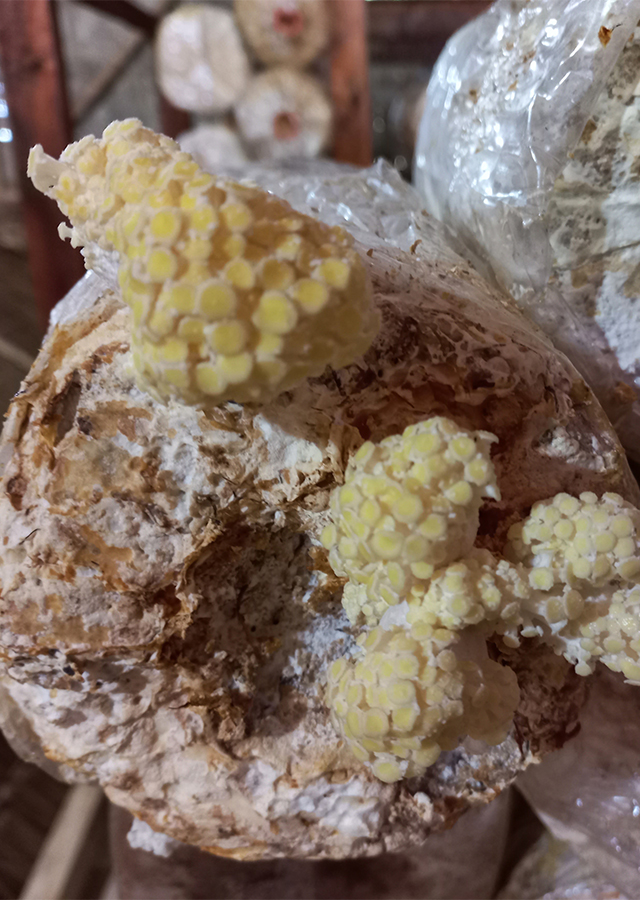
- Usually cultivated on grain, straw, or sawdust media.
Chemical Content
Lectins, glycoprotein, glucosylceramide, amino acids.
Benefits
Boosts immunity, lowers blood sugar levels for diabetics, increases male sexual desire (aphrodisiac). Has antioxidant, antihyperlipidemic, antitumor, anticancer, anticholesterol, and antiobesity activity.
Local Names
Jamur tiram emas.
Traditional Recipes
The following recipes reflect traditional knowledge passed down through generations, not a substitute for professional medical diagnosis or advice. Consult a healthcare provider before use.
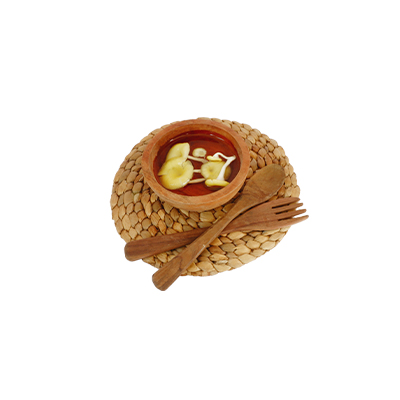
1. Increases male sexual desire (aphrodisiac)
- Take an adequate amount of golden oyster mushroom and wash until clean.
- Boil until it boils, add a little salt.
- Eating the boiled mushroom is beneficial to increase male sexual desire (aphrodisiac).
Reference Sources
- EOL. Golden Oyster, Pleurotus citrinopileatus Singer 1942. https://eol.org/pages/1016971/articles. 06-04-2022.
- Jamur Oemah. Jamur Tiram Kuning (Pleurotus citrinopileatus). https://oemahjamur.blogspot.com/2017/10/jamur-tiram-kuning-pleurotus.html. 06-04-2022.
- Healing Mushrooms. Pleurotus citrinopileatus: Golden Oyster Benefits & Identification. https://healing-mushrooms.net/golden-oyster. 06-04-2022.
- Gary Emberger, Messiah University. 2008. Pleurotus citrinopileatus. https://www.messiah.edu/Oakes/fungi_on_wood/gilled%20fungi/species%20pages/Pleurotus%20citrinopileatus.html. 06-04-2022.
- Yusnu I. N. 2018. Sukses Budidaya Jamur Tiram. Ilmu Media Publishing.