Pometia pinnata J.R.Forst. & G.Forst.
Summary
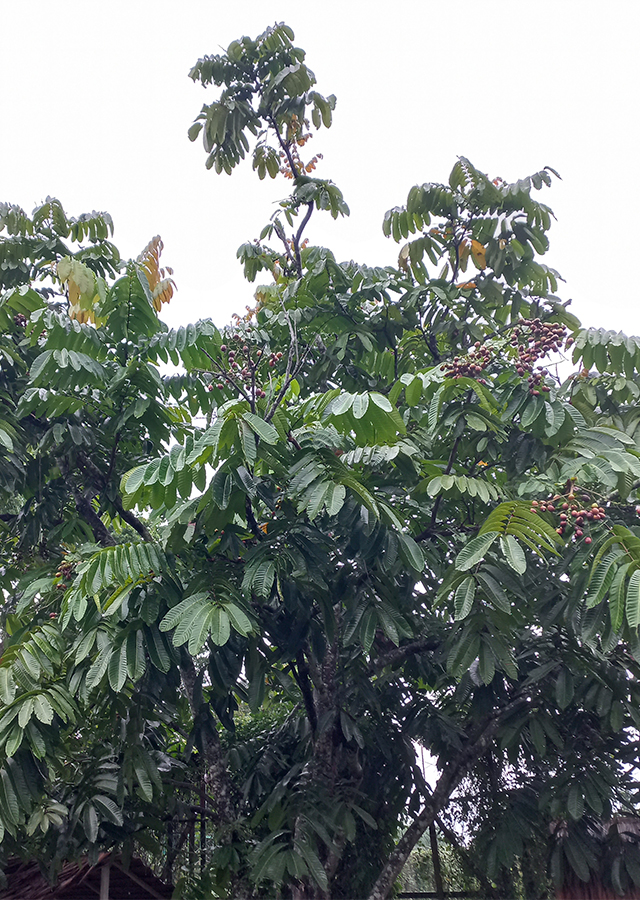
Pometia pinnata or matoa is a plant native to Papua that has long been better known as a commercial timber producer, though it has also long yielded a favorite local fruit with a unique flavor combining rambutan and longan. Its largest production comes from Jayapura, and matoa fruit has now even become nationally known as a promising economic commodity. In the Pacific Islands, matoa is also commonly used in traditional medicine to relieve bone pain, fever, and various other ailments.
Agroecology
Matoa is a moist tropical lowland plant, usually found at elevations below 500 m asl, although sometimes found at elevations of 1,700 m asl. In its native region, matoa succeeds with mean annual rainfall in the range of 1,500-5,000 mm, without a severe dry season. Mean annual temperature ranges between 22-28°C, mean maximum temperature 25-32°C, and minimum tolerance 5-16°C. Prefers deep, fertile, moist soil and a position in full sun or bright shade. This tree is found in various soils in its native region: in limestone soil, clay, sandy or loam, mostly in dryland forest, sometimes in freshwater swamps. A very fast-growing tree, with a height increase of 1.7 m recorded over one year.
Morphology
- Roots have a taproot system.
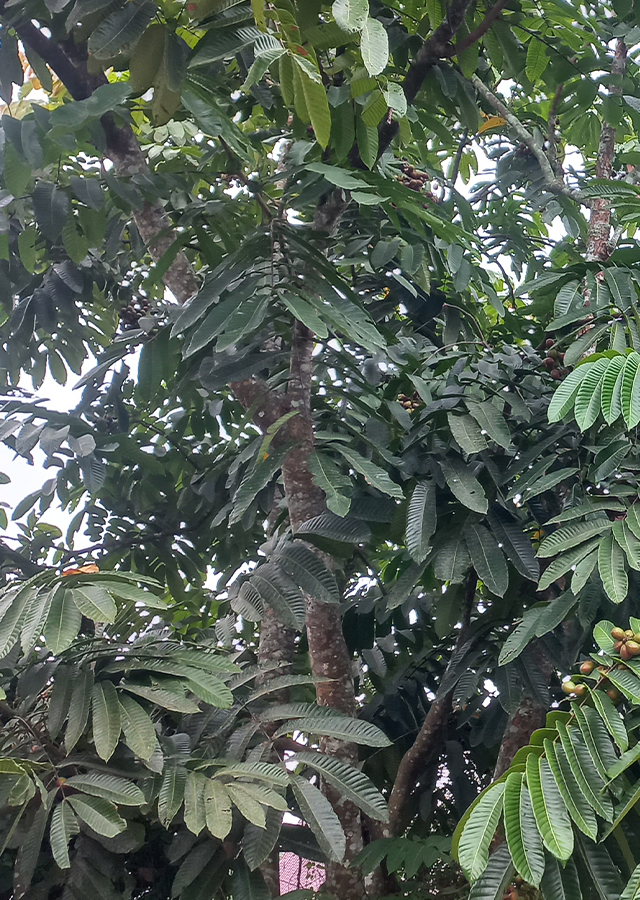
- Trunk diameter can reach up to >100 cm, with buttress roots up to 5 m tall, trunk straight but sometimes crooked with many branches, crown round and free bole height to first branch 18-30 m. Dead outer bark 0.2-2 mm thick, light gray to reddish brown, bark shallowly grooved and peeling in small flakes.
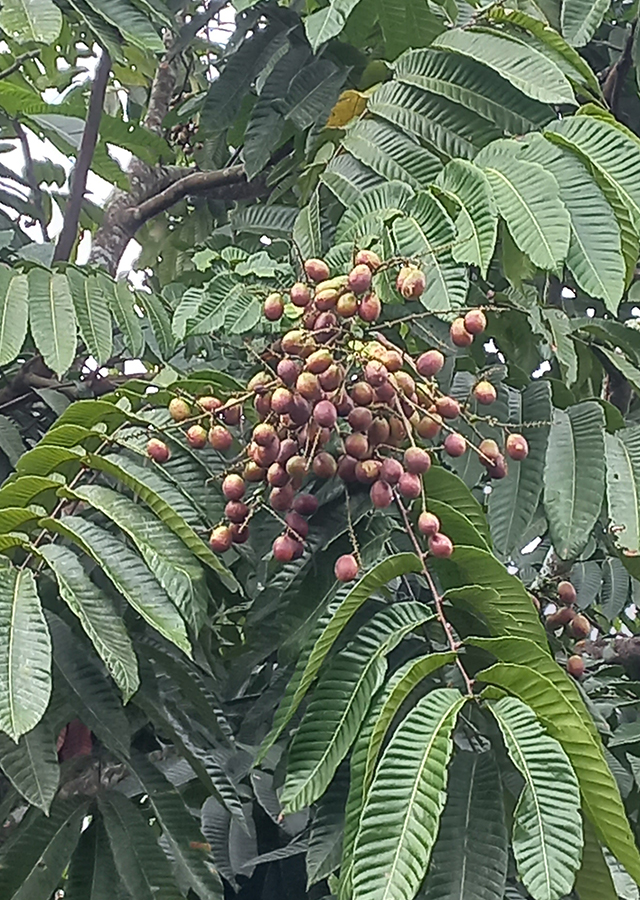
- Leaves alternately compound, petiolate, more than 1 m long. Each leaf consists of 4-15 pairs of leaflets, with no terminal leaflet. Leaflets thin to coarse, egg-shaped to drop-shaped, slightly to clearly sickle-shaped, red when young, dark green above and light green below when mature, hairless to covered with hair, 6-40 by 2-13 cm, and with a toothed margin. The lowest pair of leaflets is smaller than the others, round, ear-shaped or pillow-shaped, 0.4-3 by 0.3-5 cm, appearing as stipule-like, with one leaflet reduced.
- Flowers monoecious, producing male and female flowers on the same individual. The flowers are about 2-2.5 mm, generally white to green-yellow, and appear on a branched flower stalk 15-70 cm long.
- Fruit fleshy with a stony core each, ellipsoid to round, 1.5-5 by 1-3 cm, red turning black when ripe.
- Seeds egg-shaped, sides unequal, up to 2.5 by 1.5 cm, brown in color, with a white covering (aril).
Cultivation
Matoa is very easy to propagate through seed, but the constraint is that matoa seeds cannot be stored long-term (recalcitrant), making seed supply efforts difficult. Matoa seeds freshly taken from the tree will germinate well if planted immediately, but if stored for one week, germination drops very drastically.
Chemical Content
Alkaloids, saponins, tannins, triterpenoids, flavonoids, phenolic compounds.
Benefits
Used to treat bone pain, migraine headaches, helps expel the placenta after childbirth, relieves aches in muscles and joints, reduces fever, a cold and flu remedy, heals diarrhea, stomachache, cough, constipation, diaper rash, wounds, treats an unclosed fontanelle, an emetic remedy for mouth infections, colds and mucus congestion, to treat stomachache, treats mouth cancer. Has antimicrobial, antibacterial, and antioxidant activity.
Simplisia
- Take an adequate amount of fresh matoa leaves and wash with running water until clean.
- Dry at a temperature of 30-60°C.
- Grind using a blender until it becomes powder.
- Store in a clean, airtight container.
Local Names
Ihi (Manikiong-Manokwari),Tien, Boeruat (Kebar-Manokawari), Mawai (Biak, Mangon, Mondek (Tehit_Sorong), Megaan, Mendek (Sorong) Tawan, Dar (Onim-Fakfak), dan Piediepik, Iniaopi (Yapen).
Traditional Recipes
The following recipes reflect traditional knowledge passed down through generations, not a substitute for professional medical diagnosis or advice. Consult a healthcare provider before use.
1. Fever
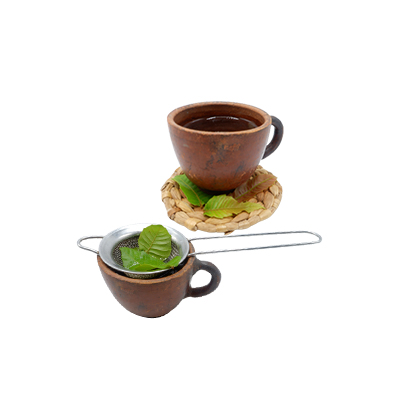
- Take an adequate amount of fresh matoa leaves and wash until clean.
- Boil until it boils.
- Let it cool to warm/cold.
- Strain then drink.
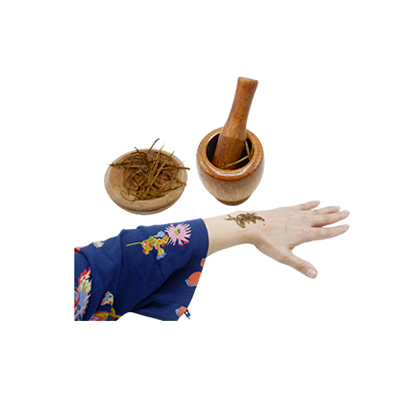
2. Treats wounds
- Take an adequate amount of matoa bark and wash until clean.
- Grind until it becomes a paste.
- Apply to the wound.
Reference Sources
- Royal Botanic Gardens, Kew. Plants of the World Online: Pometia pinnata J.R.Forst. & G.Forst.. https://powo.science.kew.org/taxon/urn:lsid:ipni.org:names:784485-1#synonyms. 19-09-2022.
- CAB International. 2019. Pometia pinnata (fijian longan). https://www.cabi.org/isc/datasheet/42815. 19-09-2022.
- Flora Fauna Web. 2021. Pometia pinnata J. R. Forst. & G. Forst.. https://www.nparks.gov.sg/florafaunaweb/flora/3/0/3084. 19-09-2022.
- Useful Tropical Plants. 2022. Pometia pinnata. https://tropical.theferns.info/viewtropical.php?id=Pometia+pinnata. 19-09-2022.
- Adisti Restina Poli, Dewa Gede Katja, Henry F Aritonang. 2022. POTENSI ANTIOKSIDAN EKSTRAK DARI KULIT BIJI MATOA (POMETIA PINNATA J. R & G. FORST). Vol 15, No 1 (2022). DOI https://doi.org/10.35799/cp.15.1.2022.43151. https://ejournal.unsrat.ac.id/index.php/chemprog/article/view/43151.