Procris repens (Lour.) B.J.Conn & Hadiah
Summary
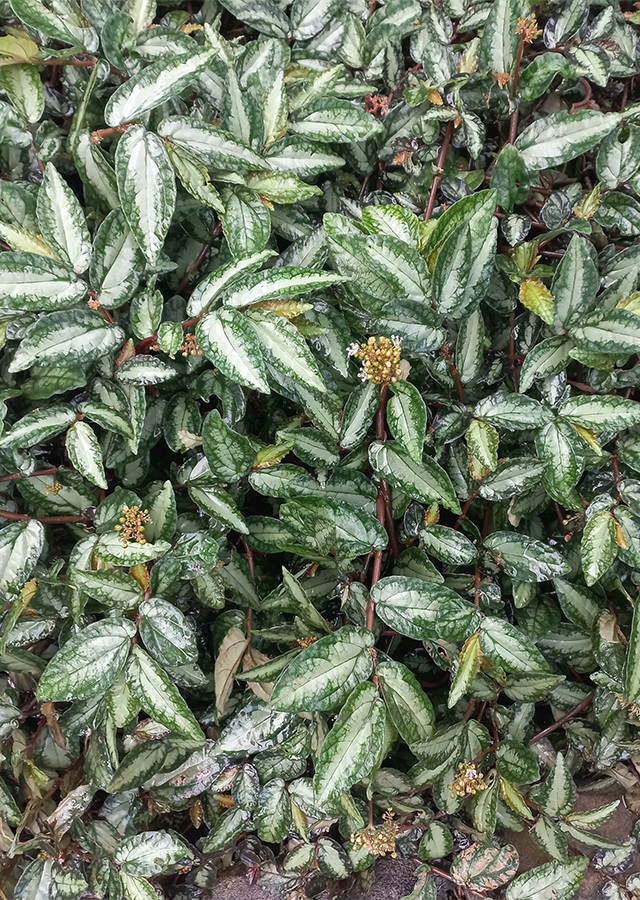
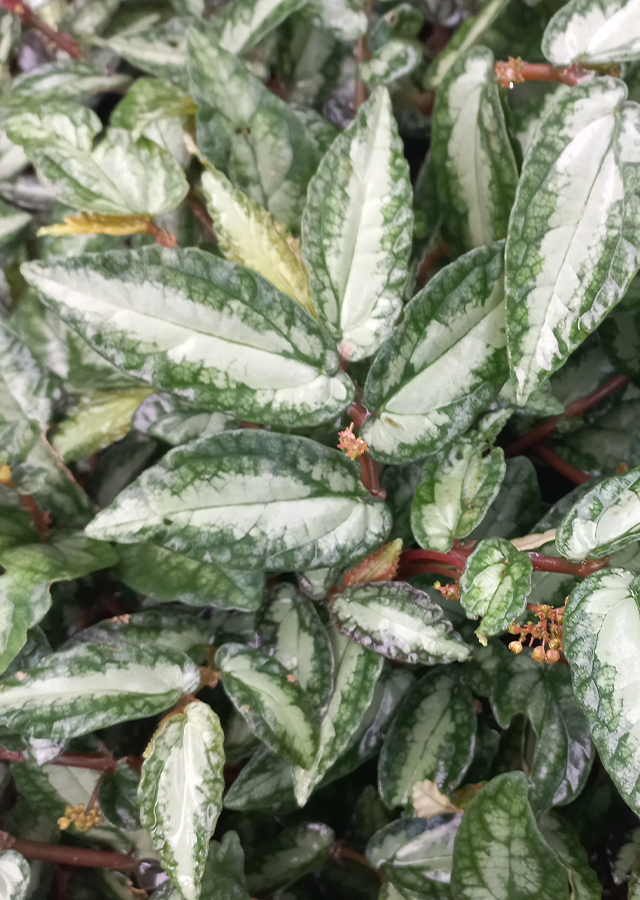
Begonia watermelon (Procris repens) is a creeping herb up to 0.2 meters tall from the Urticaceae family distributed from Bhutan to Indonesia. Its watermelon-rind-like leaf pattern makes it a popular hanging and terrarium ornamental. In Malaysia, begonia watermelon is traditionally used as a poultice for boils and its decoction to treat rheumatism.
Agroecology
This plant prefers moist, well-drained soil and is prone to rotting under continuously waterlogged conditions. Begonia watermelon requires high humidity, so it is best cultivated in a terrarium if placed in an air-conditioned or cold, windy location, and can grow in soil high in organic matter in a full sun or partially shaded position.
Morphology
- Stem semi-succulent, somewhat zigzagging, brownish, rooting at the nodes after contact with soil.
- Leaves fleshy, alternate, with toothed or wavy blades that are elliptic to oblong shaped, and sometimes broadly ovate, asymmetrically heart-shaped, and 2.5-10 x 2-5 cm in size. Veins appear mosaic-like on the upper leaf surface, and clearly reddish or brownish on the lower surface. Stipules pinkish-red, diamond-shaped, found at the base of the petiole. Leaf color resembles watermelon rind or certain Begonia foliage and varies, ranging from gray-green among brownish edges to purplish green to green almost entirely brownish, and becoming fully purplish brown with age.
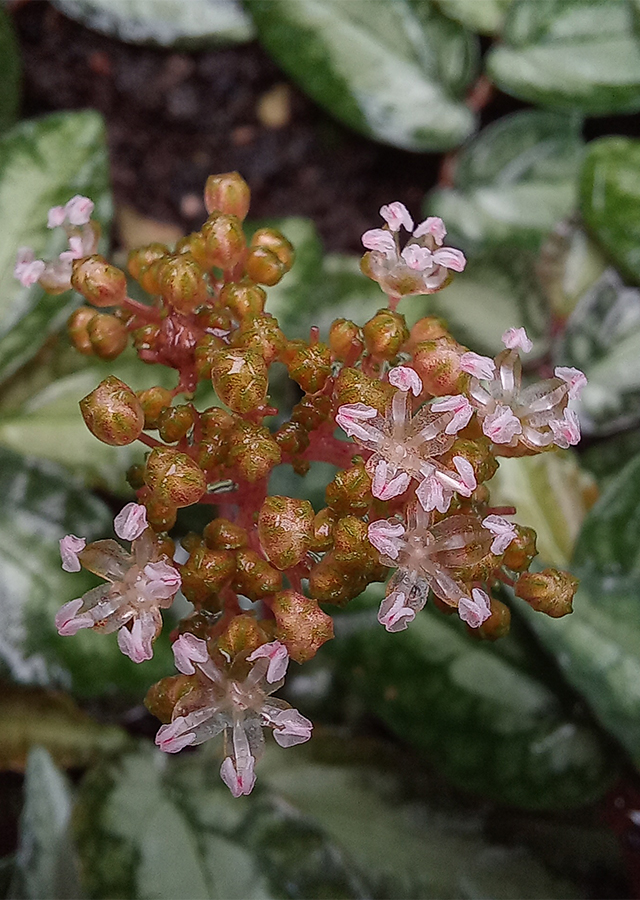
- Flowers tiny, white or pink with a silvery sheen, arranged in branched clusters. Male inflorescences 0.6-3.0 cm, and 2-14 cm long, with male flowers bearing 5 tepals (petals and sepals that cannot be distinguished) and 5 stamens. Female (pistillate) inflorescences smaller (3 mm), stalkless, with female flowers bearing 5 tepals (as long as or longer than the fruit).
- Fruit small, ovoid to elliptic, tuberculate.
Cultivation
This plant is easily propagated with stem cuttings.
Chemical Content
Information not found. Further research is needed.
Benefits
Used by the Malays as a poultice for boils, swollen areas, and stomach ache. A decoction of the plant is used for rheumatism
Local Names
Informasi tidak ditemukan. Butuh penelusuran lebih lanjut.
Traditional Recipes
The following recipes reflect traditional knowledge passed down through generations, not a substitute for professional medical diagnosis or advice. Consult a healthcare provider before use.
1. Boils
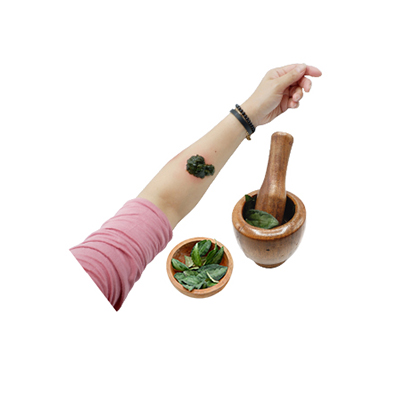
- Prepare an adequate amount of begonia watermelon leaves and wash until clean.
- Grind until it becomes a paste.
- Apply the leaf paste to the boil.
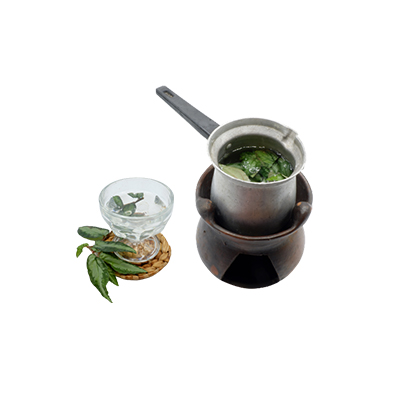
2. Rheumatism
- Take an adequate amount of begonia watermelon leaves and wash until clean.
- Boil until it boils.
- Let it cool to warm/cold.
- Strain then drink.
Reference Sources
- Royal Botanic Gardens. Plants of the World Online: Procris repens (Lour.) B.J.Conn & Hadiah. https://powo.science.kew.org/taxon/urn:lsid:ipni.org:names:77118256-1#synonyms. 02-04-2022.
- Flora Fauna Web. 2022. Procris repens (Lour.) B.J.Conn & Hadiah. https://www.nparks.gov.sg/florafaunaweb/flora/1/3/1388. 02-04-2022.
- NC. State Extention. Procris repens. https://plants.ces.ncsu.edu/plants/procris-repens/, 02-04-2022.