Pteris ensiformis Burm.f.
Summary
Pteris ensiformis or lace fern grows naturally from Sri Lanka, India, China, to Southeast Asia, northern Australia, and Polynesia. Besides its potential for environmental bioremediation and as an ornamental, its steamed young leaves can be eaten or used as a food flavoring, and in Taiwan this fern is an ingredient in most traditional beverage formulas. For generations, this plant has also been used to address dysentery, fever, malaria, and various infections.
Agroecology
P. ensiformis is found in irrigated rice paddy sections whose habitat is under tree shade and has high humidity levels as well as a soil base covered by moss, supporting the growth of this fern species. Also commonly found in shaded places under rocks, in crevices, or old wet walls, among tree roots in open places. Epiphytic on dead tree trunks. Lithophytic on riverbanks and ditch cliffs, wall crevices, road curbs, rock crevices.
Morphology
- Rhizome slender, creeping, spreading or erect, scaly with dark brown, glossy scales.
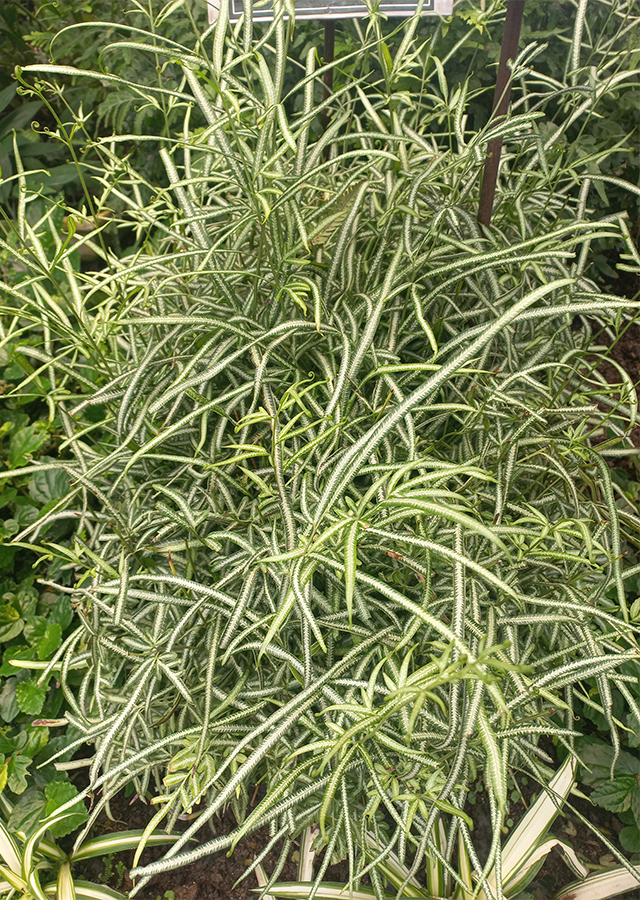
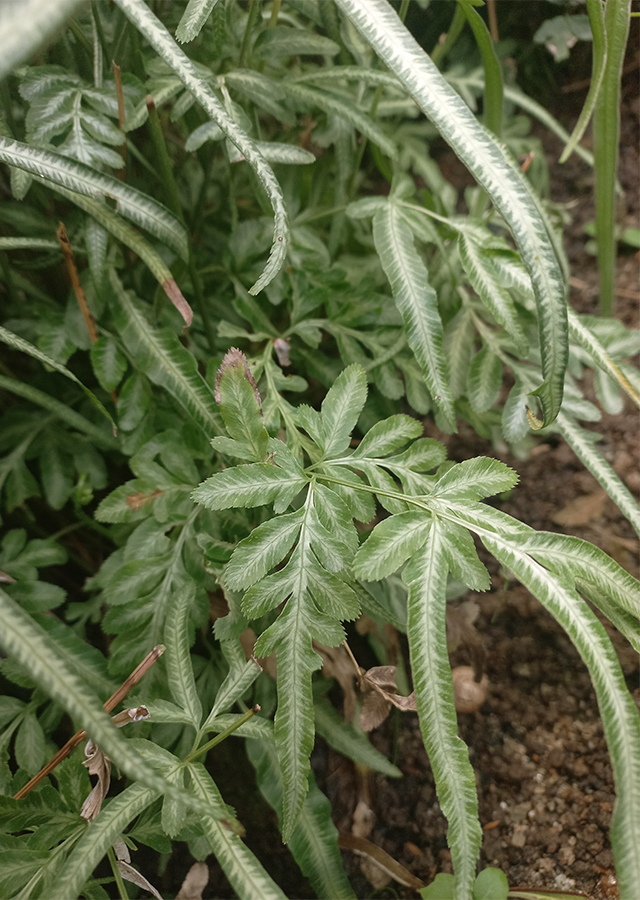
- Leaves dimorphic, lobed, pinnate to bipinnate, sometimes tripinnate, dark green above, hairless. Fronds pinnatifid with opposite leaf arrangement, sterile lamina sword-shaped or oblong, with the lower pinnae usually pinnate, leaf tip rounded, margin toothed, veins forking to the margin, below tripinnatifid or pinnate with 1-3 lobes or pinnules. Petiole round, green with white hairs. There are two kinds of fronds, sterile and fertile. Sterile fronds are shorter and located at the lower part of the stem, their leaf blades wider and irregularly toothed at the margin. Fertile fronds have thin but strong leaf blades, taller, bipinnate, fertile pinnae branching only once near the base, lobes much narrower than in the sterile pinnae.
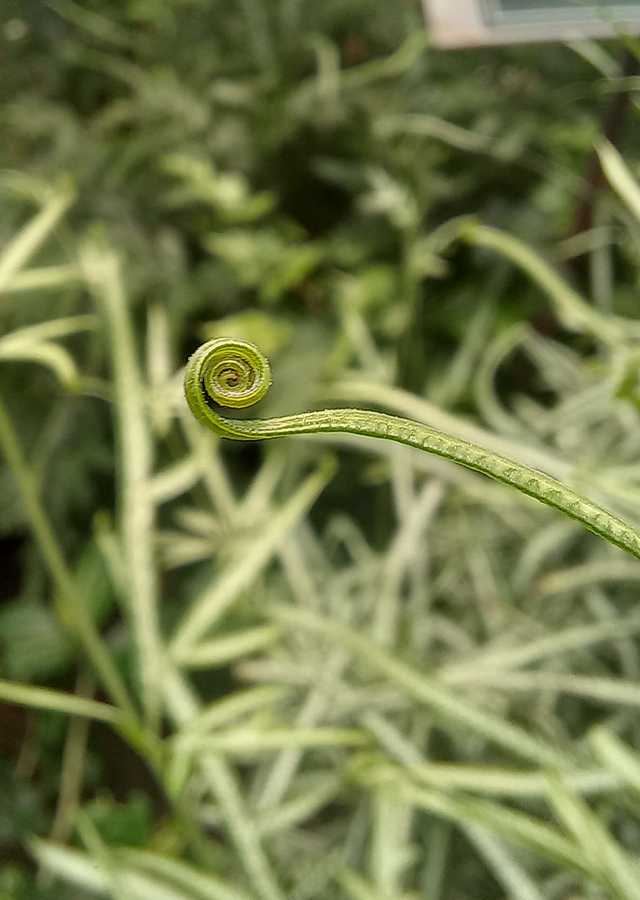
- Sori arranged linearly, lined up along the margin of the fertile pinnules, protected by a false indusium curving toward the abaxial side. Green when young, becoming dark brown when mature, tuberculate surface, thick perispore.
Cultivation
Plant propagation through spores, rhizome cuttings, and separation of plantlets.
Chemical Content
2'-hydroxy-4'-methoxychalcone, quercetin, 2',4'-dihydroxychalcone, 5,7,3',4'-tetrahydroxyflavone, 7,3',4'-trihydroxyflavone, multikaurane B, henrin A, ent-11α-hydroxy-15-oxokaur-16-en-19-oic acid, (+)-(βR)-3',4-dihydroxy-3,4'-dimethoxydihydrochalcone, (−)-(βS)-3',4-dihydroxy-3,4'-dimethoxydihydrochalcone, kaempferol 3-O-β-L-rhamnopyranoside-7-O-[α-D-apiofuranosyl-(1→2)-β-D-glucopyranoside], 7-O-caffeoylhydroxymaltol 3-O-β-D-glucopyranoside, hispidin 4-O-β-D-glucopyranoside.
Benefits
Cleanses unhealthy children's tongues (astringent), addresses swollen neck glands, treats dysentery, enteritis, fever, malaria, swollen and sore throat, urinary tract infections, vaginal discharge, mumps, measles, eczema, boils and arrow wounds, controls menstruation, hemorrhoid bleeding, dysmenorrhea. Has antioxidant, anti-inflammatory, antipyretic, and antirheumatic activity.
Simplisia
- Prepare an adequate amount of fresh lace fern fronds and wash until clean.
- Dry under the sun or with an oven at 40°C until the moisture content reaches 10%.
- Store in a clean, airtight container.
Local Names
Paku padan, Paku mukut atau Paku pelandok (Melayu).
Traditional Recipes
The following recipes reflect traditional knowledge passed down through generations, not a substitute for professional medical diagnosis or advice. Consult a healthcare provider before use.
1. Treats dysentery
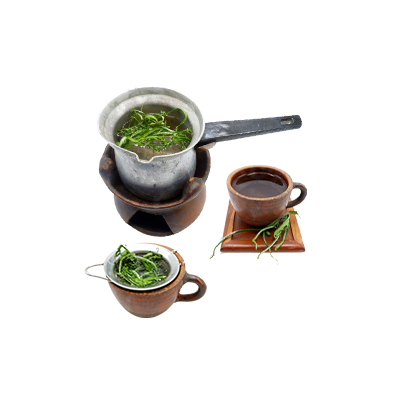
- Prepare an adequate amount of fresh young lace fern leaves and wash until clean.
- Boil until it boils.
- Let it cool to warm/cold.
- Strain then drink.
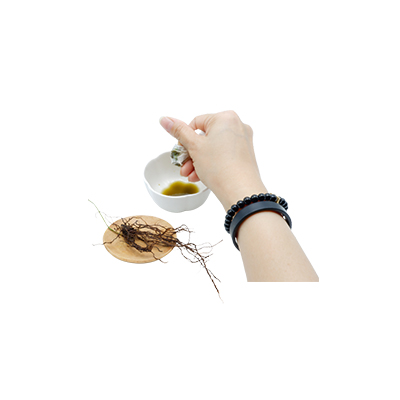
2. Treats swollen neck glands
- Prepare an adequate amount of fresh lace fern root.
- Blend the root until it becomes juice.
- Apply the juice to treat swollen neck glands.
Reference Sources
- Royal Botanic Gardens. Plants of the World Online: Pteris ensiformis Burm.f. https://powo.science.kew.org/taxon/urn:lsid:ipni.org:names:17212520-1. 08-09-2022.
- Agatha S. M., Safitri K. A., Pulungan A., Maskana, Sedayu A. 2019. Panduan Lapangan: Paku-pakuan (Pteridofita) di Taman Margasatwa Ragunan. Laboratorium Biologi FMIPA, Universitas Negeri Jakarta.
- Aulakh M. K., Kaur N., Saggoo M. I. S. 2019. Bioactive, Phytoconctituents of Pteridophytes - A Review. Indian Fern J. 36 : 37-79 (2019).
- Stuartxchange. 2011. Philippine Medicinal Plants: Buntot-kapon. http://www.stuartxchange.org/BuntotKapon. 08-09-2022.
- Flora Fauna Web. 2022. Pteris ensiformis. https://www.nparks.gov.sg/florafaunaweb/flora/1/5/1566. 08-09-2022.
- Plant Resources of South-East Asia. 2016. Pteris (PROSEA). https://uses.plantnet-project.org/en/Pteris_(PROSEA). 08-09-2022.