Pueraria montana (Lour.) Merr.
Summary
Kudzu (Pueraria montana) is a vine up to 15-30 meters tall from the Fabaceae family that originates from China and Japan, considered one of the 50 fundamental herbs of Chinese herbal medicine. Its starch-rich root is processed into noodle ingredients and soup thickener, while its flowers and young leaves are consumed as vegetables. Kudzu is traditionally believed to reduce fever and is effective as a poultice for boils.
Agroecology
Kudzu grows in areas up to 1,500 m asl. It prefers an average annual rainfall in the range of 1,200-1,400 mm, well-drained soil, and a sunny position. It grows best at annual daytime temperatures in the range of 18-28 °C, in loam soil with good fertility. The plant does not tolerate waterlogging in any soil type. It prefers a pH in the range of 5.5-6.5.
Morphology
- Roots a strong taproot.
- Tuber very large, up to 2 m long and 18-45 cm wide, weighing up to 180 kg in mature plants.
- Stem or branches sturdy, about 0.6-2.5 cm in diameter and up to 30 m long.
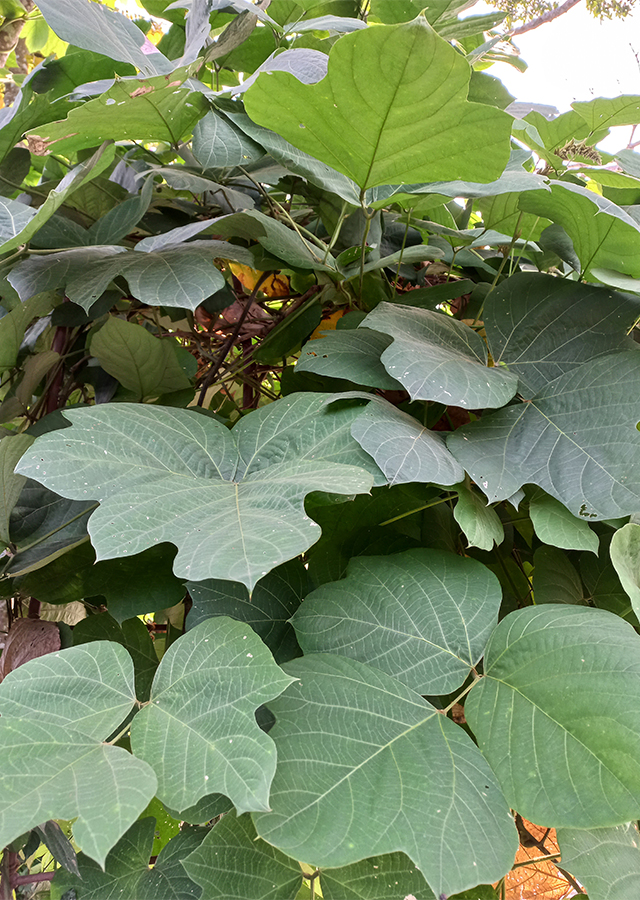
- Leaves pinnate, trifoliate (three leaflets), 8-20 cm long and 5-19 cm wide, each leaflet ovate to round in shape, unlobed or with 3 lobes. Leaves pale green above and light green to grayish below.
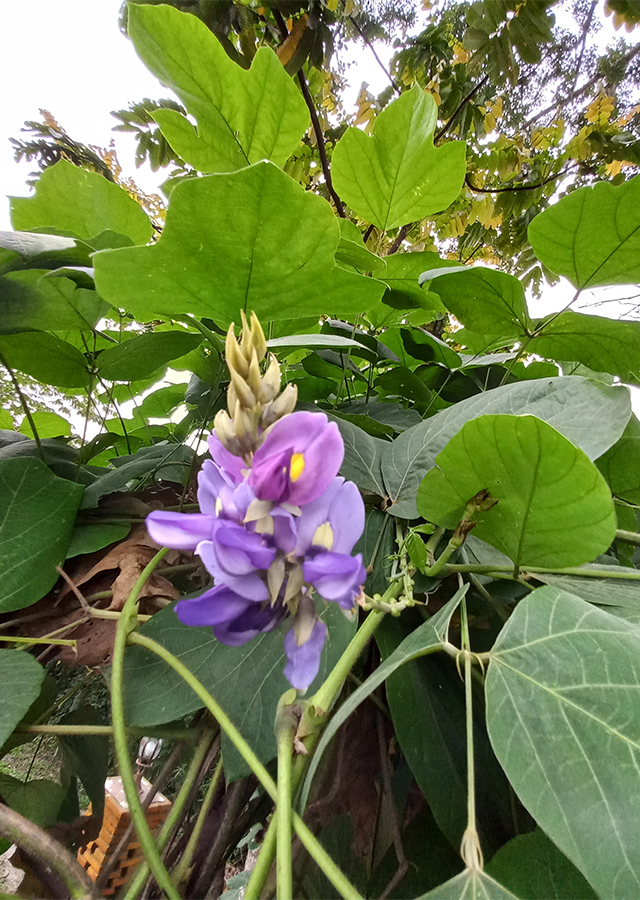
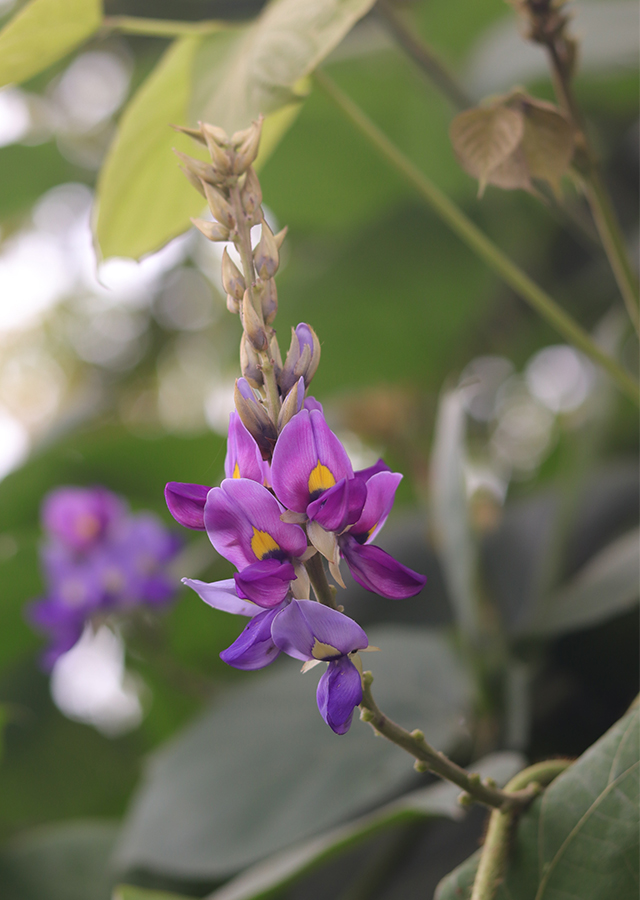
- Flowers purple to blue, grape-scented, growing on mostly unbranched inflorescences 10-25 cm long.
- Fruit a pod with golden hairs, brown, flattened, oblong, 4-13 cm long and 0.6-1.3 cm wide.
- Seeds flat, ovate and reddish-brown with a black mosaic pattern. About 4-5 mm long, 4 mm wide, and 2 mm thick.
Cultivation
- Propagation by seeds and separation of young shoots.
- Before planting, soak seeds for 12 hours in warm water and sow.
Chemical Content
Isoflavonoids and flavonoids, daidzin, daidzein, puerarin, genistin, genistein, tectorigenin, glycirin, tectoridin, 6″-O-xylosyltectoridin, 6″-O-xyloglycitin, biochanin A, and spinasterol, glutamic acid, adenine, asparagine, butyric acid, kakkalide.
Benefits
Poultice for new boils, swelling, mouth sores, treats hangovers, reduces fever, colds, diarrhea, acute intestinal obstruction, dysentery, styptic, angina pectoris and migraine, remedy for measles.
Simplisia
- Prepare kudzu root, wash until clean, then drain.
- Dry under direct sunlight for several days or with an oven at 40 °C until moisture content reaches 10%.
- Store the dried preparation in a clean, airtight plastic or container.
Local Names
Bitok, Ngu lok, Tebi, Tobi.
Traditional Recipes
The following recipes reflect traditional knowledge passed down through generations, not a substitute for professional medical diagnosis or advice. Consult a healthcare provider before use.
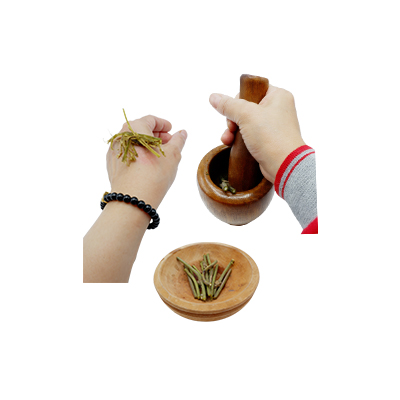
1. New boils
- Wash fresh kudzu stem as needed until clean.
- Grind the material finely into a paste.
- Apply the paste to the boil.
- Repeat until healed.
Reference Sources
- Royal Botanic Gardens. 2017. Plant of the World Online: Pueraria montana (Lour.) Merr. http://www.plantsoftheworldonline.org/taxon/urn:lsid:ipni.org:names:516708-1. 14-09-2021.
- Stuartxchange. 2019. Philipphine Medicinal Plants: Baai Pueraria montana var. lobata (Willd.) Sanjappa & Pradeep KUDZU Ge gen. http://www.stuartxchange.org/Baai. 14-09-2021.
- Useful Tropical Plants Database. 2021. Pueraria montana. http://tropical.theferns.info/viewtropical.php?id=Pueraria+montana. 14-09-2021.
- CAB International. 2021. Pueraria montana var. lobata (kudzu). https://www.cabi.org/isc/datasheet/45903. 14-09-2021.