Raphanus raphanistrum subsp. sativus (L.) Domin
Summary
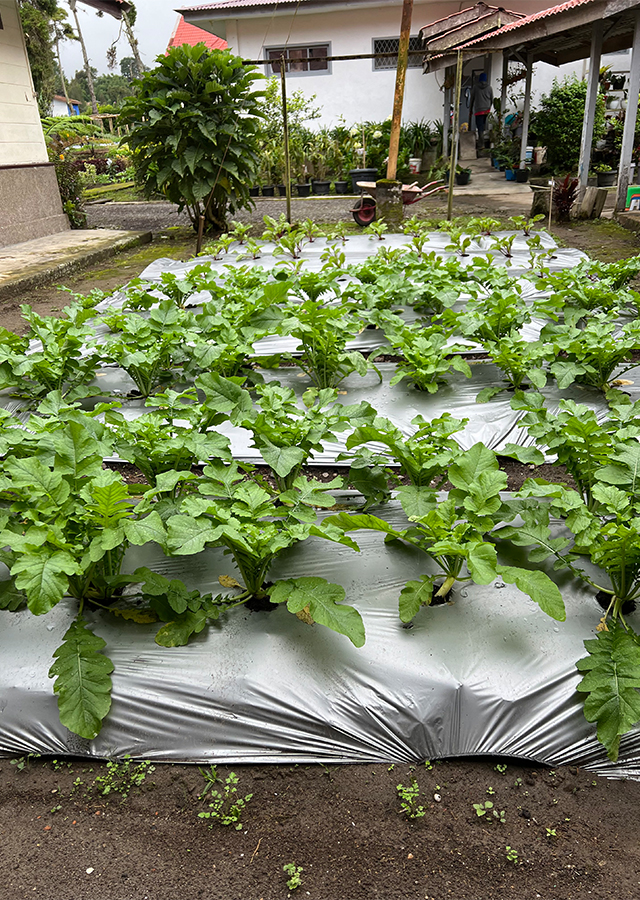
Radish (Raphanus raphanistrum subsp. sativus) is an annual herb 0.2-1 meter tall from the Brassicaceae family with a diversity center in the Eastern Mediterranean, cultivated since before 2000 BC. Its thick fleshy root is an important vegetable in Japan, Korea, and Taiwan, while its leaves are used as green manure in Europe. Radish is traditionally used in India as a laxative and expectorant.
Agroecology
Radish can be cultivated in both highlands and lowlands. Radish is generally a temperate-region or winter-season plant, where cool conditions stimulate strong growth. Best growth in tropical regions is at higher latitudes (>10°) during winter and in highlands above 1000 m asl. Radish requires light, sandy, deep, well-drained soil, containing high organic matter, with a soil pH of 6.0-6.5. Heavy soil can cause malformed roots. The suitable air temperature for radish plants is 12.77-32°C, but the optimal temperature is 30°C and the optimal air humidity is 91%, with average rainfall ranging around 3,500 mm/year. The radish plant's water requirement is fairly large.
Morphology
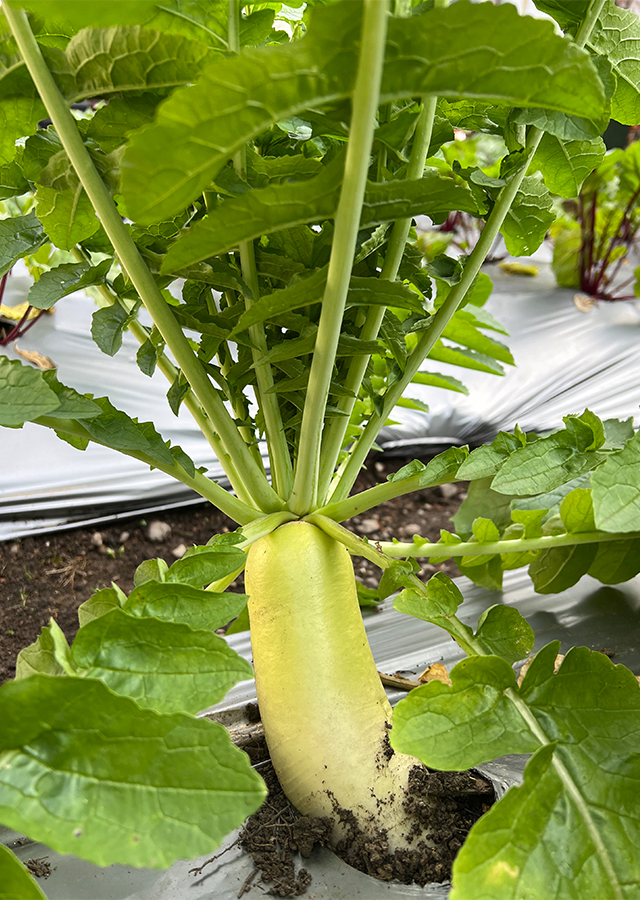
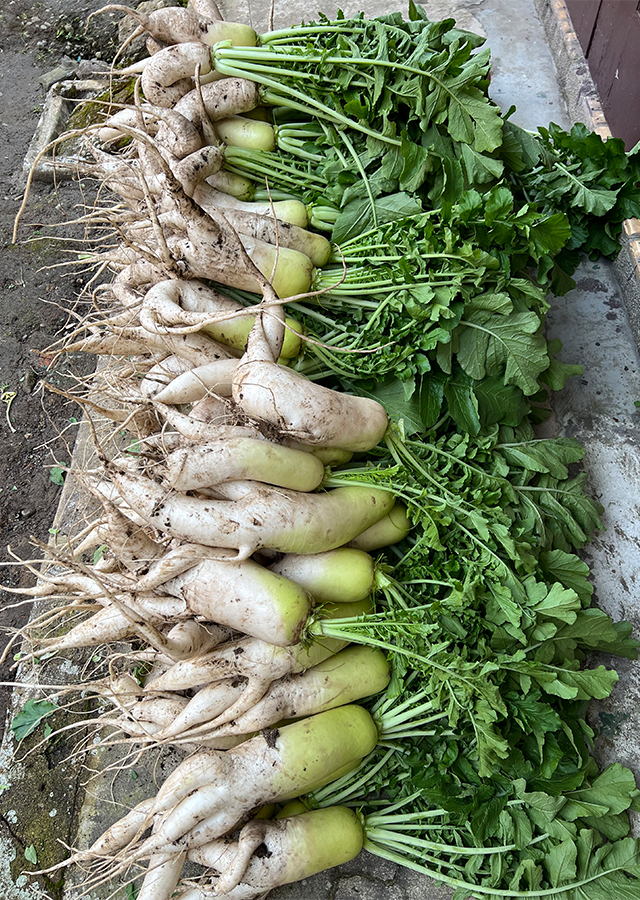
- Roots a taproot, fleshy, with root hairs present. The upper part of the taproot and hypocotyl become swollen and form a cylindrical tuber, white to red, tapering or narrowing at the tip, highly variable in shape and size. Has a mild taste and crisp texture.
- Leaves alternate, green, unifoliate, hairless or with a few stiff hairs, the lower ones in a basal rosette. Lower leaves oblong (elongated), oblong-ovate (elongated to egg-shaped) to lyrate-pinnatifid (blade divided into lobes forming a feather-like pattern with the largest lobe at the tip), higher leaves much smaller, short-stalked, margin more or less dentate.
- Flowers bisexual, fragrant, white to light purple with purple veins. Sepals free, 4-lobed, oblong-linear. Petals free, 4-lobed, spatulate shaped, blunt to rounded at the tip. Stamens 6, 4 long and 2 short, ovary superior. Inflorescence a terminal raceme, upright, long, many-flowered.
- Fruit cylindrical, consisting of 2-several stacked segments, the lower segment very short and seedless, the upper part much larger, and divided into 2-12 single-seeded compartments, indehiscent, with a long seedless beak.
- Seeds ovoid-globose, 3 mm in diameter, yellowish in color.
Cultivation
- Propagation is done generatively using seed.
- Radish seeds take about 4-10 days to germinate, at a temperature of 20-30°C. Plants are harvested within 30-50 days after sowing.
Chemical Content
Alkaloids (pyrrolidine, phenethylamine, N-methylphenethylamine, 1,2-pyrrolidine-thion-3-yl-3-carboxylic acid-1,2,3,4-tetrahydro-ß-carboline, and sinapine), flavonoids (kaempferol, kaempferol 3-O-α-arabinopyranoside, kaempferol 3-O-α-rhamnopyranoside, kaempferol 3-O-β-glucopyranoside-7-O-α-rhamnopyranoside, kaempferol 3-O-α-rhamnopyranoside-7-O-β-glucopyranoside, kaempferol 3,7-di-O-α-rhamnopyranoside, kaempferol 3-O-(2′′−β-glucopyranosyl)-α-rhamnopyranoside-7-O-α-rhamnopyranoside, quercetin 3-O-α-rhamnopyranoside-7-O-α-arabinopyranoside, quercetin 3-O-β-glucopyranoside-7-O-α-rhamnopyranoside, quercetin 3-O-α-rhamnopyranoside-7-O-β-glucopyranoside), glycosides, cardiac glycosides, tannins, saponins, amino acids, terpenoids, steroids, coumarins, phenolic compounds, raphanol, rettichol, essential oil, methylmercaptan, sulfuric acid, erucic acid, four main organic acids (oxalic, malic, malonic, and erythorbic acid), ascorbic acid.
Benefits
Treats asthma, liver disorders, bronchitis, cough, burns, bruises, diarrhea, stomach ache, hemorrhoids, gastric cancer, treats foot odor, increases urine flow and eases bowel movements, expels intestinal gas, reduces fever, heals kidney stones and gallstones, boosts breast milk. Has laxative, diuretic, antiscorbutic, and antitumor properties.
Simplisia
- Prepare radish root, wash clean with running water.
- Cut the radish into pieces to make it easier to dry.
- Dry under the sun or with an oven at 40°C until the moisture content reaches 10%.
- Grind using a blender until it becomes powder.
- Store in a clean, airtight container.
Local Names
Informasi tidak ditemukan. Butuh penelusuran lebih lanjut.
Traditional Recipes
The following recipes reflect traditional knowledge passed down through generations, not a substitute for professional medical diagnosis or advice. Consult a healthcare provider before use.
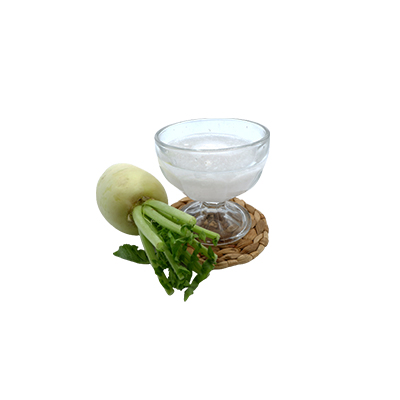
1. Expels intestinal gas
- Prepare an adequate amount of radish root then peel it.
- Wash the peeled radish.
- Grate or blend, adding an adequate amount of water.
- Strain then drink.
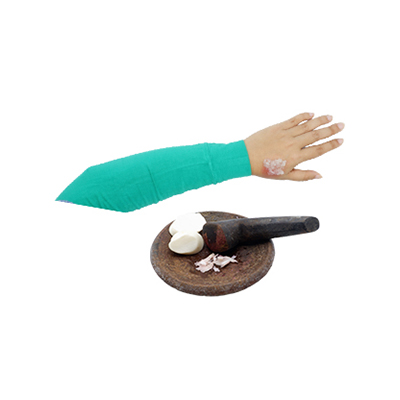
2. Burns
- Wash the peeled radish root clean.
- Grind until it becomes a paste.
- Apply the paste as a poultice on the burned skin.
Reference Sources
- Royal Botanic Gardens. 2021. Plants of the World Online: Raphanus raphanistrum subsp. sativus. https://powo.science.kew.org/taxon/urn:lsid:ipni.org:names:77159305-1. 20-21-2021.
- Flora Fauna Web. 2021. Raphanus raphanistrum subsp. sativus cultivar [White Oriental Radish]. https://www.nparks.gov.sg/florafaunaweb/flora/3/3/3336. 20-12-2021.
- PROTA4U. Raphanus sativus L. https://www.prota4u.org/database/protav8.asp?h=M6&t=radish%E2%80%99&p=Raphanus+sativus. 20-12-2021.
- CAB International. 2021. Invasive Species Compendium. Raphanus sativus (radish). https://www.cabi.org/isc/datasheet/46796#toPictures. 20-12-2021.
- Stuartxchange. 2019. Labanos. http://www.stuartxchange.com/Labanos.html. 20-12-2021.
- Nurwijayo W. 2021. Cara Menanam Lobak Putih Di Polybag, Hasilkan Kualitas Ekspor. https://gdm.id/cara-menanam-lobak/. 20-12-2021.