Rauvolfia serpentina (L.) Benth. ex Kurz
Summary
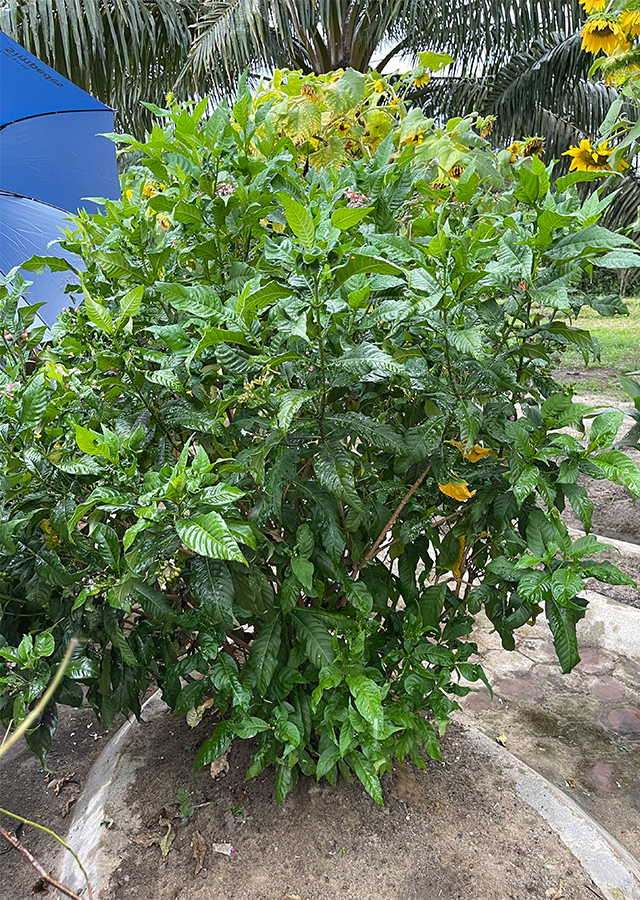
Pule pandak (Rauvolfia serpentina) is an upright shrub up to 1 meter tall from the Apocynaceae family, distributed from Bangladesh to Vietnam, concentrated on the island of Java in Indonesia. In 1949, more than 90% of Indian doctors used this plant to treat hypertension, making it an important source of compounds for the pharmaceutical industry. Pule pandak is not recommended for pregnant women because it is traditionally used to stimulate uterine contractions.
Agroecology
Pule pandak is commonly found growing wild in fields, teak forests, or mountains. This species is a tropical plant and can grow well from lowlands up to an elevation of 1,000 m asl. This species is tolerant of various agroclimates, from wet regions such as West Java to extremely dry regions such as East Nusa Tenggara. It grows best in areas where the mean annual daytime temperature is in the range of 22-30°C, but can tolerate 4-35°C, and mean annual rainfall in the range of 1,500-3,500 mm, but tolerates 1,100-4,500 mm. This species prefers locations in full sun as well as shaded locations. Suitable in fertile, well-drained loamy soil, with soil acidity (pH) in the range of 5.5-7, but can tolerate 5-7.5.
Morphology
- Roots tuberous with pale brown cork. Root shape is coiled when planted in a pot, while in open areas the roots grow straight like a rat's tail. Root surface rough. At each root branching, fine roots (root hairs) grow.
- Stem usually unbranched, cylindrical, slender, branches grayish-brown and young stems green, exuding sap.
- Leaves large, single (unifoliate), short-petioled, positioned opposite, lanceolate-elliptic, about 3-20 cm long and 2-9 cm wide, in whorls of three. Upper leaf surface bright green and smooth while the lower surface pale green and smooth. Leaf margin entire, tip acuminate and base cuneate, veins pinnate.
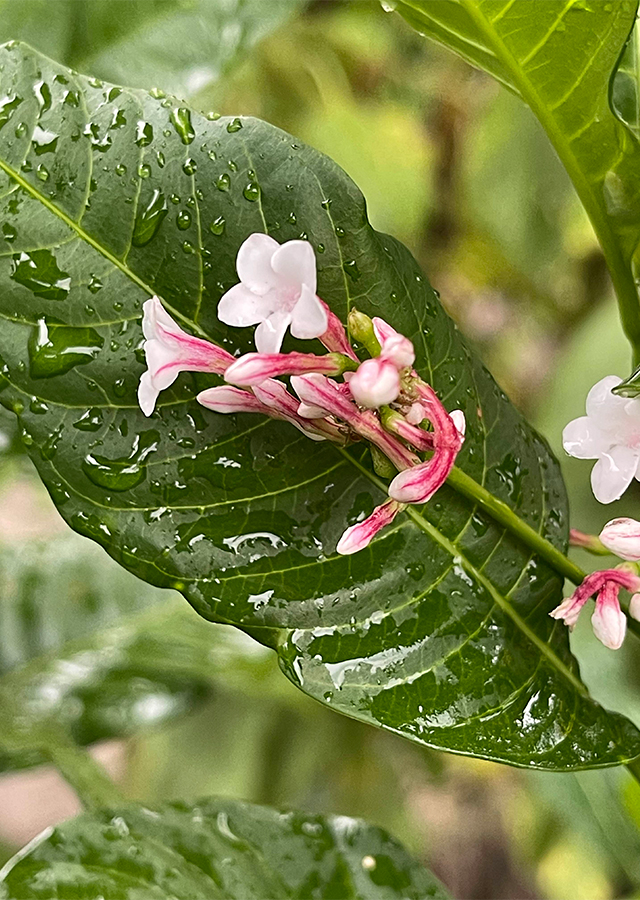
- Flowers compound, with green flower stalks. Calyx has lanceolate lobes. Flower tube purplish-red, slender, tube length between 1-1.5 cm. Petals 5, white, lobes elliptic-oblong. Inflorescence umbellate, emerging from the tip of the stalk. Number of flowers per stalk reaches 25-35 flowers. Flowers bloom gradually, starting with the outermost flowers.
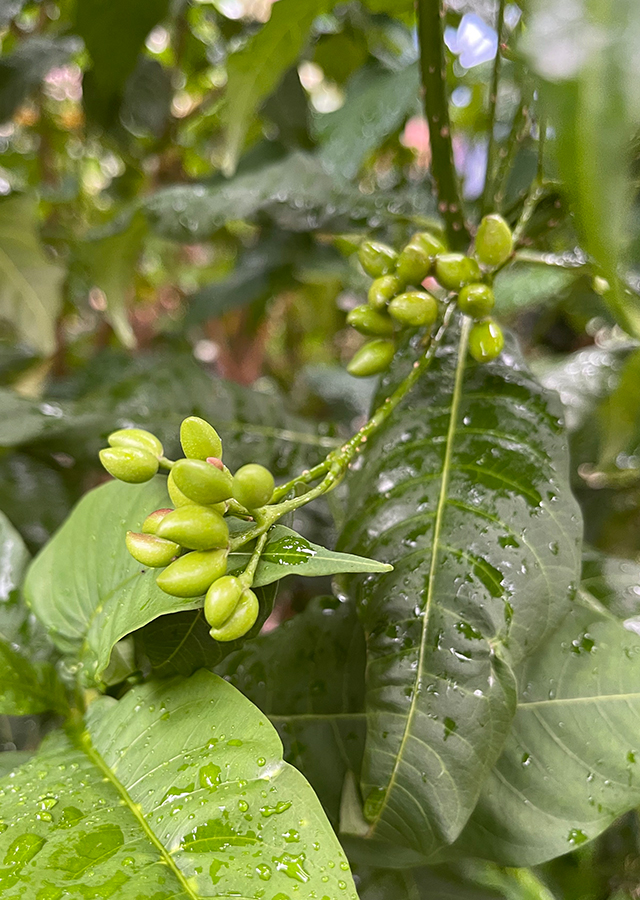
- Fruit a drupe type, ovoid, seeded, small, glossy, fleshy, young fruit green turning blackish-purple when ripe. Number of fruits per stalk reaches 10-20.
- Seeds one per fruit, small.
Cultivation
- Propagation is generative (seed) and vegetative (layering, root cuttings, tissue culture).
- Propagation through seed requires sowing as soon as possible, as the seed's dormancy period is very short.
- Pule pandak can be harvested at 1 year of age after planting. Ideally, the roots of pule pandak are harvested between 3-5 years of age, to obtain optimum alkaloid content.
Chemical Content
Indole alkaloids (ajmalidine, ajmaline, ajmalinine, ajmalicine, aricine, canescine, coryanthine, deserpidine, isoajmaline, isoserine, isoserpiline, lankanescine, neoajmaline, papaverine, raubasine, raucaffricine, rauhimbine, rauwolfinine, recanescine, rescinnamine, reserpiline, reserpine, reserpinine, sarpagine, serpentine, serpentinine, thebaine, yohimbine, and yohimbinine), flavonoids, glycosides, cardiac glycosides, phlobatannin, resin, saponins, steroids, tannins, triterpenoids, phenols, phytosterols, oleoresin.
Benefits
Treats hypertension, an antidote for stings and bites from venomous insects and reptiles, mental disorders (as a sedative), schizophrenia, impotence, removes clouding of the eye cornea, reduces heat or fever, treats intestinal pain, stimulates uterine contractions, addresses insomnia, treats headaches, sore throat, lower back pain, toothache, abdominal pain, influenza, epilepsy, acute hepatitis, malaria, diarrhea, hernia, cholera, colic, goiter (hyperthyroid), boils, scabies, wounds, bruises, and itching.
Simplisia
- Prepare pule pandak roots, wash clean with running water then drain.
- Dry under direct sunlight for several days or with an oven at 40°C until the moisture content reaches 10%.
- Store the simplicia in plastic or a clean, airtight container.
Local Names
Akar tikus, Pulai pandak (Jawa), Akar ular.
Traditional Recipes
The following recipes reflect traditional knowledge passed down through generations, not a substitute for professional medical diagnosis or advice. Consult a healthcare provider before use.
1. Influenza
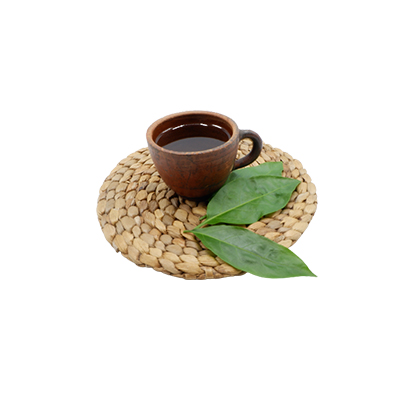
- Take 25 g of fresh pule pandak leaves and wash until clean.
- Boil with 3 glasses of water until 1 glass of water remains.
- Let it cool then strain.
- Drink.
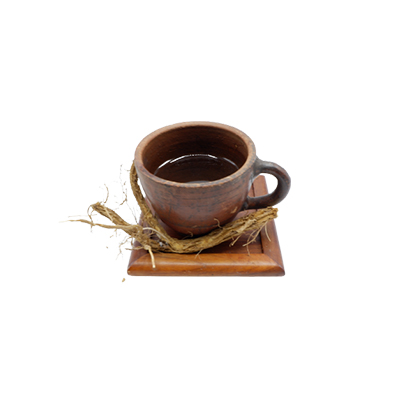
2. Headache
- Prepare 10-15 g of pule pandak root and wash until clean.
- Boil with 3 glasses of water until 1 glass of water remains.
- Let it cool then strain.
- Drink twice, morning and evening, ½ glass each time
Reference Sources
- Royal Botanic Garden. Plant of the World Online: Rauvolfia serpentina (L.) Benth. ex Kurz. https://powo.science.kew.org/taxon/urn:lsid:ipni.org:names:81648-1. 07-03-2022.
- Stuartxchange. 2018. Philippine Medicinal Plants: Serpentina. http://www.stuartxchange.org/Serpentina.html. 07-03-2022.
- Flora Fauna Web. 2020. Rauvolfia serpentina (L.) Benth. ex Kurz. https://www.nparks.gov.sg/florafaunaweb/flora/5/8/5894. 07-03-2022.
- Tropical Plants Database, Ken Fern. 2021. Rauvolfia serpentina. https://tropical.theferns.info/viewtropical.php?id=Rauvolfia+serpentina. 07-03-2022.
- Abhijit Dey, J.N. De. 2010. Rauvolfia serpentina (L.) Benth. ex Kurz.-A Review. Asian Journal of Plant Sciences, 9(6): 285-298.
- Haryudin W. 2013. Manfaat Pule Pandak (Rauvolfia serpentina) sebagai Tanaman Obat. Warta Penelitian dan Pengembangan Tanaman Industri, 19(3): 21-24.