Ruscus hypophyllum L.
Summary
Ruskus (Ruscus hypophyllum) is a shrub up to 0.42 meters tall from the Asparagaceae family native to the Mediterranean, popular as a long-lasting filler in flower arrangements. In Palestine, its rhizome extract is traditionally used to treat skin diseases, while in Turkey its decoction is drunk for eczema and kidney stones. In some regions of Italy, ruskus is also used to treat diarrhea.
Agroecology
Ruscus hypophyllum prefers clay soil, rich in nitrogen and with a C/N ratio higher than 10. Its preferred soil has an acidic pH (3.3-7.3). In Kroumirie, Ruscus hypophyllum is rarely found above an elevation of 650 m, mostly between 50 and 650 m, with a maximum around 450 m. This species has an affinity for low slopes (0-10%). The growing medium used is a mixture of soil and humus in a 2:1 ratio. This plant is also resistant to seasonal changes, tolerant of both the rainy and dry seasons. Drought-resistant.
Morphology
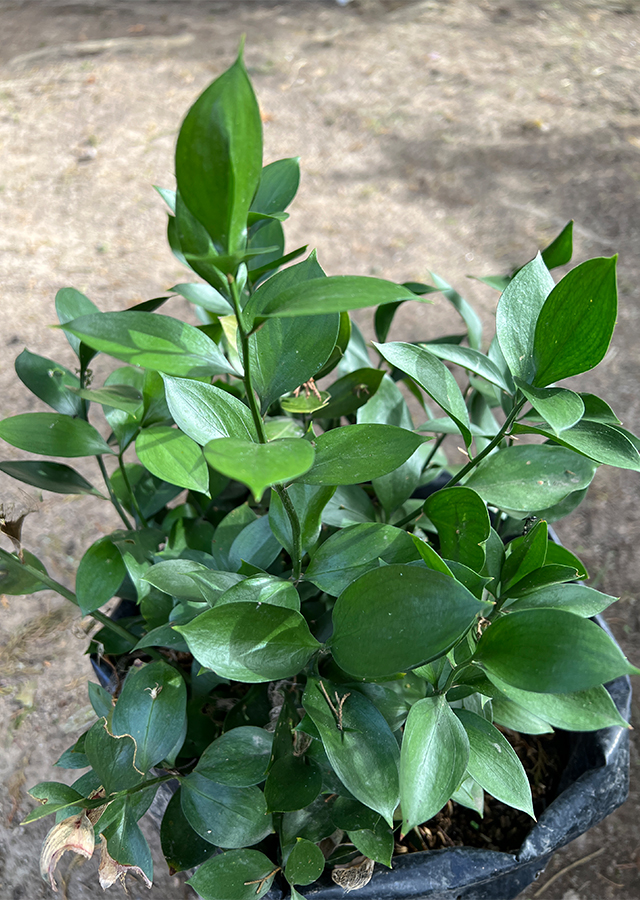
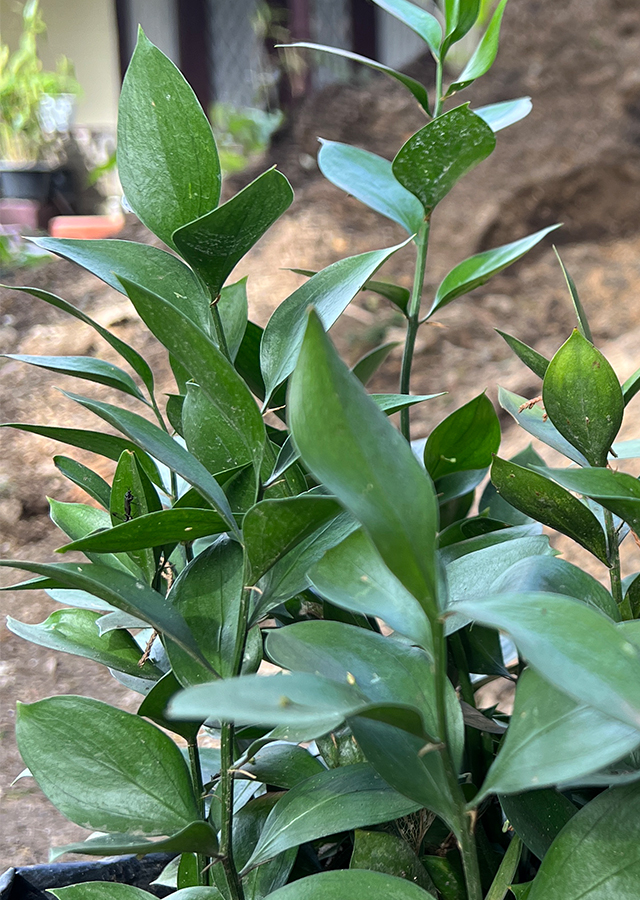
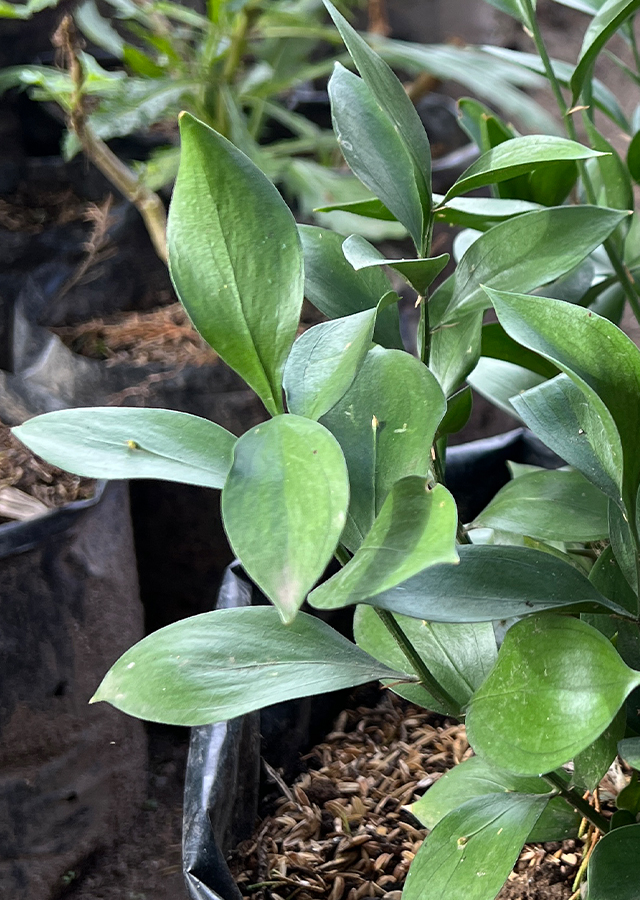
- Rhizome creeping, thick, sympodially branching to form an oval pyramidal shrub. Stems appear striated, green, upright, and much-branched, growing up to 1 m tall.
- Leaves reduced to triangular scales up to 5 mm and functionally replaced by rigid cladodes (flattened leaf-like stem tissue also known as phylloclades) 2-18 cm long and 1-8 cm wide, each arising from a leaf axil; cladodes ovate, entire, dark green, and pointed.
- Flowers small, arising from the axil of a small bract at the center of the upper cladode surface, each with a short pedicel. Perianth greenish white, about 3 mm long, and consisting of two whorls of three papillate segments. In this species, male and female plants are very similar in appearance; female flowers show a cup formed from stamen filaments fused around a superior unilocular ovary, which has a subsessile capitate stigma, while male flowers have three stamens and green or purple filaments fused into a tube around an undeveloped ovary.
- Fruit a round, bright red berry, 8-14 mm in diameter, with 1-4 large seeds.
Cultivation
Conventionally, R. hypophyllum is propagated using seed, cuttings, and rhizome division. Ruskus can also be propagated using tissue culture techniques.
Chemical Content
Steroidal glycosides, namely (23S,25R)-23-hydroxyspirost-5-en-3 beta-yl O-alpha-L-rhamnopyranosyl-(1→4)-beta-D-glucopyranoside (1), 1 beta-hydroxyspirosta-5,25(27)-dien-3-beta-yl O-alpha-L-rhamnopyranosyl-(1→4)-beta-D-glucopyranoside (2), (22S)-16 beta,22-dihydroxycholest-5-en-3 beta-yl O-alpha-L-rhamnopyranosyl-(1→4)-beta-D-glucopyranoside (3), (22S)-16 beta-[(beta-D-glucopyranosyl)oxy]-22-hydroxycholest-5-en-3 beta-yl O-alpha-L-rhamnopyranosyl-(1→4)-beta-D-glucopyranoside (4), (22S)-16 beta-[(beta-D-glucopyranosyl)oxy]-22-hydroxycholest-5-en-3 beta-yl beta-D-glucopyranoside (5), (22S)-16 beta-[(beta-D-glucopyranosyl)oxy]-3 beta,22-dihydroxycholest-5-en-1 beta-yl O-alpha-L-rhamnopyranosyl-(1→2)-(3,4-di-O-acetyl-beta-D-xylopyranoside) (6), and (22S)-16 beta-[(beta-D-glucopyranosyl)oxy]-3 beta,22-dihydroxycholest-5-en-1 beta-yl O-alpha-L-rhamnopyranosyl(1→2)-O-[beta-D-xylopyranosyl-(1→3)]-beta-D-xylopyranoside (7). Spirostanol saponins (1-5) including new saponin (4), and nine furostanol saponins (6-14) including three new saponins (9-11), along with a known cholestane glycoside (15) and a new cholestane glycoside (16).
Benefits
Treats skin diseases, warts and hives, treats eczema, kidney stones, nephritis, and diarrhea.
Local Names
Informasi tidak ditemukan. Butuh penelusuran lebih lanjut.
Traditional Recipes
The following recipes reflect traditional knowledge passed down through generations, not a substitute for professional medical diagnosis or advice. Consult a healthcare provider before use.

1. Treats kidney stones
- Prepare ruskus rhizome and wash until clean.
- Boil until it boils.
- Let it cool to warm/cold.
- Strain then drink to treat kidney problems.
2. Treats itching
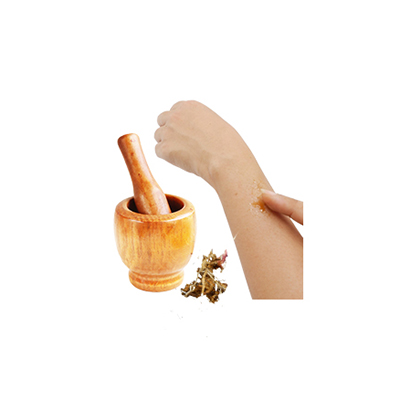
- Prepare ruskus rhizome and wash until clean.
- Grind until it becomes a paste.
- Squeeze to extract the liquid.
- Apply to treat itchy skin.
Reference Sources
- Royal Botanic Gardens. Plants of the World Online: Ruscus hypophyllum L.. https://powo.science.kew.org/taxon/urn:lsid:ipni.org:names:540453-1 05-03-2022.
- Mimaki Y, Aoki T, Jitsuno M, Kilic CS, Coskun M. Steroidal glycosides from the rhizomes of Ruscus hypophyllum. Phytochemistry 2008; 69: 729–737
- Mimaki Y, Aoki T, Jitsuno M, Yokosuka A, Kilic CS, Coskun M. Steroidal saponins from the rhizomes of Ruscus hypophyllum. Nat Prod Commun 2008; 3: 1671–1678
- Agus Purwito, Prima Muklisa, dan Awang Maharijaya. 2005. Perbanyakan Ruskus (Ruscus hypophyllum L.) secara In Vitro In Vitro Propagation of Ruscus ( Ruscus hypophyllum). Bul. Agron. (33) (2) 39 – 45 (2005).
- Jdaidi Nouri, Aloui Foued, Selmi Houcine, Chaabane Abbees 2021. Characterization of the central and marginal ecological habitat of a rare medicinal species in Tunisia: Case of Ruscus hypophyllum L. International Journal of Phytology Reseach 2021. 1(1) :22-26. https://www.researchgate.net/publication/354375045_Characterization_of_the_central_and_marginal_ecological_habitat_of_a_rare_medicinal_species_in_Tunisia_Case_of_Ruscus_hypophyllum_L. 05-03-2022.
- National Museum of Natural History. Ruscus hypophyllum L. https://eol.org/pages/1082041/articles. 05-03-2022.