Saribus rotundifolius (Lam.) Blume
Summary
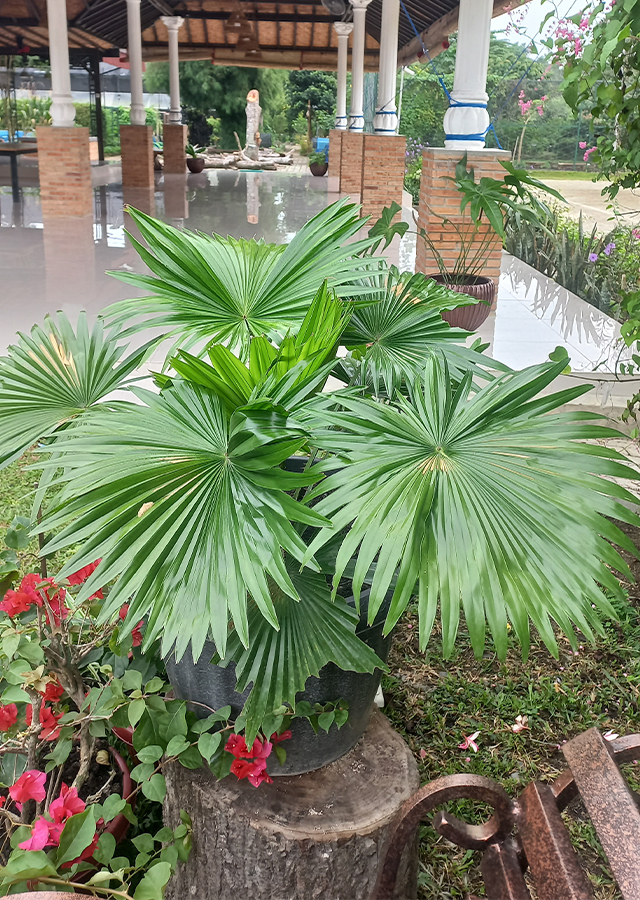
Saribus rotundifolius or palem sadeng is a palm native to Southeast Asia found in the Philippines, Sabah, and several islands in Indonesia, and is now popular as a landscape plant thanks to its attractive leaf and fruit shapes. Beyond its ornamental function, its leaves and trunk are used as roofing material, house posts, and crafts, while its shoots are a popular vegetable. The Benguet people in the Philippines also traditionally use its leaves as a poultice to treat fresh wounds.
Agroecology
Palem sadeng can be found abundantly in swamp forests, seasonally dry swamp forests, mangrove fringes, rainforests, secondary forests, moist evergreen forests, along rivers, at elevations up to 300 m asl. This species can only be cultivated in tropical and subtropical climates, as it cannot withstand near-freezing temperatures except for a very short time. Palem sadeng prefers sunny locations, but also does well in shade with some direct sunlight, though young specimens require partially shaded conditions. Its growth is very suited to fertile loamy soil, but can adapt to various well-drained soil types, including clay and sand, with alkaline or acidic soil pH. This species also prefers evenly moist media that is not consistently wet. Palem sadeng is fairly resistant to damage but not tolerant of strong winds.
Morphology
- Roots fibrous.
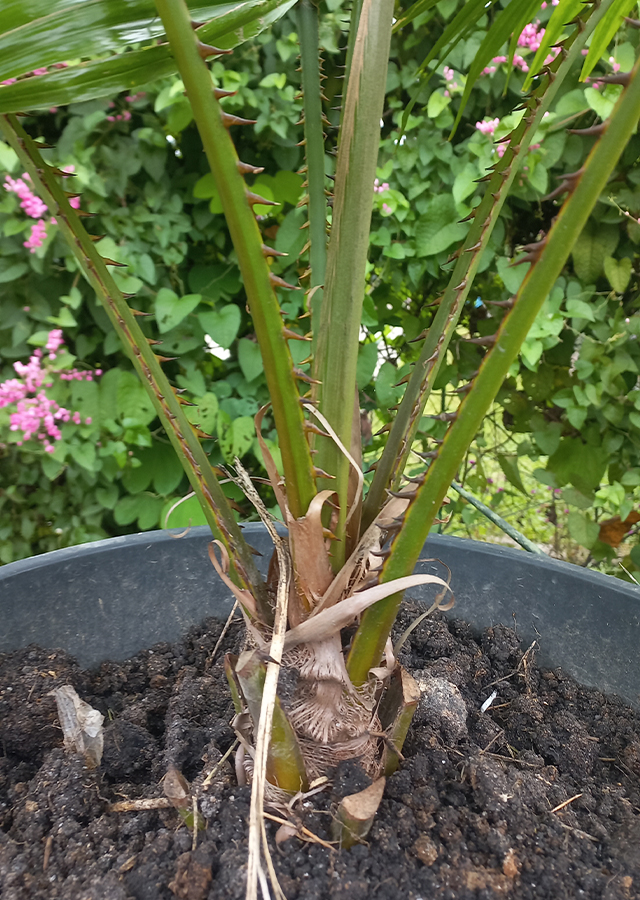
- Trunk single, straight, smooth, slender with a diameter of about 20-25 cm, brown, bearing prominent leaf scars, and covered with a beautiful grayish woven fiber at the top, below the crown. Topped by a crown of 20-50 leaves.
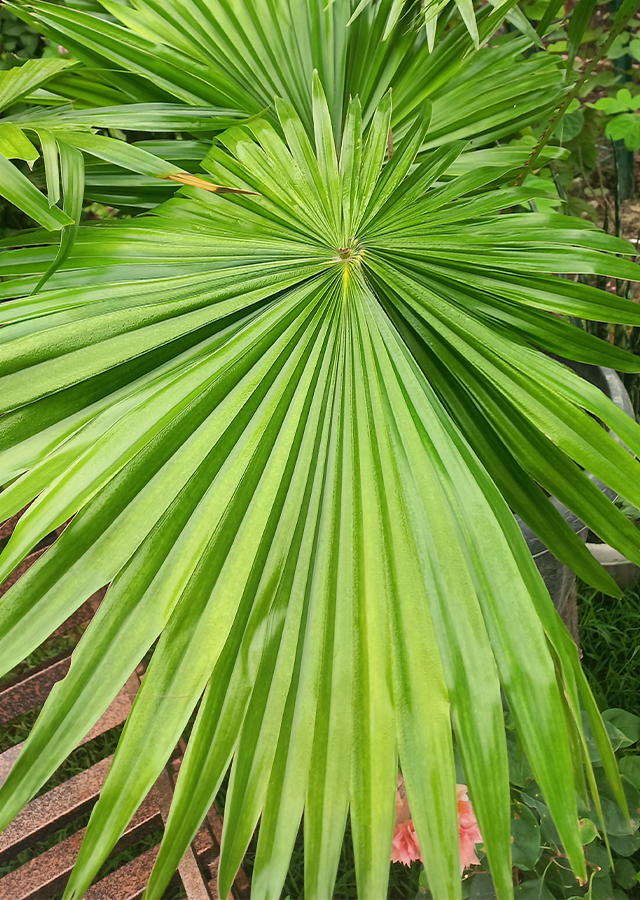
- Leaves palmate (fan-shaped compound leaves) arranged spirally, blade nearly round fan-shaped, medium to large in size, glossy green, divided into many linear, stiff, folded lobes, becoming more divided with age. A spiny petiole (at the base of the lower surface in young plants) supports the leaf blade, long, and slightly curved.
- Flowers small, yellow, bisexual. Inflorescence long-stalked, about 0.9-1.2 m long, divided into 3 main axes bearing up to 4 branchings. Flower panicle cream-colored.
- Fruit seeded, small, globose to subglobose shaped, about 11-25 mm in diameter with a very thin flesh layer, fruit bright orange-red to red and turning black when ripe.
- Seeds hard, round, brown.
Cultivation
- Plant propagation is done through seed. Fresh seeds, if kept warm, can germinate easily within 2 months after sowing.
- Flower pollination is assisted by bees.
Chemical Content
Saponins, phlobatannin, tannins, anthraquinones, cardiac glycosides, terpenes, alkaloids, flavonoids, deoxysugars, phenols.
Benefits
Treats fresh wounds and diarrhea. Has antioxidant and antibacterial activity.
Local Names
Palem serdang, Palem kipas, Telapak kaki bangku.
Traditional Recipes
The following recipes reflect traditional knowledge passed down through generations, not a substitute for professional medical diagnosis or advice. Consult a healthcare provider before use.
1. Fresh wounds
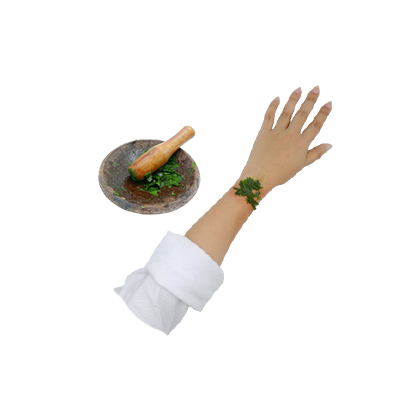
- Prepare an adequate amount of fresh palem sadeng leaves and wash until clean with running water.
- Grind until it becomes a paste.
- Apply the leaf paste to the fresh wound.
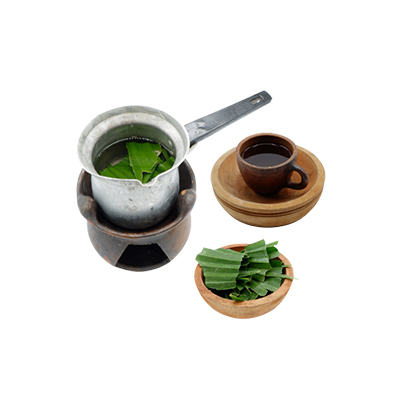
2. Diarrhea
- Prepare an adequate amount of fresh palem sadeng leaves and wash until clean with running water.
- Boil the leaves until it boils.
- Let it cool to warm/cold.
- Strain then drink to treat diarrhea.
Reference Sources
- Royal Botanic Gardens. Plants of the World Online: Saribus rotundifolius (Lam.) Blume. https://powo.science.kew.org/taxon/urn:lsid:ipni.org:names:669832-1. 18-04-2022.
- Stuartxchange. 2019. Philippine Medicinal Plants: Anahaw. http://www.stuartxchange.org/Anahaw. 18-04-2022.
- Tropical Plants Database, Ken Fern. 2021. Saribus rotundifolius. http://tropical.theferns.info/viewtropical.php?id=Saribus+rotundifolius. 18-04-2022.
- Flora Fauna Web. 2021. Saribus rotundifolius (Lam.) Blume. https://www.nparks.gov.sg/FloraFaunaWeb/Flora/2/6/2653. 18-04-2022.
- LLIFLE - Encyclopedia of living forms. 2022. The Encyclopedia of PALMS & CYCADS: Saribus rotundifolius (Lamarck) Blume. http://www.llifle.com/Encyclopedia/PALMS_AND_CYCADS/Family/Arecaceae/24542/Saribus_rotundifolius. 18-04-2022.