Selaginella kraussiana (Kunze) A.Braun
Summary
Selaginella kraussiana is native to the Macaronesia region, South Africa, and other tropical areas, its species name commemorating German naturalist Christian Ferdinand Friedrich von Krauss, who collected thousands of plant species during his travels in South Africa. Thriving in moist tropical biomes, various Selaginella species including this one have been used by humans since ancient times as food, medicine, handicraft material, and ornaments across different parts of the world.
Agroecology
Selaginella kraussiana prefers shade to full shade and fertile, acidic soil, moist but well-drained. Do not let the soil dry out between waterings, or plant it in conditions that are constantly waterlogged, which can cause crown rot. Prefers high humidity, sometimes misting, and growing the plant in a terrarium if used in an air-conditioned area. Too low humidity makes the plant prone to browning or blistered leaves.
Morphology
- Rhizophores at intervals along the creeping stem and branches, on the dorsal side in the axils of the stem branches.
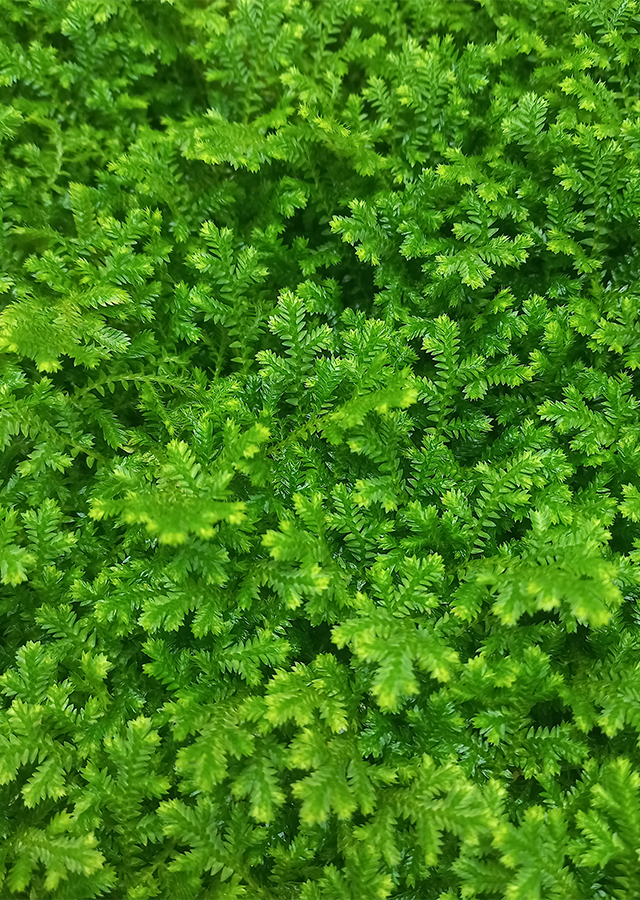
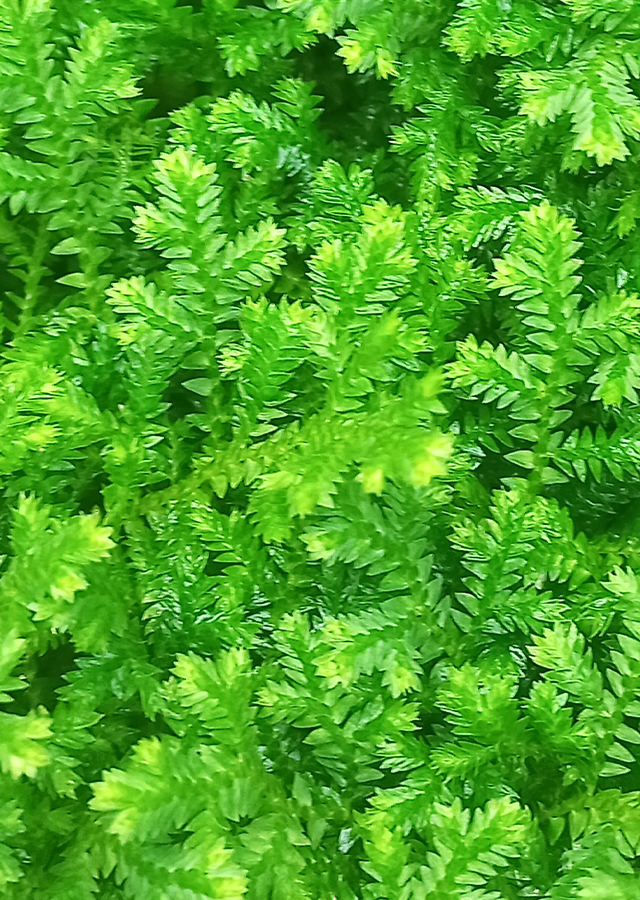
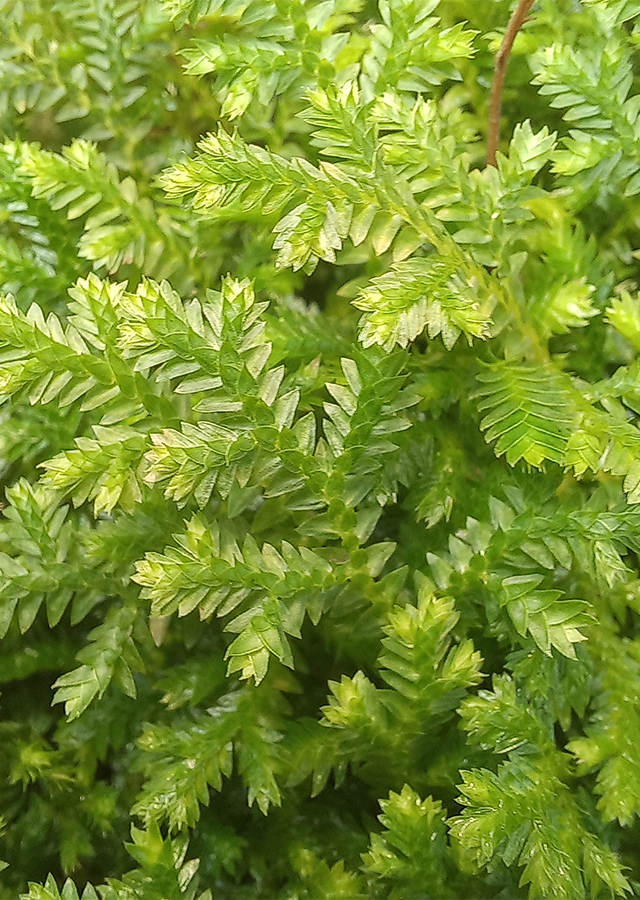
- Main stem branching throughout, not very regularly pinnately branched, slightly articulated, striate, 0.6-1.2 mm in diameter at the lower part, subquadrangular or angulate, sulcate, hairless, with 3 vascular bundles; primary leafy branches 10-20 pairs, 2 or 3 times pinnately branched, sub-branches sparse or irregular, primary branches adjacent on the main stem 2-5 cm apart, final branches 3-6 mm wide including leaves.
- Leaves: axillary leaves on the main stem not clearly larger than on the branches, oblong-elliptic, base not peltate, obtuse; axillary leaves on branches symmetric, oblong-elliptic, 2.3-3.8 × 1-2 mm, base exauriculate (obtuse), margin denticulate. Dorsal leaves asymmetric, on branches approximate or not, broadly elliptic-lanceolate, 2.1-2.8 × 0.6-1 mm, not carinate or slightly carinate, base oblique, slightly uniauriculate (on the outer side), not peltate, margin denticulate, tip acuminate. Ventral leaves asymmetric, those on the main stem clearly not larger than those on the branches; ventral leaves on branches distant, spreading, ovate-elliptic, 2.4-4 × 1.2-1.8 mm, margin denticulate, tip acute; acroscopic base not enlarged. Fertile branches erect.
- Strobili solitary, terminal and lateral on branches, compact, tetragonal, 3-4 × ca. 1 mm. Sporophylls uniform, not white-margined, ovate-lanceolate, margin denticulate, tip acuminate. The lower side of the strobilus with only 1 megasporophyll at the base, elsewhere with microsporophylls. Microsporangia elliptic-oblong, with relatively large cells in the middle part. Microspores echinate, 25-36 µm, megaspores cristate-reticulate, 400-1100 µm.
Cultivation
Propagated with leafy stem cuttings, layering, division, and spores.
Chemical Content
The most common flavonoids are amentoflavone and robustaflavone.
Benefits
Selaginella kraussiana has potential and shows activity as an antitumor, antimalarial, antiallergic, antithrombotic, anti-inflammatory, antihypertensive, antibacterial, antioxidant, antihepatotoxic, estrogenic, and antiviral agent.
Local Names
Information not found. Further research is needed.
Reference Sources
- Royal Botanic Gardens, Kew. Plants of the World Online: Selaginella kraussiana (Kunze) A.Braun. https://powo.science.kew.org/taxon/urn:lsid:ipni.org:names:90781-3#synonyms. 07-09-2022.
- Flora Fauna Web. 2022. Selaginella kraussiana (Kunze) A. Braun 'Brownii'. https://www.nparks.gov.sg/florafaunaweb/flora/3/7/3752. 07-09-2022.
- Flora of China. Selaginella kraussiana (Kunze) A. Braun. http://www.efloras.org/florataxon.aspx?flora_id=2&taxon_id=200002794. 07-09-2022.
- Adnan M., dkk. 2021. Evidence-Based Medicinal Potential and Possible Role of Selaginella in the Prevention of Modern Chronic Diseases: Ethnopharmacological and Ethnobotanical Perspective. ACG Publications. Rec. Nat. Prod. X:X (2021) XX-XX. DOI: http://doi.org/10.25135/rnp.222.20.11.1890.