Selaginella willdenowii (Desv.) Baker
Summary
Selaginella willdenowii or peacock fern is widely distributed from the Andaman Islands to China, Southeast Asia, and has been introduced to various other tropical regions such as Colombia and Florida. Its young leaves can be eaten as a vegetable, while in several Asian countries this plant is used as traditional medicine for wounds, high fever, and menstrual pain, in line with research findings on its antioxidant and anticancer activity.
Agroecology
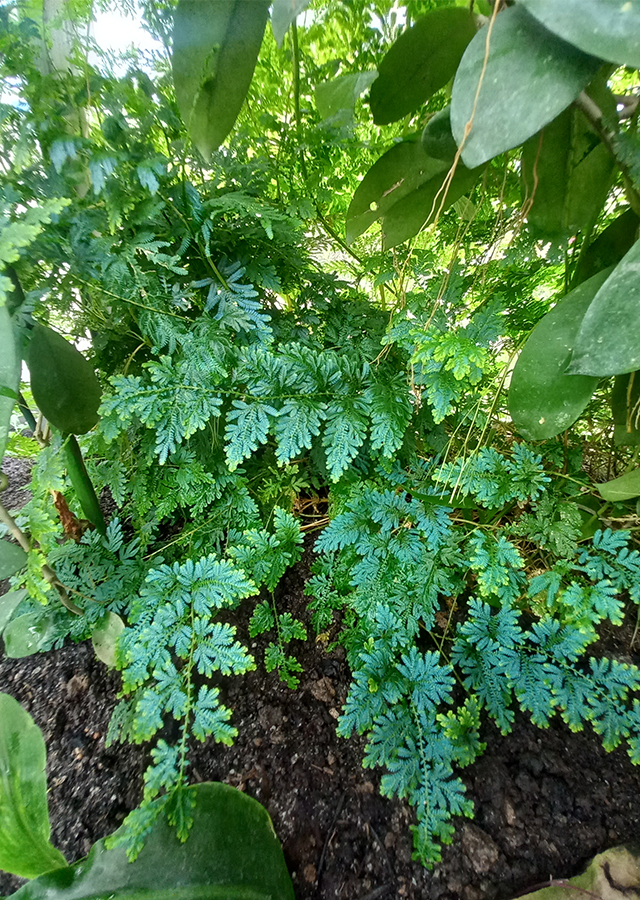
Peacock fern is commonly found in forests at elevations of 100-1,000 m asl with high humidity, in semi-shaded or partially to fully shaded conditions.
Morphology
- Rhizophores restricted to the lower part of the main stem or up to the upper part, with a few spine-like protrusions at the base (also on the stem axis).
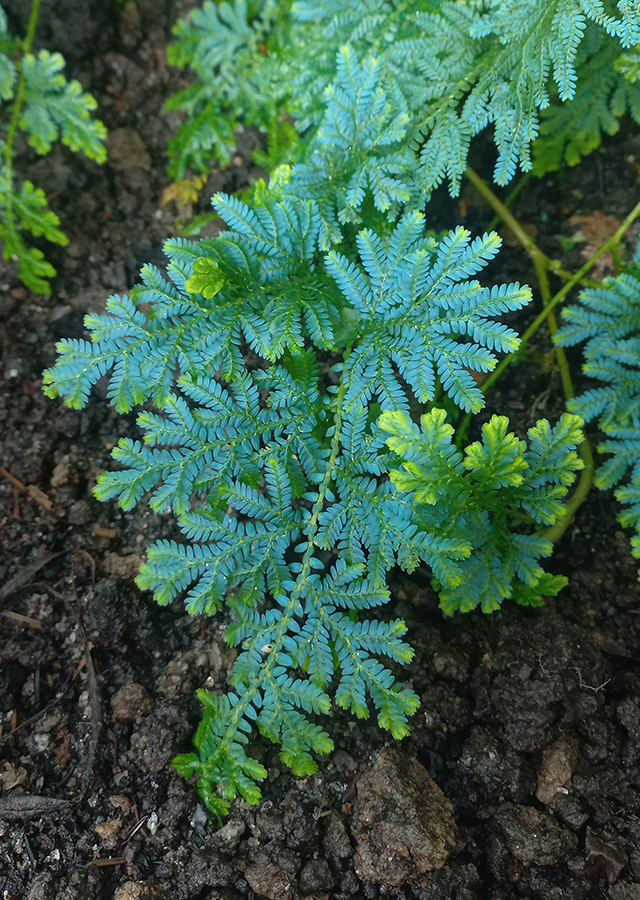
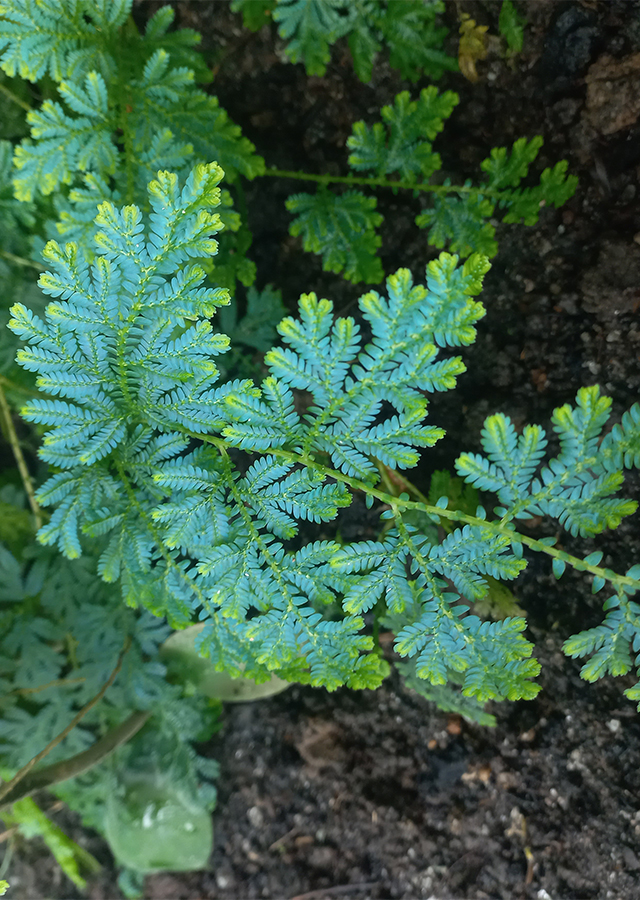
- Main stem branching from near the base upward, striate or reddish, 2.4-3.5 mm in diameter at the lower part, angled, sulcate, hairless. Primary leafy branches 5-15 pairs, 3 times pinnately branched, final branches simple or branched, branches sparse and regular, primary branches adjacent on the main stem 6-13 cm apart, final branches 3-7 mm wide including leaves.
- Leaves, where the axillary leaves on the main stem are clearly larger than on the branches, oblong, biauriculate (auricle larger than in Selaginella helferi). Axillary leaves on branches symmetric, oblong or oblong-elliptic, 1.5-2.4 × 1-1.6 mm, base biauriculate, margin entire. Dorsal leaves asymmetric, those on the main stem clearly larger than those on the branches. Dorsal leaves on branches nearly imbricate, overlapping at the leaf tip, falcate, 0.9-1.4 × 0.4-0.6 mm, not carinate, base obliquely subcordate, margin entire, tip obtuse cuspidate. Ventral leaves asymmetric, those on the main stem clearly larger than those on the branches. Ventral leaves on branches slightly ascending or spreading, distant or approximate, oblong, 2.8-4 × 1-1.5 mm, margin entire, tip obtuse. Acroscopic base with a rounded auricle, stem and branches not overlapping.
- Strobili solitary, terminal, compact, tetragonal, 5-35 × 1.8-3.8 mm. Sporophylls unlike the sterile leaves, uniform, white-margined, suborbicular, margin entire, tip acute or cuspidate. Megasporophylls in the middle on the lower side of the strobilus. Microsporangia orbicular, rather thin, cells regular. Microspores pale yellow, megaspores whitish.
Cultivation
Propagated generatively using spores. Vegetatively using stem cuttings and separation of offshoots from the parent plant.
Chemical Content
Phenolics, alkaloids, terpenoids, and flavonoids, isocryptomerin, 4',7''-di-O-methyl-amentoflavone, bilobetin, 2'',3''-dihydro-isocryptomerin, robustaflavone, 7''-O-methyl-robustaflavone.
Benefits
Treats wounds, reduces high fever and relieves back pain, and is used as a tonic remedy, treats stomach pain and urinary tract infections, relieves menstrual pain and treats skin diseases such as itching and ringworm, addresses depurative needs and stomachache, a protective remedy after childbirth.
Local Names
Information not found. Further research is needed.
Traditional Recipes
The following recipes reflect traditional knowledge passed down through generations, not a substitute for professional medical diagnosis or advice. Consult a healthcare provider before use.
1. High fever
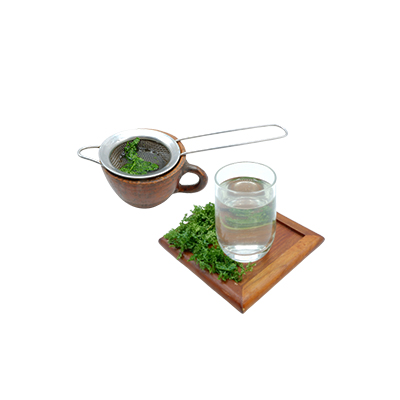
- Take an adequate amount of peacock fern leaves and wash until clean.
- Soak in water and wait for a while.
- Strain then drink.
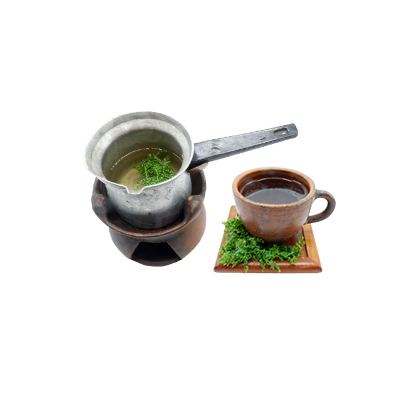
2. Urinary tract infection
- Prepare an adequate amount of peacock fern leaves and wash until clean.
- Boil until it boils.
- Let it cool to warm/cold.
- Strain then drink.
Reference Sources
- Royal Botanic Gardens, Kew. Plants of the World Online: Selaginella willdenowii (Desv.) Baker. https://powo.science.kew.org/taxon/urn:lsid:ipni.org:names:60471496-2#synonyms.19-08-2022.
- Flora Of China. Selaginella willdenowii. http://www.efloras.org/florataxon.aspx?flora_id=2&taxon_id=233501249. 19-08-2022.
- Flora Fauna Web. 2022. Selaginella willdenowii (Desv. ex Poir.) Bakerhttps://www.nparks.gov.sg/florafaunaweb/flora/1/5/1578. 19-08-2022.
- Setyawan AD. 2009. Traditionally utilization of Selaginella; field research and literature review. N U S A N T A R A B I O S C I E N C E ISSN: 2087-3948 Vol. 1, No. 3, pp. 146-158 E-ISSN: 2087-3956 November 2009 DOI: 10.13057/nusbiosci/n010307.
- Tsun-Thai Chai dan Fai-Chu Wong. 2012. Antioxidant properties of aqueous extracts of Selaginella willdenowii. Journal of Medicinal Plants Research Vol. 6(7), pp. 1289-1296, 23 February, 2012 Available online at http://www.academicjournals.org/JMPR DOI: 10.5897/JMPR11.1376 ISSN 1996-0875 ©2012 Academic Journals.
- Mohd Adnan. dkk. 2021. Evidence-Based Medicinal Potential and Possible Role of Selaginella in the Prevention of Modern Chronic Diseases: Ethnopharmacological and Ethnobotanical Perspective. ACG Publications. Rec. Nat. Prod. X:X (2021) XX-XX. DOI: http://doi.org/10.25135/rnp.222.20.11.1890.