Smilax leucophylla Blume
Summary
Canar (Smilax leucophylla) is a vine up to 10 meters long of the Smilacaceae family, distributed from Peninsular Malaysia to Papua and northern Australia. Its young shoots are commonly eaten as a vegetable, while its mature stems are used as a rattan substitute. Traditionally, canar is also believed to relieve rheumatism, skin diseases, and act as an antidote.
Agroecology
Grows optimally in dry soil, moist soil such as in dense forests, riverbanks, ravines and near the sea, at moderate elevations and adapted to areas with a pH of 4-6.2.
Morphology
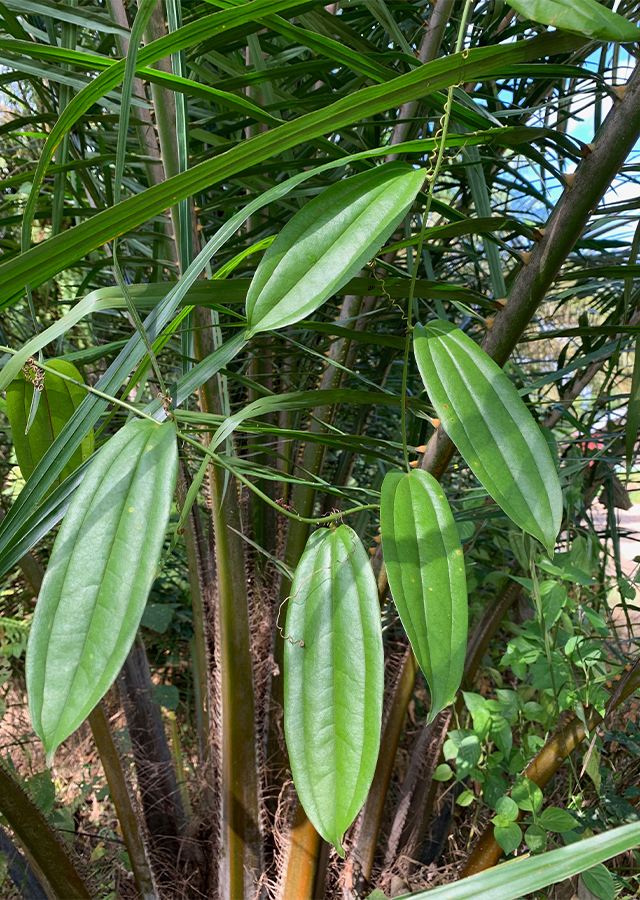
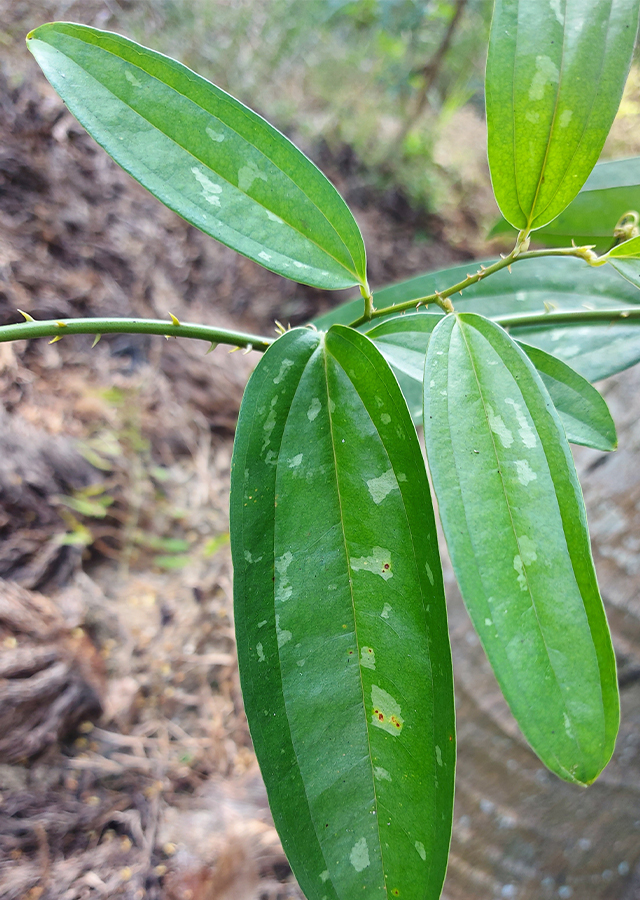
- Stem climbing with tendrils, mature stems dark green, smooth surface, and stiff thorns can be found along the stem, about 0.5 cm in size.
- Leaves alternate, somewhat pinnate, 10-32 cm long and 4-22 cm wide. Egg-shaped and oblong with a fairly stiff texture, petiole about 4 cm.
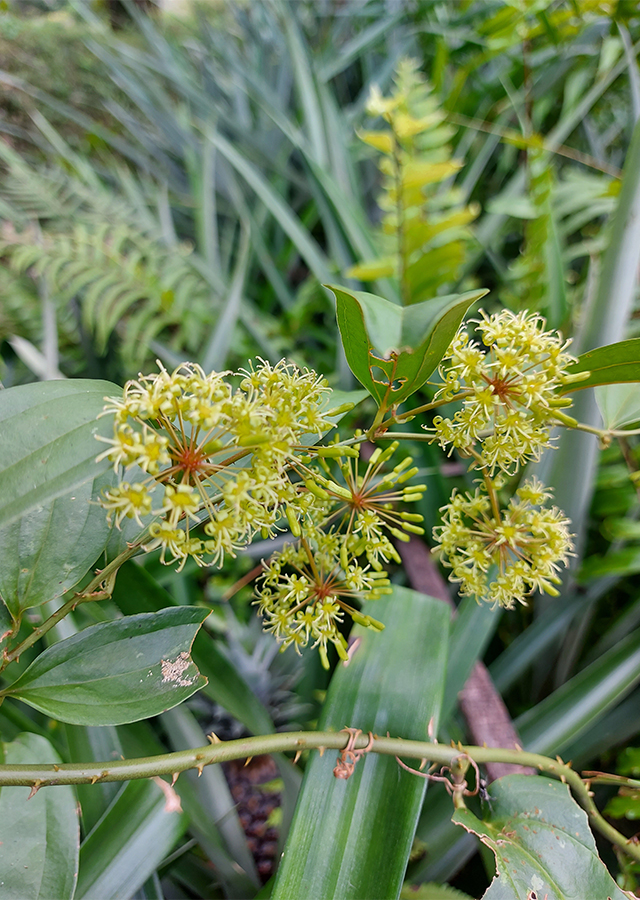
- Flowers appear in leaf axils, consisting of 2-6 flowers. Male flowers are pale white, greenish-yellow or brown.
- Fruit round with a diameter of 10 mm, red and black when ripe with a long stalk.
- Seeds round and located in the center of the fruit, 1-6 seeds.
Cultivation
- Propagated by seed and stem cuttings.
- Propagation by seed produces good germination if the seeds are planted without light at a room temperature of around 30°C.
- Stem cuttings are done by cutting a 20 cm stem length leaving two nodes on the planting material.
Chemical Content
Saponin, terpenoid, phenolic compounds, alkaloid, flavonoid, tannin.
Benefits
Remedy for rheumatism, syphilis, skin disease (boils), menstrual disorders, hemorrhoids, swelling from sprains, antiseptic, antibacterial, stomach ache, antidote.
Simplisia
- Collect fresh, good-quality leaves and stems.
- Wash thoroughly with running water.
- Air-dry the material for several days.
- Once completely dry, grind into a coarse powder.
- Place in a clean, airtight container.
Local Names
Ubi danau, Akar banar, Kayu kancil (Riau), Canar bokor (Sunda), Wando (Maluku), Canar gede, Canar minyak, Cangkores (Sunda).
Traditional Recipes
The following recipes reflect traditional knowledge passed down through generations, not a substitute for professional medical diagnosis or advice. Consult a healthcare provider before use.
1. Boils
- Prepare fresh leaves as needed.
- Wilt the leaves by heating over a stove on low heat.
- Apply to the boil.
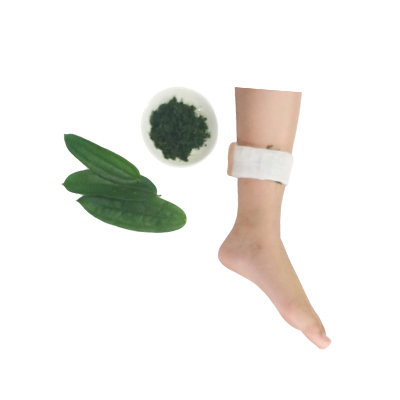
2. Remedy for swollen feet (sprains)
- Take canar leaves as needed, pound until fine and juicy.
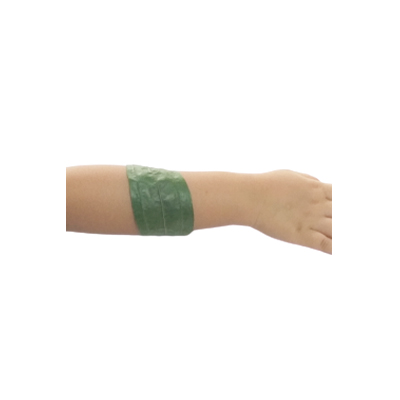
- Apply to the foot swollen from a sprain or fracture and bind with cloth.
- Leave until the pounded leaves dry, then it can be removed.
- Repeat several times until the swelling decreases.