Solanum lasiocarpum Dunal
Summary
Terung dayak (Solanum lasiocarpum) is an annual herb 0.5-1.5 meters tall from the Solanaceae family distributed from China to the Solomon Islands. Its very sour fruit is used to add sour flavor to Indian and Thai curries, and as an ingredient in Thailand's signature 'nam prik' sauce. In Kalimantan, terung dayak is traditionally used as a poultice for swelling and to treat toothache.
Agroecology
Terung dayak is a plant of humid tropical regions, found at elevations up to 1,500 m asl. It grows best in areas where the mean annual daytime temperature is in the range of 24-30°C, but can tolerate 10-35°C. This plant prefers mean annual rainfall in the range of 1,200-2,000 mm, but tolerates 800-4,200 mm. It succeeds in full sun and in shade. It can grow in various fertile, well-drained soil types. Prefers a pH in the range of 5.5-7, tolerating 4.5-7.5.
Morphology
- Stem densely spiny, with star-shaped hairs.
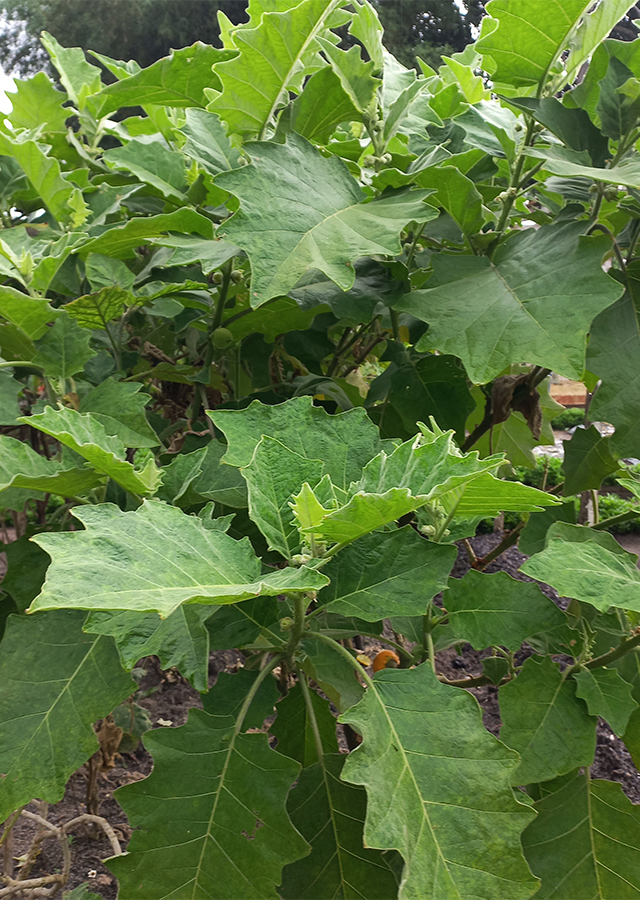
- Leaves broadly ovate shaped, 15-20 cm long, 12-23 cm wide, lobed at the margins, and densely covered with stiff hairs above and fine hairs plus spiny prickles beneath the midrib, lobes triangular shaped and 2.5-4 cm deep.
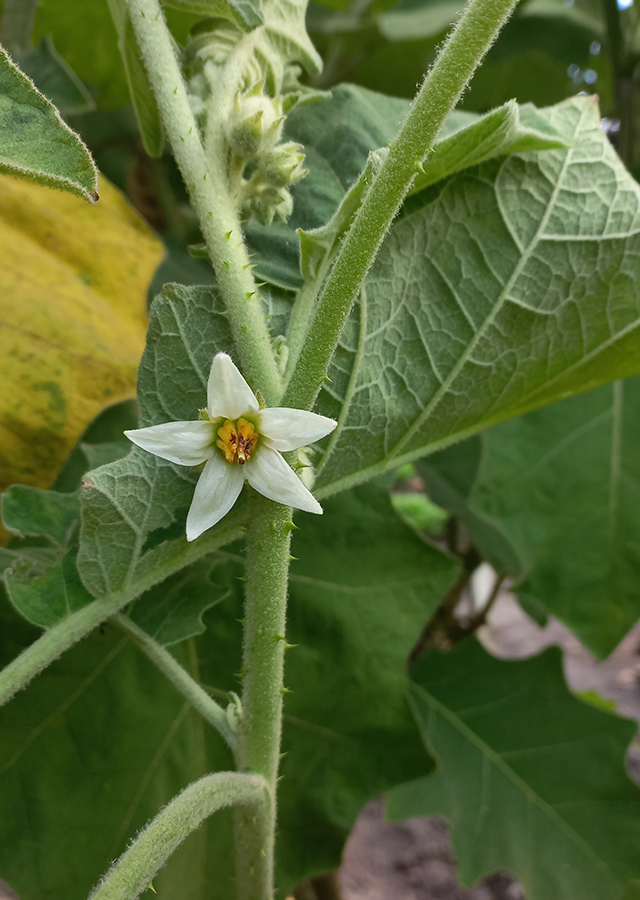
- Flowers borne on lateral racemes. Calyx short, funnel-shaped, with ovate-triangular lobes. Corolla densely hairy outside, white, rectangular shaped, 2-2.5 cm long.
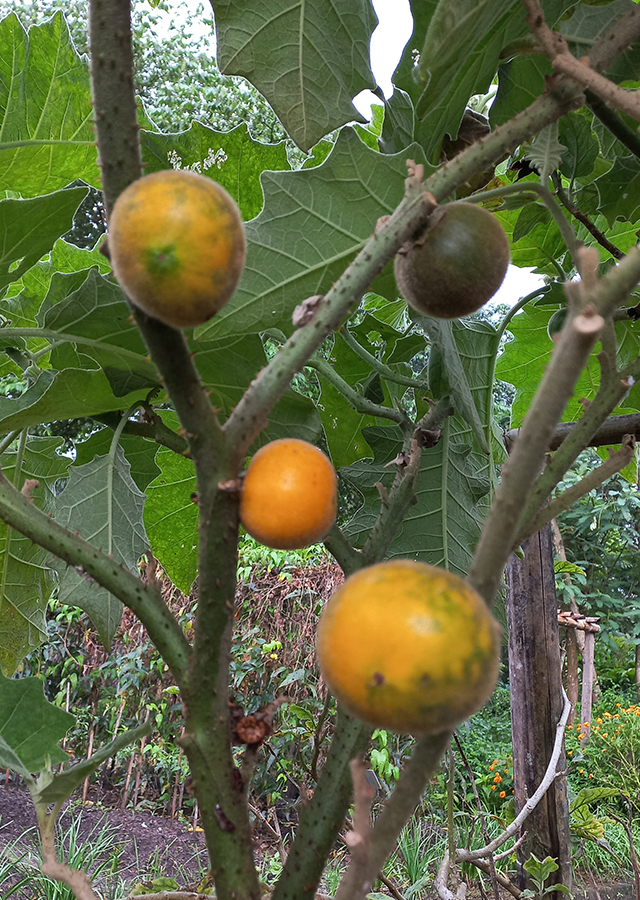
- Fruit a berry, yellow, round, 2.5-3.5 cm in diameter, densely covered with needle-like hairs, and many-seeded.
Cultivation
Propagation of terung dayak uses seeds from ripe fruit; select good seeds, then sun-dry them, after which soak the seeds in clean water for 24 hours to break seed dormancy, then sow the seeds, which will germinate within 1-2 weeks. Once the seedlings have 2 leaves or are 1-1.5 cm tall, or are 2-3 weeks old, the seedlings can be transplanted to the field, with a planting spacing for terung dayak of 0.6 x 1.0 m. In addition, terung dayak can be propagated with mature (semi-hardwood) stem cuttings. These cuttings are very easy and will root within a few weeks.
Chemical Content
Alkaloids, terpenoids, phenolics especially flavonoids, fatty acids, palmitic acid, stearic acid, oleic acid, and linoleic acid.
Benefits
Used as a poultice for swelling, relieves severe body-wide pain and discomfort after eating, treats syphilis, night fever, itching, wounds, severe bruising, treats toothache, cough, asthma, fever, vomiting, sore throat, gonorrhea, and female sexual disorders.
Simplisia
- Prepare an adequate amount of terung dayak seeds, wash clean with running water.
- Dry under the sun or with an oven at 40°C until the moisture content reaches 10%.
- Store in a clean, airtight container.
Local Names
Terong perat (Madura), Cung bulu, Latteoeng, Terong asam, (Sumatra), Asam rimbang (Dayak).
Traditional Recipes
The following recipes reflect traditional knowledge passed down through generations, not a substitute for professional medical diagnosis or advice. Consult a healthcare provider before use.
1. Swelling
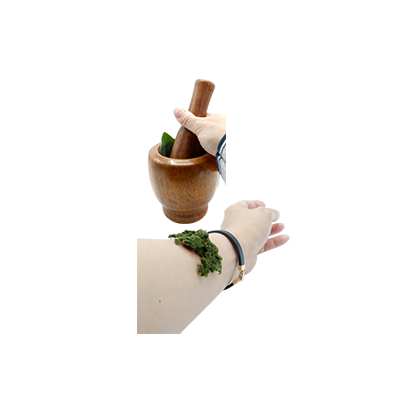
- Prepare terung dayak leaves and wash until clean.
- Grind until it becomes a paste.
- Apply the leaf paste to the swollen skin.
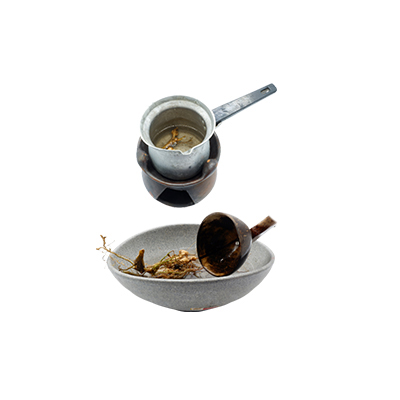
2. Fever
- Take an adequate amount of terung dayak root and wash until clean.
- Boil until it boils.
- Let it cool to warm then use for bathing.
Reference Sources
- Royal Botanic Gardens. 2017. Plants of the World Online: Solanum lasiocarpum Dunal. https://powo.science.kew.org/taxon/urn:lsid:ipni.org:names:819751-1. 10-12-2021.
- Useful Tropical Plants Database. 2021. Solanum lasiocarpum. http://tropical.theferns.info/viewtropical.php?id=Solanum+lasiocarpum. 10-12-2021.
- Stuartxchange. 2018. Philippine Medicinal Plants: Tarambulo. http://www.stuartxchange.org/Tarambulo. 10-12-2021.
- T. K. Lim. 2013. Edible Medicinal And Non-Medicinal Plants Volume 6, Fruits. Solanum lasiocarpum. p 333-335. https://link.springer.com/chapter/10.1007/978-94-007-5628-1_39. 10-12-2021.
- Flora Kampung. 2014. Terong Asam. http://flora-kampung.blogspot.com/2014/12/terong-asam.html. 10-12-2021.
- Syarpin, Wahyu Nugroho, Sari Rahayu. 2018. Uji Fitokimia dan Antioksidan Ekstrak Etanol Buah Terung Asam (Solanum ferox L). Acta Pharmaciae Indonesia. September 2018, 6(2) 46-50; E-ISSN: 2621-4520. Jurusan Pendidikan MIPA, Program Studi Pendidikan Kimia, FKIP, UniversitasPalangka Raya (UPR). Palangka Raya.