Symphytum officinale L.
Summary
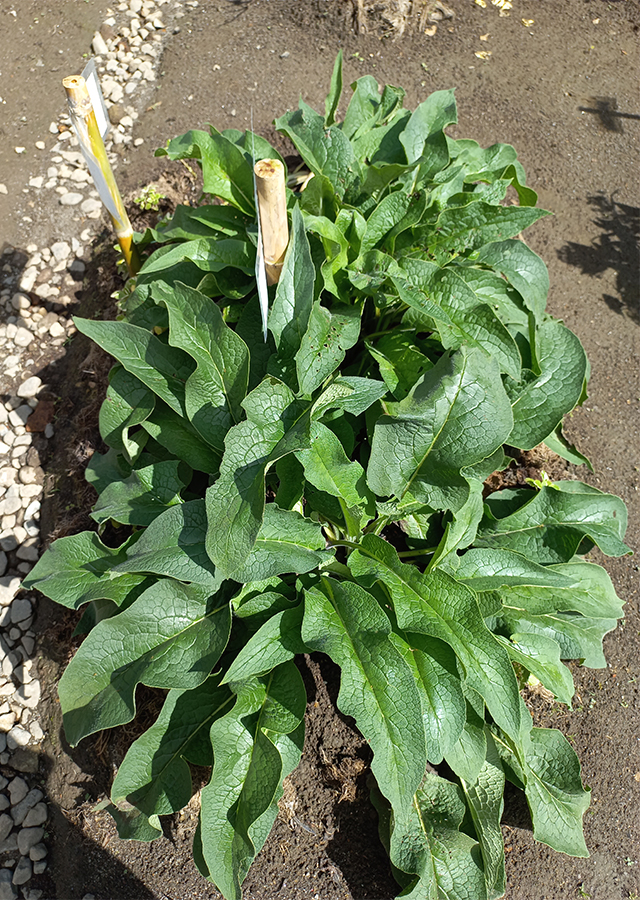
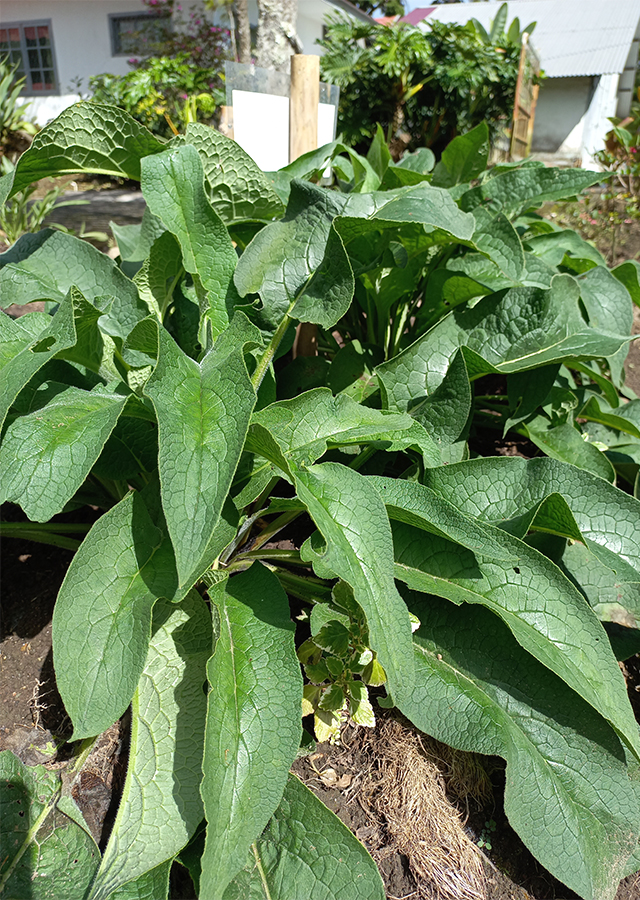
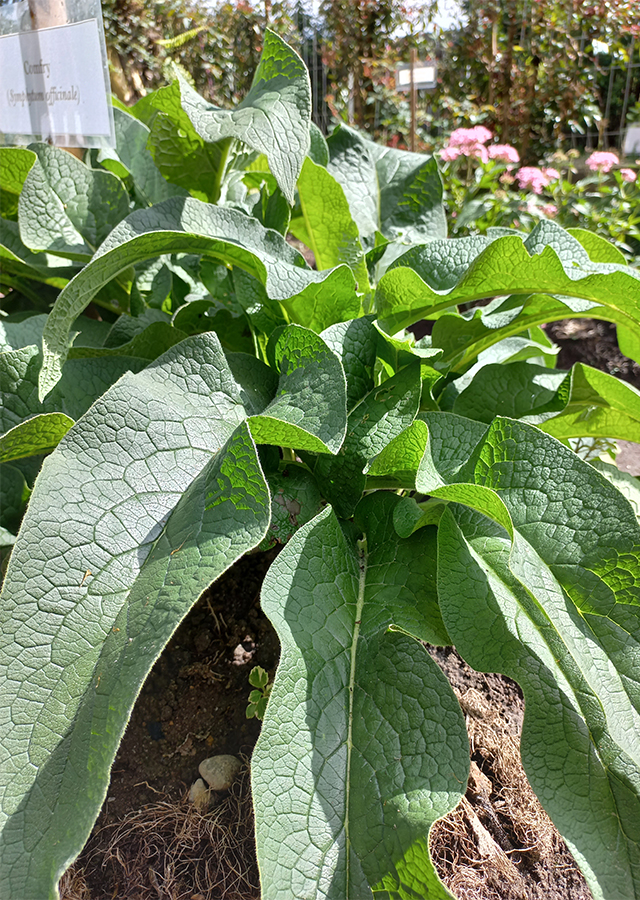
Kompri (Symphytum officinale) is a clump-forming herb up to 120 cm tall from the Boraginaceae family that originates from Europe, used since 400 BC by the Greeks for bronchial problems and mending broken bones. Its pyrrolizidine alkaloid content has led to a ban on internal use in many European countries, but external application for bruises and sprains is still considered safe thanks to its healing, soothing allantoin content.
Agroecology
Kompri can be found living in moist grasslands, riverbanks, and roadsides. This plant can adapt to most soils, but with moist and wet soil conditions, and grows well in heavy clay soil. The kompri plant is suited to a position in the open, or with partial shade.
Morphology
- Roots taproot and brown.
- Rhizome thick, black outside and white inside.
- Stem pseudostem, non-woody, winged, hollow, often branched, fleshy lower stem.
- Leaves single, sheaths growing alternately at the base forming a basal rosette, lanceolate to ovate-lanceolate, dark green and hairy, blade ovate-lanceolate to ovate, extending at the base into a petiole and stem, forming wings, tip tapering, smooth margin, pinnate venation, rough hairy surface.
- Flowers compound, borne on short curved cymes. Has a calyx 5-lobed lanceolate shaped and a cylindrical tubular corolla, 12-18 mm long, small-lobed, purple, dull pink or white, with scales at the throat. Stamens numbering five and located in the middle of the corolla tube, short filaments.
- Fruit round-shaped, consisting of 4 seeds, glossy dark brown or black, covered by the calyx.
- Seeds round, small, hard, black.
Cultivation
- Propagation is done generatively using seeds, or vegetatively by root division and in vitro propagation from root explants.
- The optimal planting spacing is 70 cm × 70 cm.
Chemical Content
Allantoin, phenolic acids (rosmarinic, chlorogenic, caffeic, and lithospermic acid), p-hydroxybenzoic, p-coumaric acid, silicic acid, pyrrolizidine alkaloids (heliosupine, echimidine, echinatin, lasiocarpine, heliosupine, lycopsamine, 7-acetyllycopsamine and 7-acetylintermedine, symphytine, cynoglossine, symlandine, intermedine), tannin, terpenoid, sterol/triterpenoid, flavonoid, amino acid, flavone, saponin, choline, asparagine, essential oil.
Benefits
Treats asthma, colds, phlegmy cough especially for children, indigestion, constipation, hypertension, sprains and broken bones, swollen inflammation, insect bites, peptic ulcers, various skin diseases (sores, athlete's foot, boils, acne, irritation), wound and burn healing, bruises, excessive menstrual flow, vaginal discharge, breast cancer, mouthwash for gum problems, pharyngitis, pneumonia and angina, gum disease, sleep aid, psoriasis, joint pain, rheumatism, arthritis, gout, and has anti-inflammatory and hemostatic (stopping bleeding) properties.
Simplisia
- Prepare kompri leaves, wash clean with running water then drain.
- Dry under sunlight or with an oven at 40 °C until moisture content reaches 10%.
- Blend into powder and sieve with a 60-mesh sieve.
- Store in a clean, airtight container.
Local Names
Gomfri, Kompering, Komring (Java).
Traditional Recipes
The following recipes reflect traditional knowledge passed down through generations, not a substitute for professional medical diagnosis or advice. Consult a healthcare provider before use.
1. Constipation
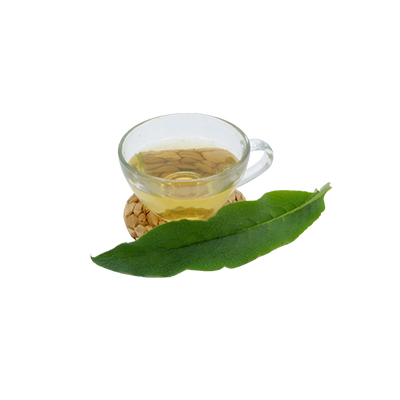
- Prepare kompri leaves as needed and wash until clean.
- Boil the ingredients until boiling.
- Strain the decoction.
- Drink while warm.
2. Swollen inflammation
- Prepare kompri leaves and wash until clean.
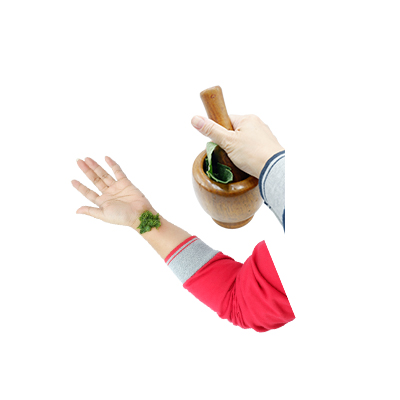
- Mash the leaves into a paste.
- Apply the leaf paste to the swollen skin area.
Reference Sources
- Royal Botanic Gardens. 2021. Plants of the World Online: Symphytum officinale L. http://www.plantsoftheworldonline.org/taxon/urn:lsid:ipni.org:names:120815-1. 11-10-2021.
- Stuartxchange. 2019. Philippine Medicinal Plants: Komprey. http://www.stuartxchange.org/Komprey. 11-10-2021.
- PROTA4U. 2020. Symphytum officinale (PROTA). https://uses.plantnet-project.org/en/Symphytum_officinale_(PROTA). 11-10-2021.
- PROSEA. 2020. Symphytum officinale (PROSEA). https://uses.plantnet-project.org/en/Symphytum_officinale_(PROSEA). 11-10-2021.
- Useful Temperate Plants Database. 2021. Symphytum officinale. http://temperate.theferns.info/plant/Symphytum+officinale. 11-10-2021.