Tecomaria capensis (Thunb.) Spach
Summary
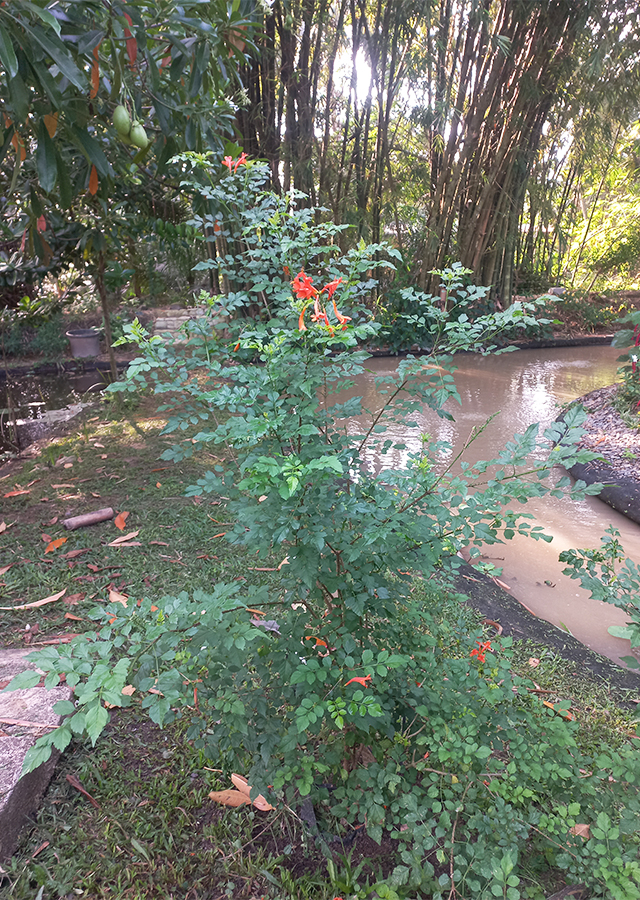
Tecomaria capensis or tekomaria is native to southern Africa, covering South Africa, Swaziland, and southern Mozambique, and is now widely commercialized as an ornamental across continents. Besides being popular as a hedge and border plant, this fast-growing shrub is also used to prevent soil erosion and as a pioneer plant for new gardens. Traditionally, tekomaria is also used as a pain reliever, sleep aid, and digestive remedy thanks to its antibacterial and anti-inflammatory content.
Agroecology
Tecomaria capensis is a subtropical to tropical plant, where this plant can be found growing in moist areas, dry thickets, grasslands, savannas, coastal dune scrub, rocky hillsides, forest edges but more often found along drainage channels, and in forests at elevations from sea level up to 2,300 m asl. T. capensis is an evergreen plant in warm climates but loses its leaves in colder regions. Grows well in areas with mean annual rainfall in the range of 750-1,750 mm and mean annual temperature in the range of 22-26°C, and in various fertile, well-drained soil types with a pH of 5.5-6.5. Its growth prefers locations exposed to sun, shaded, or partially shaded. T. capensis is tolerant of drought, salt, light frost, and wind.
Morphology
- Stem cylindrical, lenticellate, tufted.
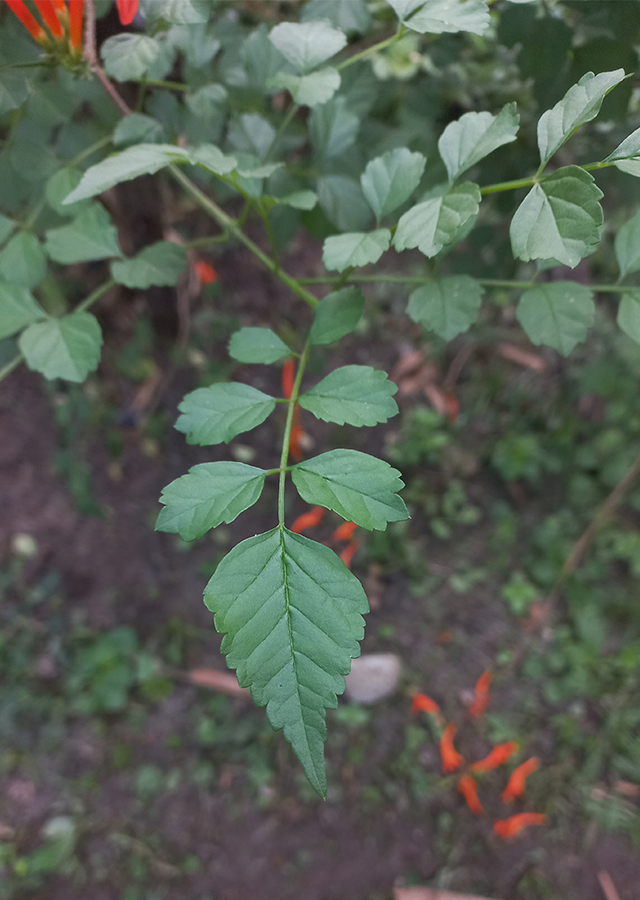
- Leaves compound, glossy green, opposite arrangement, leaflet blade oblong shaped with blunt teeth, tip rounded, base rounded or abruptly cuneate. Upper surface dull, pale with somewhat raised venation, veins pinnate. Lower surface light green, dull, mottled, with somewhat raised venation. Leaves consist of 5-7 leaflets and appear in pairs.
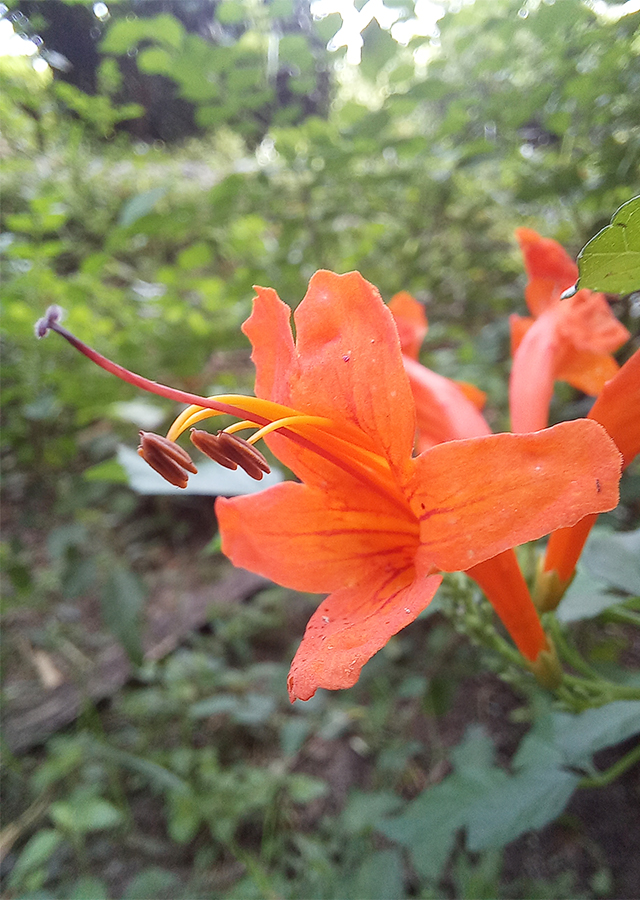
- Flowers fragrant, with an orange or reddish-orange corolla, tube-shaped, curved, 3.5-5 cm long, with 5 unequal oblong lobes (2 upper lobes smaller than the 3 lower lobes). Calyx green, 5-7 mm long, 5-pointed, ciliate, puberulent. Stamens 4, of equal length. Style long, protruding (the tip of the female organ, filament-like). Flowers appear in clusters near the branch tips. Male and female flowers appear on separate plants.
- Fruit dry, a linear capsule, flattened shaped (13 cm long) containing seeds with papery wings.
- Seeds in 2 rows, slender, 2-winged, wings hyaline-membranous.
Cultivation
Plant propagation through wood cuttings and layering.
Chemical Content
Bioflavonoids, quercetin, essential oil, tannins, salicylic acid, iridoids, phenylpropanoid glucosides, tecomoside.
Benefits
Relieves pain, addresses insomnia, pneumonia, stomachache, diarrhea, enteritis, bleeding gums to improve blood clotting, reduces fever. Has antibacterial, antiviral, antiseptic, anti-inflammatory, antioxidant, and antifungal properties.
Simplisia
- Take tekomaria bark, wash until clean, then drain.
- Dry under the sun or with an oven at 40°C until the moisture content reaches 10%.
- Grind until it becomes powder.
- Store in a clean, airtight container.
Local Names
Bignonia oranye.
Traditional Recipes
The following recipes reflect traditional knowledge passed down through generations, not a substitute for professional medical diagnosis or advice. Consult a healthcare provider before use.
1. Diarrhea
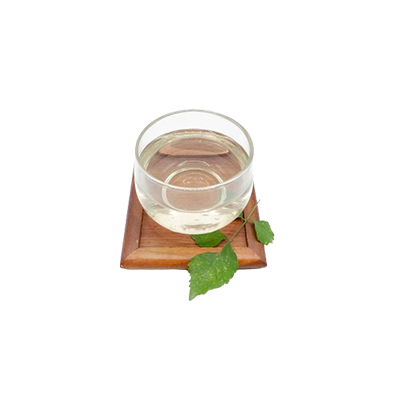
- Take an adequate amount of tekomaria leaves and wash until clean using running water.
- Boil the leaves until it boils.
- Let it cool to warm then drink.
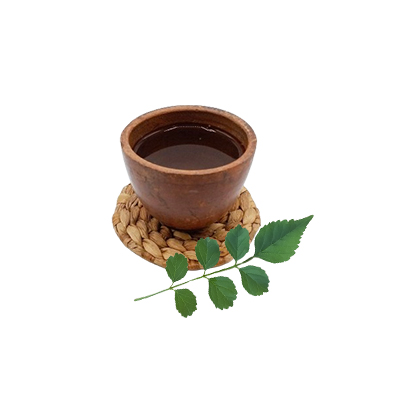
2. Enteritis
- Prepare an adequate amount of tekomaria leaves and wash until clean.
- Boil the leaves until it boils.
- Let it cool to warm then drink to treat enteritis.
Reference Sources
- Royal Botanic Gardens, Kew.Plants of the World Online: Tecomaria capensis (Thunb.) Spach. https://powo.science.kew.org/taxon/urn:lsid:ipni.org:names:111333-1. 01-11-2023.
- P Neelimaraj, P Srinivasa Babu, R Karthikeyan. 2015. Cape-honeysuckle: An Ornamental Plant to Treat Various Disease Conditions. Inventi Rapid: Planta Activa, 2015(3):1-5.
- Flora Fauna Web. Tecomaria capensis (Thunb.) Spach. https://www.nparks.gov.sg/florafaunaweb/flora/2/4/2498. 01-11-2023.
- Tropical Plants Database, Ken Fern. Tecoma capensis. https://tropical.theferns.info/viewtropical.php?id=Tecoma+capensis. 01-11-2023.
- CABI. 2016. Tecoma capensis (Cape honeysuckle). https://www.cabidigitallibrary.org/doi/full/10.1079/cabicompendium.52954. 01-11-2023.