Terminalia catappa L.
Summary
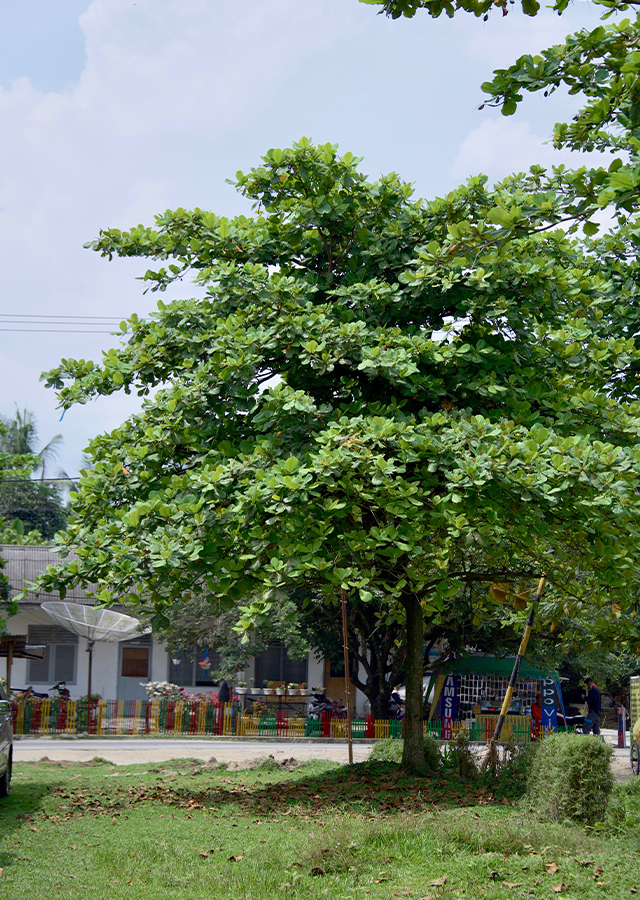
Ketapang, or tropical almond (Terminalia catappa), is a tree up to 35 meters tall of the Combretaceae family, native to Southeast Asia and now distributed as far as Australia, Africa, and the Americas. Its almond-flavored fruit can be eaten, while its wood is used in building construction and furniture. As a versatile urban shade tree, ketapang is also traditionally believed to address dysentery, cough, and hepatitis.
Agroecology
This plant is found in coastal and lowland areas up to an elevation of about 800 m above sea level, rainfall between 1,000-3,500 mm/year, and up to 6 dry months. Average annual maximum and minimum temperatures range from 21-32 °C. Favors sandy and sandy loam soil, with a neutral to alkaline pH reaction, and good drainage.
Morphology
- Roots taproot.
- Trunk erect, twig anatomy spread out horizontally.
- Leaves round, blunt, glossy, rough, dark green, later turning yellow and red before shedding.
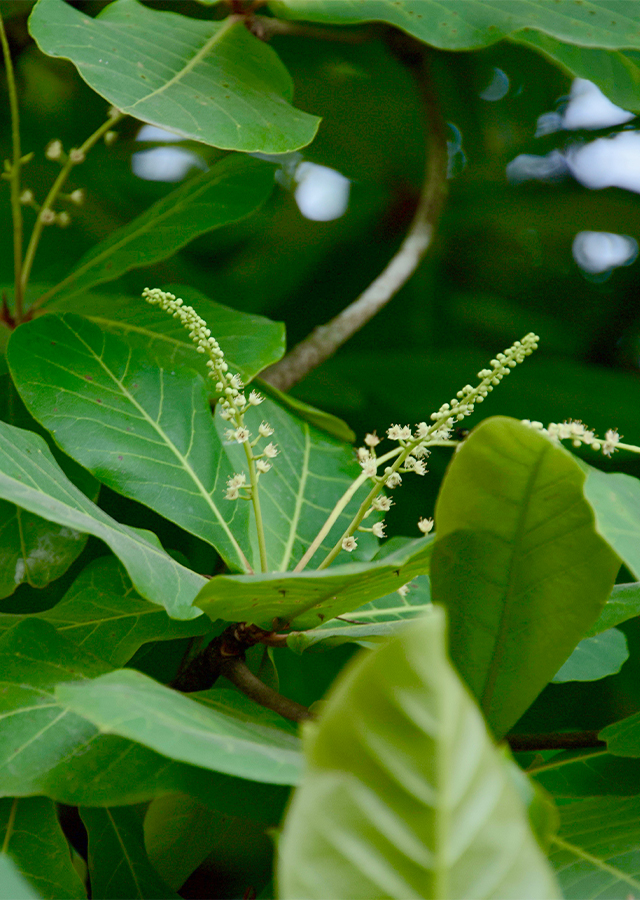
- Flowers small, gathered in a spike near the twig tip, greenish-yellow.
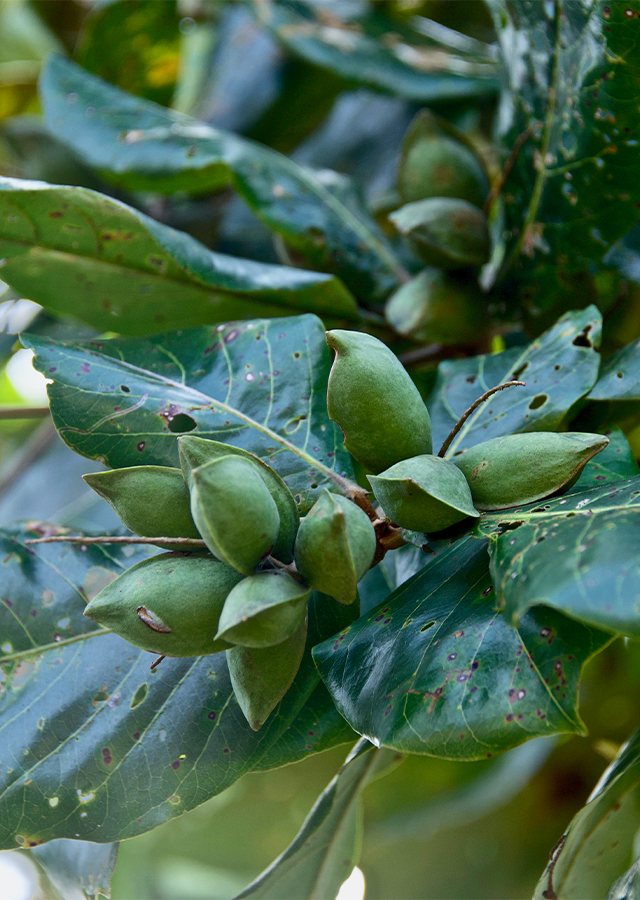
- Fruit a flattened ovoid, angled or narrowly winged, green-yellow-red or purple when ripe.
- Seeds oblong, white to brown.
Cultivation
Propagated generatively (by seed), vegetatively (by stem cuttings).
Chemical Content
Flavonoids (vitexin, isovitexin, isoorientin), triterpenoids, alkaloids, apigenin, tannins, saponins, terpenoids, glycosides, anthraquinones.
Benefits
Has antioxidant, antibacterial, anti-inflammatory, antidiabetic, and anticancer activity; treats dysentery, cough, nerve pain, hepatitis; lowers high blood pressure; treats stomach ache and kidney disease.
Simplisia
- Wash the leaves with clean running water, then drain at room temperature.
- Dry the leaves in the sun until they become brittle. Once dry, grind and sift until a fine powder is obtained.
- Store the result in a closed container at room temperature, away from direct sunlight.
Local Names
Also known locally as Hatapang (Batak), Ketapas (Timor), Sarisalo (Maluku).
Traditional Recipes
The following recipes reflect traditional knowledge passed down through generations, not a substitute for professional medical diagnosis or advice. Consult a healthcare provider before use.
1. Cough
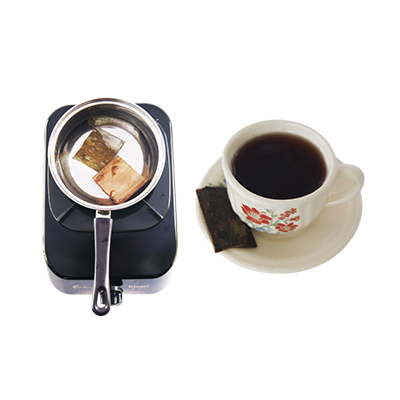
- Boil 30-40 g of ketapang bark in 3 cups of water until boiling and the water is reduced.
- Drink 3 times a day, ½ cup each time.
Reference Sources
- Annegowda HV, Mordi MN, Ramanathan S, Mansor SM. 2010. Analgesic and antioxidant properties of ethanolic extract of Terminalia catappa L. leaves. Int. J. Pharmacol 6(6): 910-915.
- Kankia HI. 2012. phytochemical screening and antibacterial activities of leaf extracts of Terminalia catappa (umbrella tree). International Journal of Science and Research 3(12): 3658-2661
- Lin YL, Kuob YH, Shiao MS, Chen CC, Ou CJ. 2000. Flavonoid Glycosides from Terminalia catappa L. Journal ofthe Chinese Chemical Society 47: 253-256.
- Potty VP, Rajesh BR, Kumari PC, Miranda MTP, Sreelekshmy SG. 2015. Antioxidant and antimicrobial activity of leaves of Terminalia catappa and Anacardium occidentale: A comparative study. Journal of Pharmacognosy and Phytochemistry. 4(1): 79-82.
- Prosea. 2016. Terminalia catappa. https://uses.plantnet-project.org/en/Terminalia_catappa_ (PROSEA) 08-05-2020
- Sarwar S, Khatun A, Nahar K, Rahman MA. 2016. Phytochemical screening, cytotoxic and anthelmintic activities of the methanolic leaf extract of Terminalia catappa Linn. Journal of Pharmacognosy and Phytochemistry 5(6): 24-27.
- Hariana Arief, Hidayat Syamsul, Mursito Bambang dkk. 2015. Kitab Resep Herbal. Penebar Swadaya, Jakarta.