Acalypha hispida Burm.f.
Summary
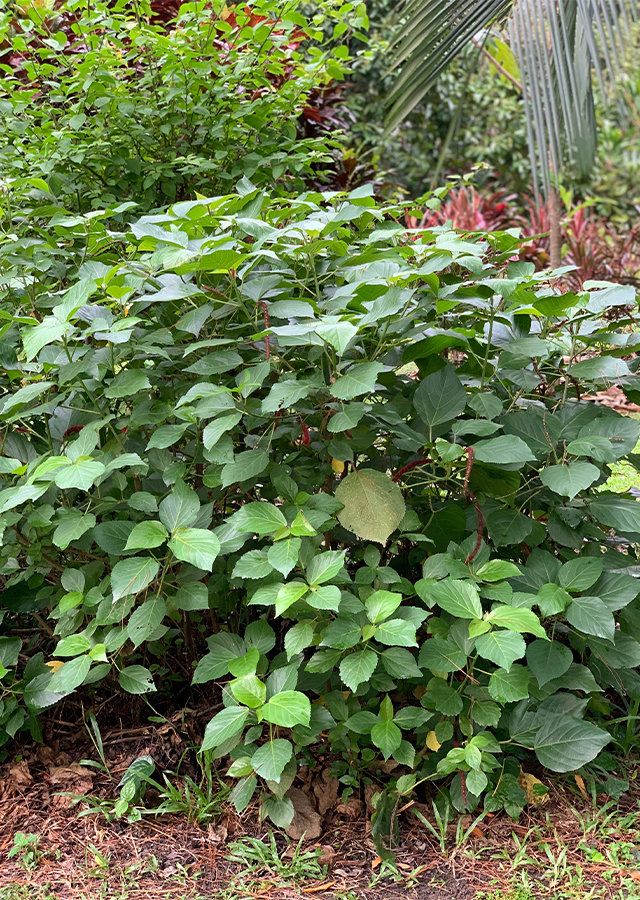
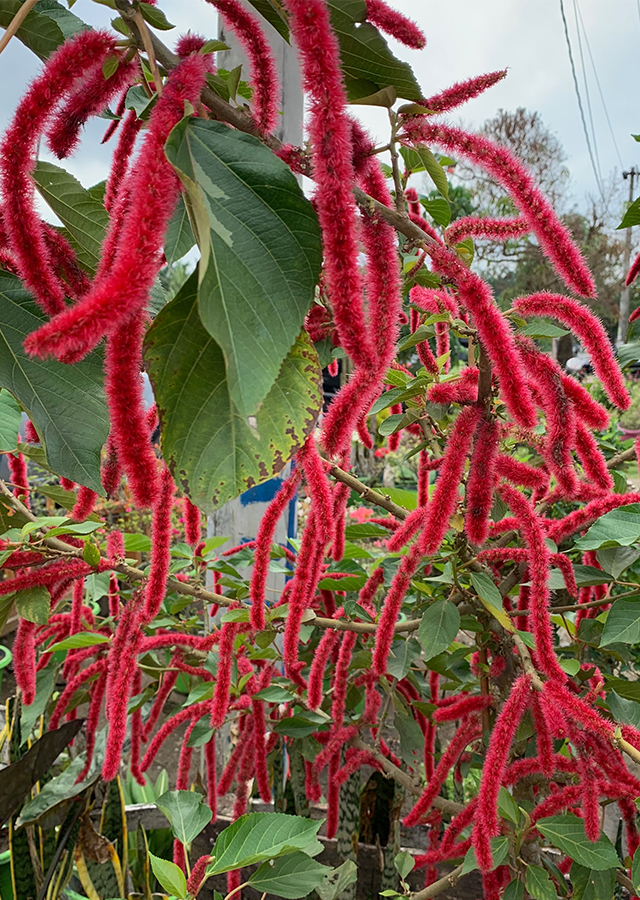
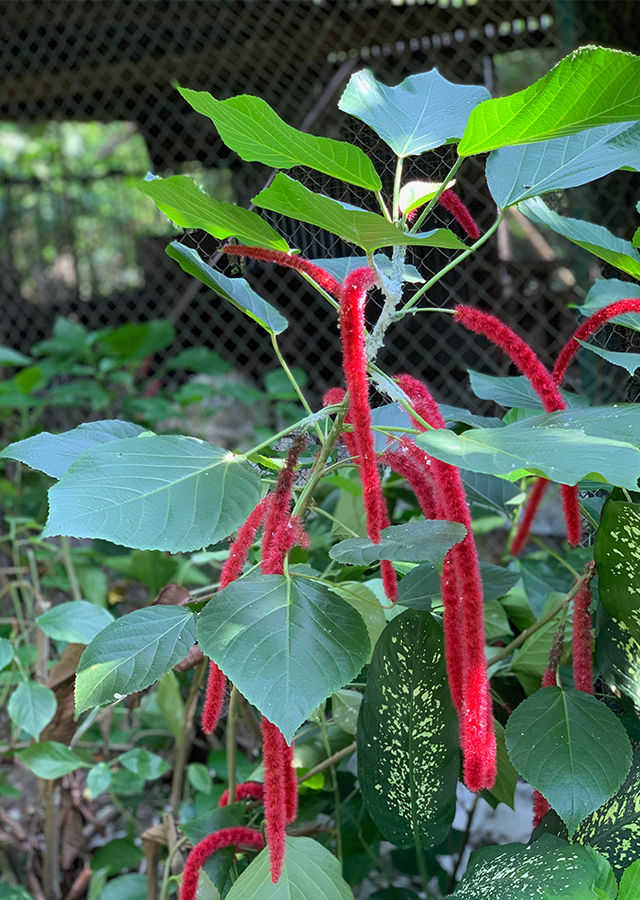
Ekor kucing (Acalypha hispida) is a shrub 1-3 meters tall of the Euphorbiaceae family, native to the West Indies and now widely cultivated in tropical regions such as Indonesia and Malaysia. Its dangling red flower spikes, resembling a cat's tail, make it a popular garden ornamental. On the other hand, its leaf preparation is traditionally used as an external remedy for boils and swelling, and to treat dysentery.
Agroecology
Generally found in secondary forests, roadsides, or yards. Grows at elevations of 100-1,260 m above sea level. Favors full sun but tolerates partial shade, and moist, well-drained soil. Ekor kucing is also tolerant of acidic and alkaline soil.
Morphology
- Stem round, sympodial branching, greenish-brown.
- Leaves simple, long-stalked, cylindrical petiole, alternately arranged, ovate to oblong, pointed tip, blunt base, toothed margins, glossy surface, pinnate venation, hairy, light green.
- Flowers compound, gathered in spike-shaped clusters emerging from the leaf axils, elongated, hanging downward, 1-1.5 cm in diameter, ± 24 cm or 20-50 cm long, short stalk, cylindrical, hairy, red.
- Fruit round, small, hairy, and green.
- Seeds round, small, and dirty white.
Cultivation
- Propagated generatively (by seed) and vegetatively (by stem cuttings).
- For cuttings, use mature, semi-woody twigs.
Chemical Content
Phenolic compounds, flavonoids, saponins, glycosides, steroids, phlobatannins, hydroxyanthraquinone, acalyphin, essential oil, alkaloids, gallic acid, corilagin.
Benefits
Treats dysentery, intestinal inflammation, vomiting, bloody stool, nosebleeds; addresses bleeding, intestinal worms, leg ulcers; treats white skin patches from pigment loss, vitiligo, coughing blood, wounds, boils, swelling, canker sores; has anti-inflammatory, antioxidant, and laxative activity.
Simplisia
- Prepare ekor kucing leaves and clean them.
- Dry by air-drying.
- Once dry, grind the leaves into a powder.
Local Names
Tali anjing (Sunda), Wunga tambang, Lancuran (Java), Ikut lutung (Bali), Lofoti (Ternate).
Traditional Recipes
The following recipes reflect traditional knowledge passed down through generations, not a substitute for professional medical diagnosis or advice. Consult a healthcare provider before use.
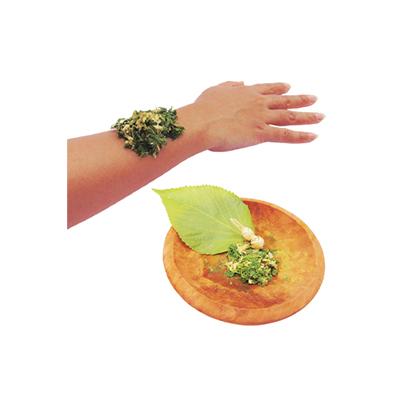
1. Vitiligo (Skin Disease)
- Wash 1 handful of fresh ekor kucing leaves and a thumb-half-sized piece of aromatic ginger (kencur), grind finely.
- Apply to the white-patched area of the body, then wrap.
- Do this daily.
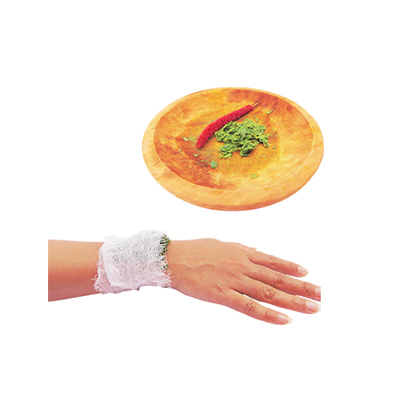
2. Bleeding Wound
- Wash 1 handful of fresh leaves thoroughly, then pound finely.
- Apply to the wound, wrap with a bandage.
Reference Sources
- Widyaningrum H. 2011. Kitab Tanaman Obat Nusantara. Penerbit Media Pressindo, Yogyakarta.
- Siraj MA, Shilpi JA, Hossain MG, Uddin SJ, Islam MK, Jahan IA, Hossain H. 2016. Anti-inflammatory and antioxidant activity of Acalypha hispida leaf and analysis of its major bioactive polyphenols by HPLC. Adv. Pharm. Bull. 6(2): 275-283.
- Siregar AH. 2002. Acalypha indica (L.) Willd. dalam Van Valkenburg, J.L.C.H, Bunyapraphatsara, N. (Editor): Plant Resource of South-East Asia 12(2). Medicinal and poisonous plants 2. Prosea Foundation. Bogor.Indonesia 34.
- Iniaghe OM, Malomo SO, Adebayo JO. 2009. Proximate composition and phytochemical costituents of leaves of some Acalypa species. Pakistan Journal of Nutrion 8(3): 256-258.