Acanthus ilicifolius L.
Summary
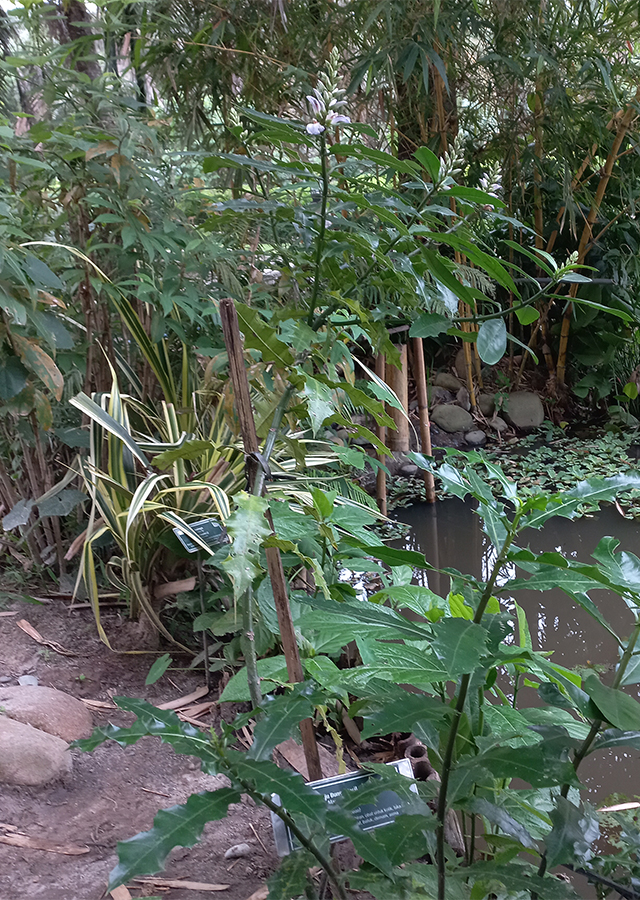
Daruju bunga kecil ungu (Acanthus ilicifolius) is a shrub up to 3 meters tall from the Acanthaceae family distributed from South India to Northern Australia, forming dense thickets in mangrove swamps. The ash of the burned plant is used as an ingredient in natural soap. In Ayurveda, daruju bunga kecil ungu is one of the nine plants in the 'Sahchara' remedy for rheumatic complaints.
Agroecology
Daruju bunga kecil ungu is a tropical plant, found near coastlines in areas without a dry season or with a short dry season. This plant grows best in areas where the mean annual daytime temperature is in the range of 18-26°C, but can tolerate 15-32°C. It prefers mean annual rainfall in the range of 1,500-2,500 mm, but tolerates 1,000-3,000 mm. It prefers a position in full sun, tolerating some shade. Grows best in heavier soil with moderate to high fertility. Tolerant of flooding and fairly high salt levels in the soil. Prefers a pH in the range of 6.8-7.2, with a tolerance of 6.5-7.5.
Morphology
- Roots support roots can sometimes develop at the base of the stem. Often produces adventitious aerial roots.
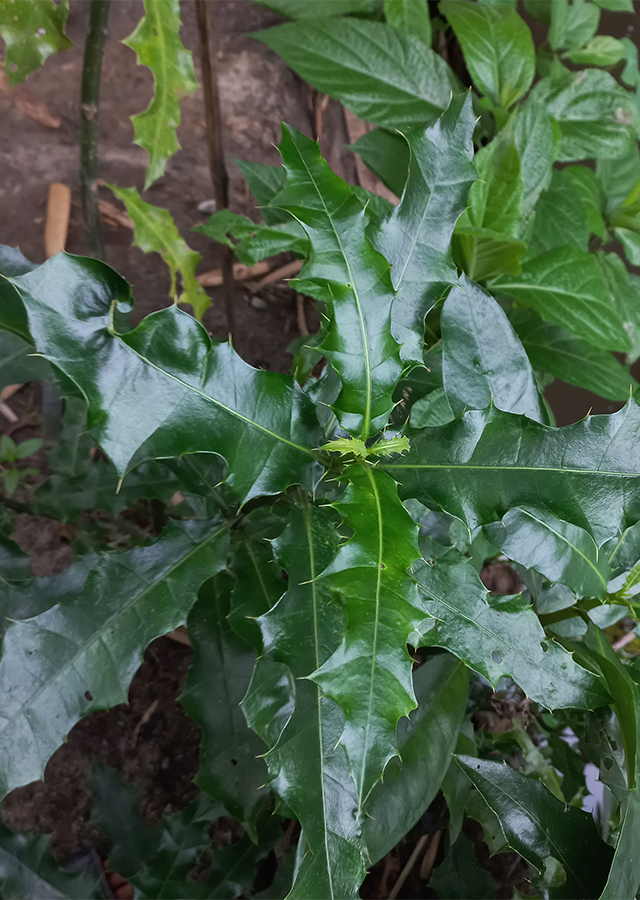
- Stem glossy green with spots, and a pair of spines at the leaf axil.
- Leaves short-stalked with a spiny, oblong leaf blade, pale green with a yellowish tinge above and green below.
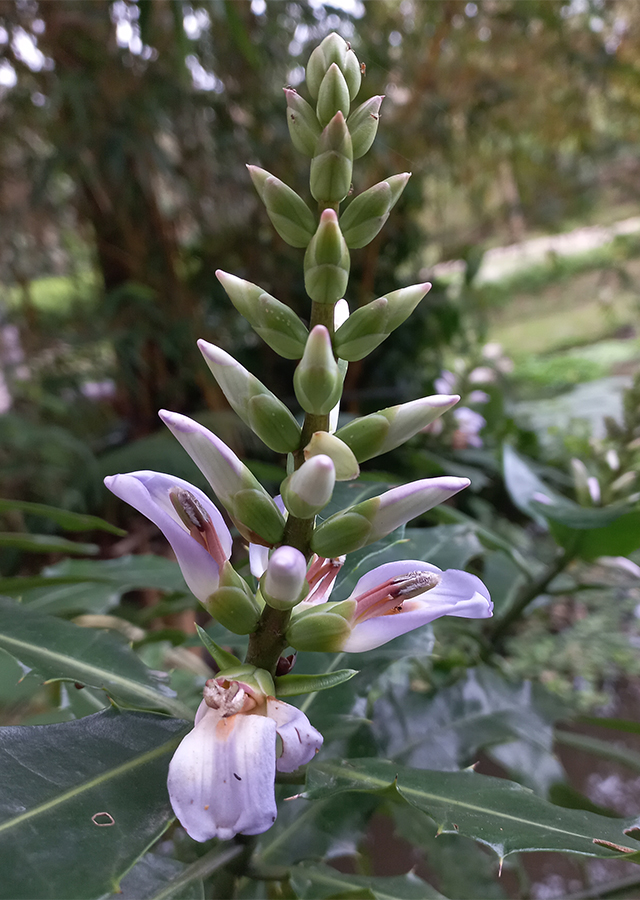
- Flowers with the flower spike reaching 20 cm long, producing 20 pairs of flowers clustered in four vertical rows at the tip. The pale lilac flowers are 2-4 cm long, with three bracts (reduced leaves) at the base.
- Fruit 4-seeded, somewhat flattened, ovate, glossy green, and 2-3 cm long. The fruit will burst open when ripe up to a distance of 2 m.
- Seeds wrinkled, whitish green in color, about 1 cm long.
Cultivation
Propagation can be done generatively with seed or vegetatively with stem cuttings.
Chemical Content
Resin, alkaloids, sulfuric acid, acanthicifoliuside, enacteoside, isoacteoside, acanthaminoside, (+)-lyoniresinol 3a-O-ß-glucopyranoside, (-)-lyoniresinol, and a-amyrin, (+)-lyoniresinol 3a-[2-(3,5-dimethoxy-4-hydroxy)-benzoyl]-O-glucopyranoside, and dihydroxymethyl-bis(3,5-dimethoxy-4-hydroxyphenyl) tetrahydrofuran-9(or 90)-O-glucopyranoside, 5,11-epoxymegastigmane glucoside, megastigmane glucoside, (6S, 9S)-roseoside, luteolin 7-O-beta-D-glucuronide, apigenin-7-O-beta-D-glucuronide, methylapigenin-7-O-beta-D-glucuronate, uridine, uracil, flavonoids, phenols, terpenoids, glycosides, {7-chloro-(2R)-2-O-ß-D-glucopyranosyl-2H-1,4-benzoxazin-3(4H)-one and (2R)-2-O-ß-D-glucopyranosyl-5-hydroxy-2H-1,4-benzoxazin-3(4H)}, (+)-lyoniresinol 3α-O-β-D-glucopyranoside, (-)-lyoniresinol 3α-O-β-D-glucopyranoside, (+)-lyoniresinol, 1H-indole-3-carboxylic acid, 1H-indole-3-carboxaldehyde, 1H-indole-3-acetic acid.
Benefits
Treats acute and chronic hepatitis, swelling and enlargement of the liver and spleen, swelling and enlargement of lymph nodes, gastralgia, asthma, aids expectoration, vaginal discharge, gastrointestinal pain, as a driving emollient for rheumatism, an antidote to snake venom, heals wounds, poisoned arrow wounds, neuralgia, kidney stones. Has antiseptic and blood-purifying activity.
Simplisia
- Prepare daruju bunga kecil ungu leaves, wash clean with running water then drain.
- Dry under the sun or with an oven at up to 40°C until the moisture content reaches 10%.
- Grind using a blender until it becomes powder.
- Store in a clean, airtight container.
Local Names
Jeruju (Sumatra), Daruju (Java).
Traditional Recipes
The following recipes reflect traditional knowledge passed down through generations, not a substitute for professional medical diagnosis or advice. Consult a healthcare provider before use.
1. Treats poisoned arrow wounds
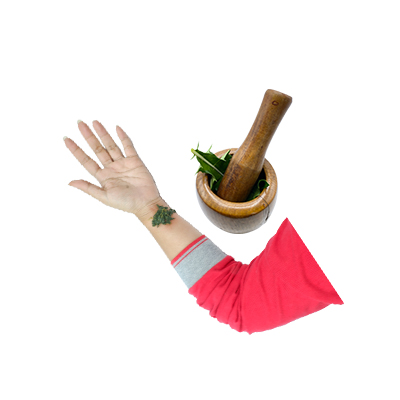
- Take an adequate amount of daruju bunga kecil ungu leaves then wash until clean.
- Grind the leaves until it becomes a paste.
- Apply to the wound.
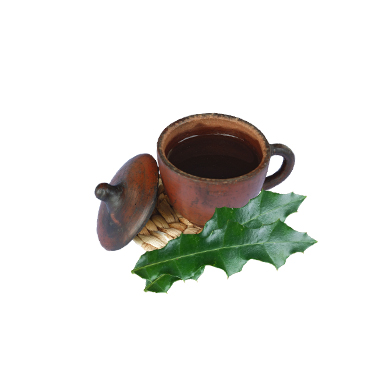
2. Treats kidney stones
- Take an adequate amount of the daruju bunga kecil ungu plant then wash until clean.
- Boil until it boils.
- Strain the decoction.
- Drink half a glass every day until signs and symptoms disappear.
Reference Sources
- Royal Botanic Gardens. 2017. Plants of the World Online: Acanthus ilicifolius L.. https://powo.science.kew.org/taxon/urn:lsid:ipni.org:names:44873-1. 24-11-2021.
- PROSEA. 2016. Acanthus ilicifolius. https://uses.plantnet-project.org/en/Acanthus_ilicifolius_(PROSEA). 24-11-2021.
- Useful Tropical Plants Database. 2021. Acanthus ilicifolius. http://tropical.theferns.info/viewtropical.php?id=Acanthus+ilicifolius. 24-11-2021.
- Stuartxchange. 2020. Philippine Medicinal Plants: Diluario. http://www.stuartxchange.org/Diluario. 24-11-2021.
- Flora Fauna Web. 2019. Acanthus ilicifolius L. https://www.nparks.gov.sg/florafaunaweb/flora/3/4/3487. 24-11-2021.