Acrostichum aureum L.
Summary
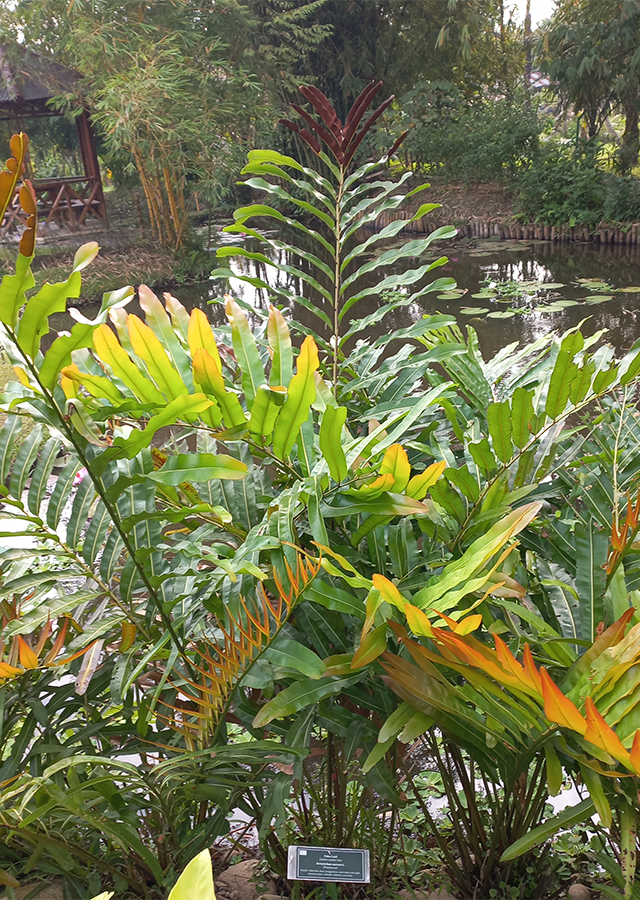
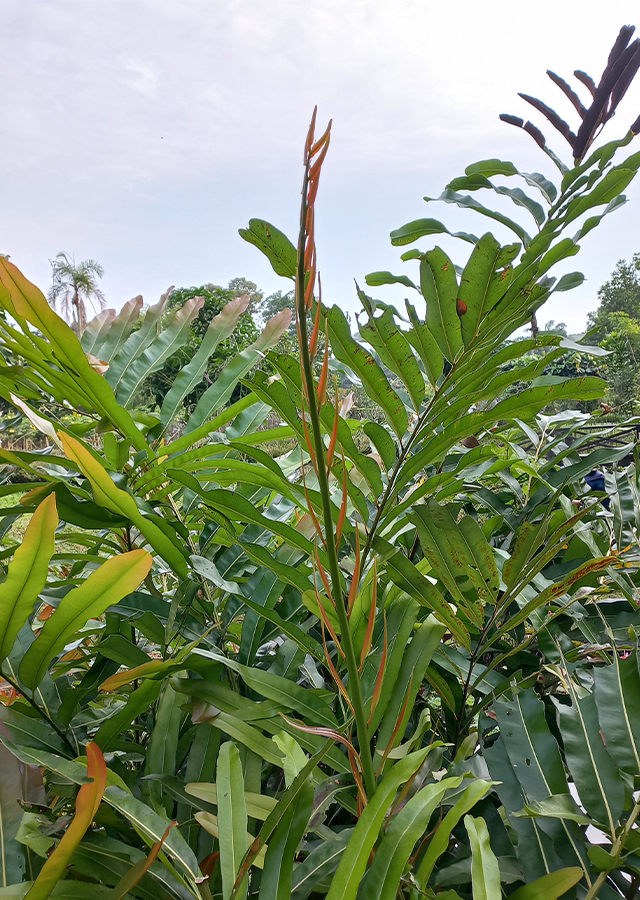
Paku laut (Acrostichum aureum) is a pantropical fern 1-3 meters tall from the Pteridaceae family, abundant in mangrove vegetation throughout Southeast Asia. Its young shoots are eaten as a vegetable after cooking to remove the thiaminase enzyme, while its dried leaves are sewn together for traditional roofing in Vietnam and the Pacific. Paku laut is traditionally used as a wound poultice and snake bite remedy in India.
Agroecology
Paku laut is a plant of humid lowland tropical and subtropical regions. Generally found in coastal areas, open mudflats in brackish swamps, mangrove or swamp edges, disturbed or clear-felled mangrove forests, along tidal streams, along the landward side of mangrove forests due to less tolerance for seawater flooding. Its young plants can tolerate changes between two conditions (saline or non-saline), but older plants become accustomed to saline or non-saline. Paku laut can grow well in full sun.
Morphology
- Rhizome upright, fibrous and covered with relatively large scales, scales linear to lanceolate to broadly ovate near the base of the petiole, shiny or pale brown with a blackish midrib.
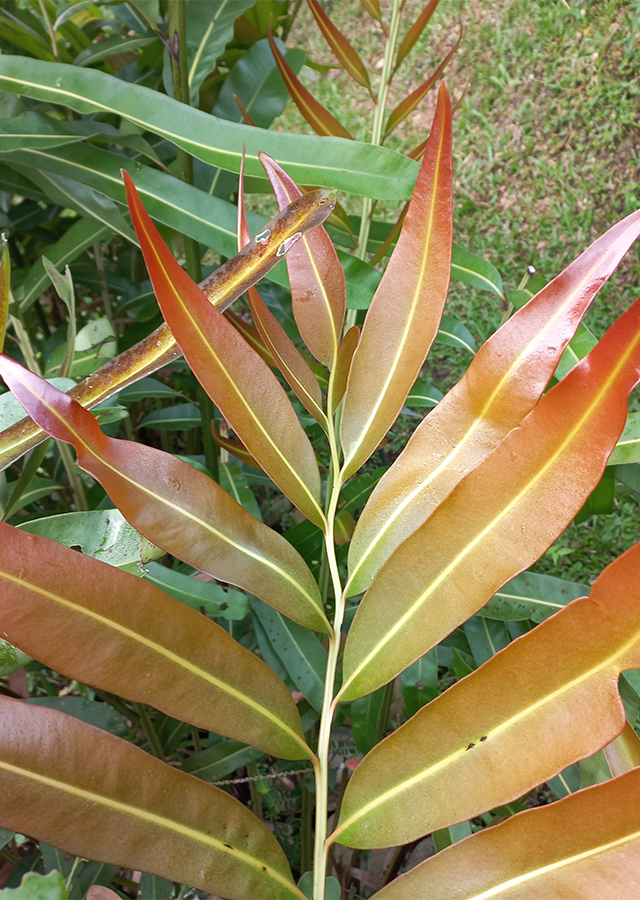
- Leaves dark green and upright or arching, consisting of 24-30 leaflets in an alternating arrangement. The frond stalk (known as a stipe) is usually about 1 m long. Five to eight pairs of leaflets near the tip of the leaf are fertile and their undersides are covered with reddish-brown sporangia. The remaining leaflets are sterile. Leaflets pinnate, narrowly oblong to elliptical shape with blunt or rounded leaf base, blunt leaf tip, small tail (mucronate), and bright red when young. Sporangia and sterile hairs (paraphyses) will cover the entire underside of the leaflet except the sheath and give a dark brown appearance.
- Flowers not produced.
Cultivation
Naturally propagated by spores. Vegetative propagation is possible by clump division and rhizome cuttings.
Chemical Content
Beta-sitosterol, alkaloids, flavonoids, phenolics, catechins, saponins, tannins, glycosides, terpenoids, steroids, amygdalin, arbutin, formic acid, oxalic acid, five phytosterols (stigmasterol, γ-sitosterol, campesterol, cycloartanol, and 24-methylene cycloartanol), 2 sesquiterpenes ((2R,3S)-sulfated pterosin C, (2S,3S)-sulfated pterosin C), and 2 derivatives ((2S,3S)-pterosin C and (2R)-pterosin P).
Benefits
Poultice for wounds and boils, treats snake bites, syphilitic ulcers, sore throat, chest pain, elephantiasis, constipation, diabetes, addresses cloudy urination in women, fever-reducing remedy, worm remedy, stops bleeding, has emollient properties (soothing and softening the skin).
Simplisia
- Prepare paku laut leaves as needed and wash with clean water.
- After clean, drain to remove excess wash water.
- Slice at 1.5 cm width so drying occurs faster.
- Dry by air-drying in a place protected from sunlight.
- Store in a clean, airtight container.
Local Names
Paku cai, Paku hata diuk (Sunda), Krakas, Warakas, Kakakeok (Java), Rewayang (Halmahera).
Traditional Recipes
The following recipes reflect traditional knowledge passed down through generations, not a substitute for professional medical diagnosis or advice. Consult a healthcare provider before use.
1. Snake bite antidote
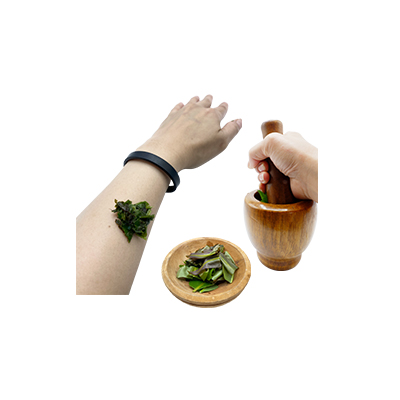
- Take fresh paku laut leaves as needed and wash until clean.
- Mash the leaves into a paste.
- Apply the leaf paste to the snake bite area.
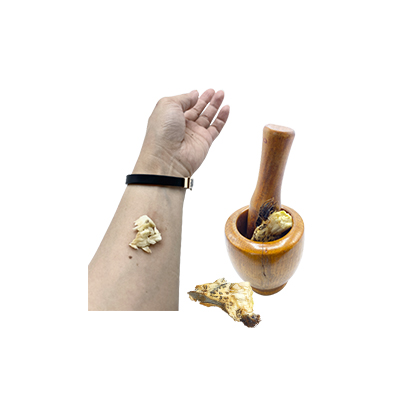
2. Boils and wounds
- Wash paku laut rhizome as needed until clean.
- Mash the rhizome into a paste.
- Apply the paste to the boil or wound.
Reference Sources
- Royal Botanic Gardens. Plants of the World Online: Acrostichum aureum L. http://www.plantsoftheworldonline.org/taxon/urn:lsid:ipni.org:names:319061-2. 2-10-2021.
- Flora Fauna Web. 2021. Acrostichum aureum L. https://www.nparks.gov.sg/florafaunaweb/flora/1/5/1535. 2-10-2021.
- Stuartxchange. 2015. Philippine Alternative Medicine: Lagolo. http://www.stuartxchange.org/Lagolo. 2-10-2021.
- Useful Tropical Plants Database. 2021. Acrostichum aureum. https://tropical.theferns.info/viewtropical.php?id=Acrostichum+aureum. 2-10-2021.
- PROSEA. 2016. Acrostichum aureum (PROSEA). https://uses.plantnet-project.org/en/Acrostichum_aureum_(PROSEA). 2-10-2021.