Adenium obesum (Forssk.) Roem. & Schult.
Summary
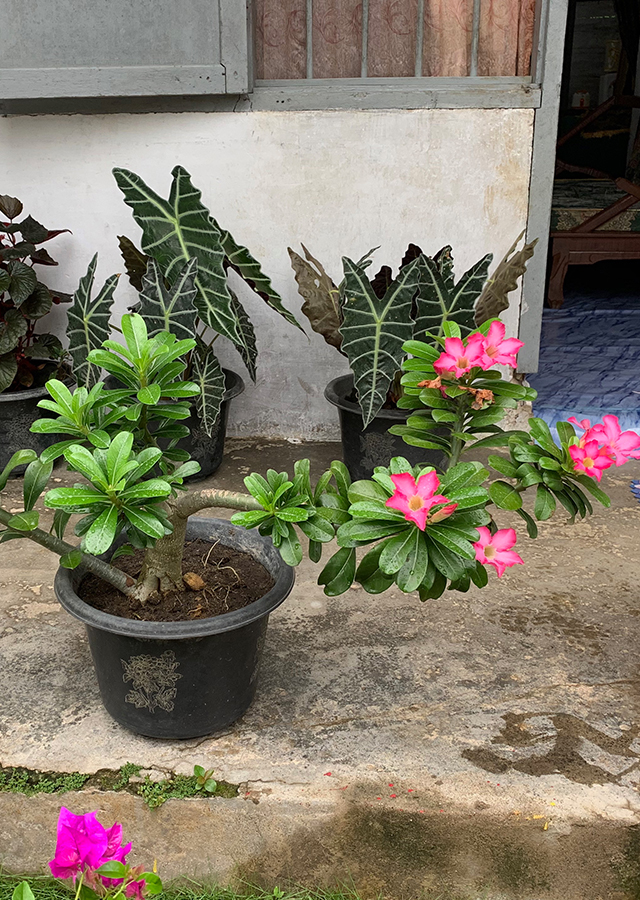
Desert rose (Adenium obesum) is a shrub up to 4 meters tall of the Apocynaceae family, native to West Asia, Africa, and the Arabian Peninsula. Its toxic sap was once used by African communities to hunt large animals, while its unique trunk shape has made it a favorite for bonsai. In traditional African medicine, its processed sap is used to treat wounds and warts.
Agroecology
A desert plant that can live up to an elevation of 2,100 m above sea level. Grows well at temperatures above 30 °C, but can also live in high air humidity. Its growth requires full sun.
Morphology
- Roots taproot, swelling to resemble a tuber.
- Stem round and elongated, soft, non-woody, latex-bearing, whitish-green.
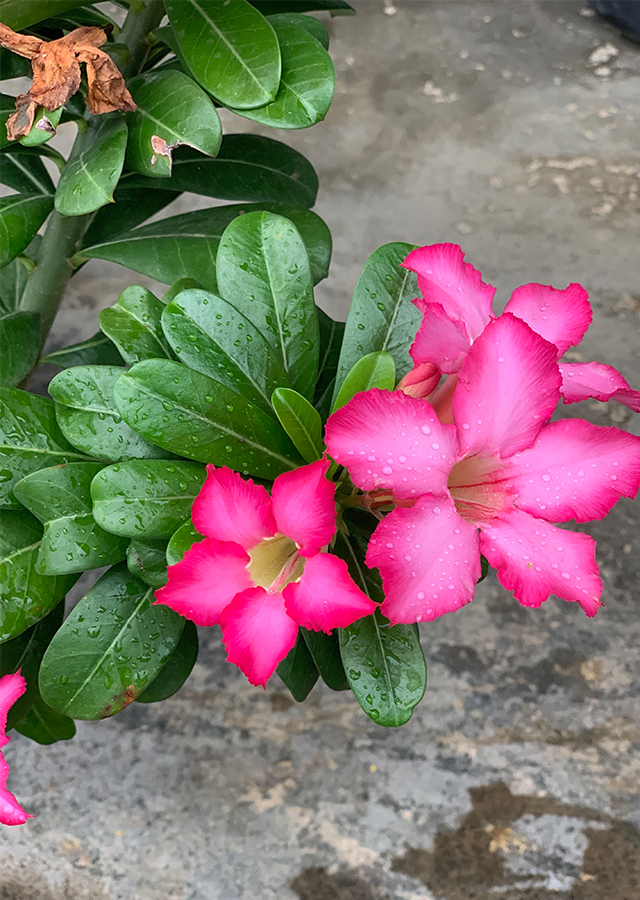
- Leaves elongated lanceolate, green, stalked, pointed base, rounded tip, smooth margins, pinnate venation, smooth upper surface, small in size.
- Flowers panicles, trumpet-like, corolla funnel-shaped, sepals and stamens numbering 5, varying in color.
- Fruit long and flattened, brownish-green when ripe, growing in pairs.
- Seeds small, light brown.
Cultivation
- Propagated through seed, stem cuttings, grafting.
- Generatively (seed), sprouting begins at 12-14 days, growing to a height of 4-5 cm after 2-3 months.
- Stem cuttings come from a healthy, sufficiently mature parent plant. After 6-7 days it can be moved to a hotter location.
- Grafting uses a rootstock with a sturdy base, with the scion coming from a plant with the desired flower. The rootstock must be larger than the scion. Shoots appear after 2 weeks.
Chemical Content
Fuvoplumerin, citronellol, phenethyl alcohol, geraniol, linalool, farnesol, saponins, glycosides.
Benefits
Treats wounds and warts, gonorrhea; addresses swelling; maintains skin elasticity; has anti-inflammatory activity.
Simplisia
- Prepare fresh desert rose stems and wash thoroughly under running water.
- Slice the stem thinly, then sun-dry for several days until dry.
- Grind the dried stem slices into a powder.
- Store in a clean, closed container.
Local Names
Information not found. Further research needed.
Traditional Recipes
The following recipes reflect traditional knowledge passed down through generations, not a substitute for professional medical diagnosis or advice. Consult a healthcare provider before use.
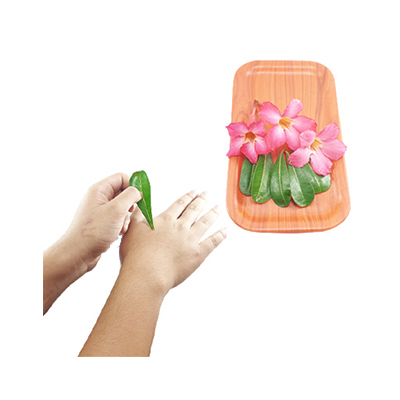
1. Treating Skin Warts
- Clean the wound or wart to be treated with water. Pick 1 desert rose leaf, and once sap emerges from the tip of the leaf stalk, drip or apply it to the wound or wart.
- Do this once a day until the wound dries or the wart falls off.
Reference Sources
- Mangyono. 2014. Cara mengobati luka, kutil dengan getah Adenuim obesum/kamboja jepang. https://www.mangyono.com/2014/05/cara-mengobati-luka-kutil-dengan-getah.html 01-08-2020