Alchornea rugosa (Lour.) Müll.Arg.
Summary
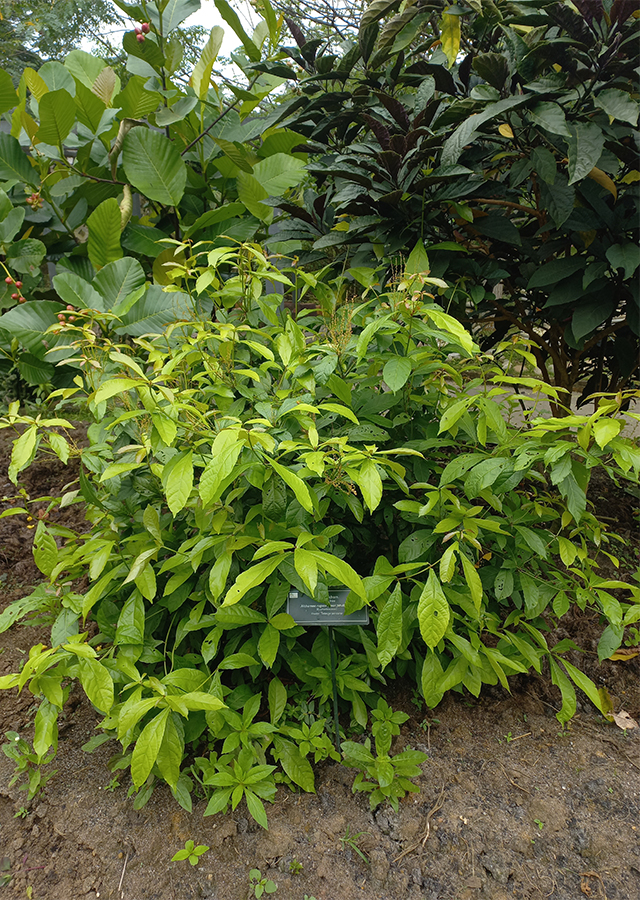
Alchornea rugosa or alchorn tree grows spread widely from China and Myanmar to Indonesia, the Philippines, and Papua New Guinea. In Vietnam, this wild plant has long been used in traditional medicine to reduce fever, treat malaria, and as a laxative, while its leaves are also used as a vegetable and cigarette paper material.
Agroecology
Alchorn tree grows widely in moist tropical areas, usually found at elevations up to 1,200 m asl, sometimes rising to 2,800 m asl. This plant is found in various soil types in the wild, often on or near limestone, even partly in guano near caves, clay loam, deep loam, ultrabasic soil; bedrock: shale, quartzite, sandstone, granite, in shaded or semi-shaded locations in various types of primary forest; secondary seasonal and heavily degraded forest; grasslands, cultivated land; coconut plantations; often in wet places such as swamps or along waterways.
Morphology
- Stem woody, multi-stemmed, height reaching 10 m.
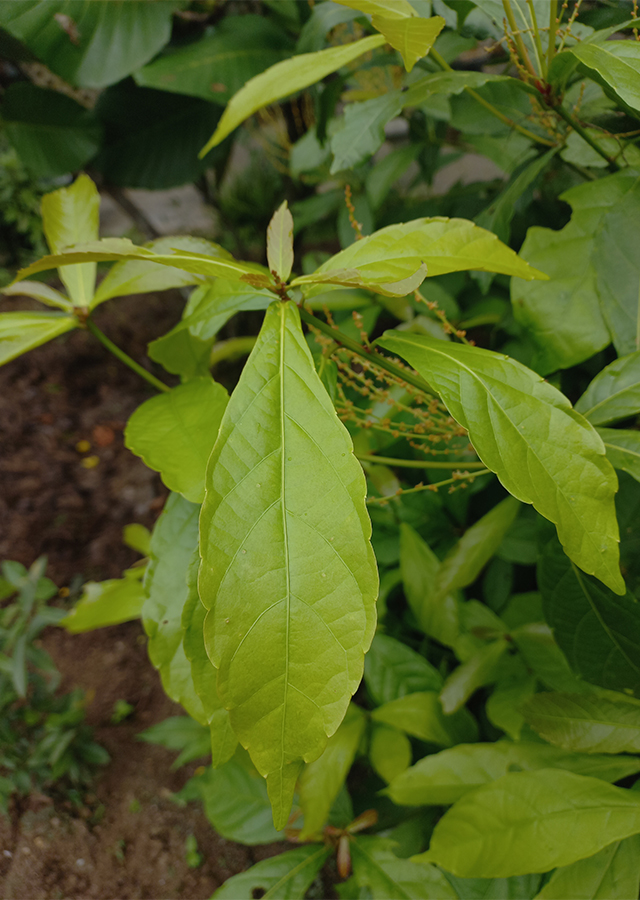
- Leaves cuneate-obovate, veins pinnate, with a very short petiole, stipulate.
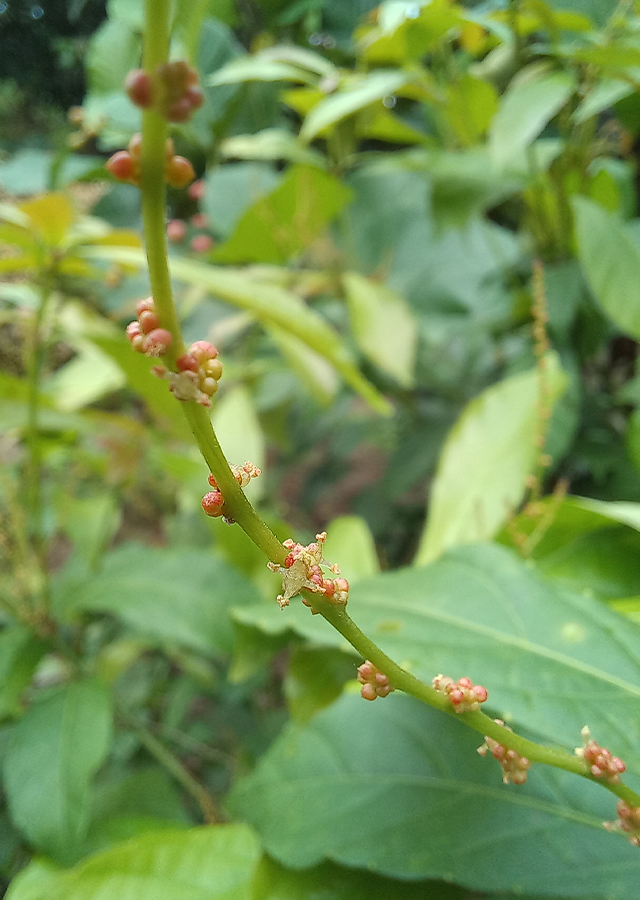
- Flowers divided into male and female flowers. Male flowers spike-shaped, fascicled and paniculate, branch length about 10-20 cm or more. Female flowers spike or raceme shaped, about 10-15 cm long. Stigma linear-subulate shaped, often persisting at the tip.
- Fruit a puberulent capsule, round +/- flattened shaped, 3-lobed, about 7-8 x 9-10 mm in size, calyx and stigma persistent.
- Seeds about 6 x 4-5 mm.
Cultivation
Plant propagation is done generatively with seed.
Chemical Content
There are five compounds including 3β-friedelanol, friedelan-3-one, methyl syringate, isovitexin, and rhoifolin.
Benefits
Reduces fever and treats malaria, relieves constipation or acts as a laxative, heals wounds, broken bones, and muscle regeneration.
Local Names
Kedung leutik, Ki bewok (Sunda), Drejeg (Jawa).
Traditional Recipes
The following recipes reflect traditional knowledge passed down through generations, not a substitute for professional medical diagnosis or advice. Consult a healthcare provider before use.
1. Wound
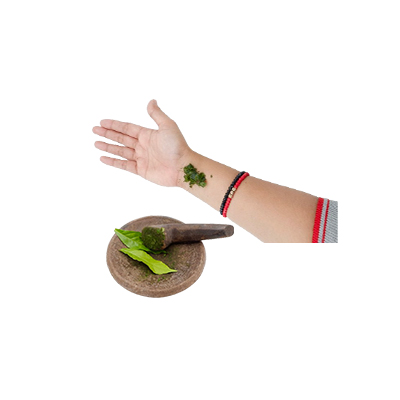
- Take an adequate amount of alchorn tree leaves and wash until clean.
- Grind until it becomes a paste.
- Apply the leaf paste as a poultice on the wound.
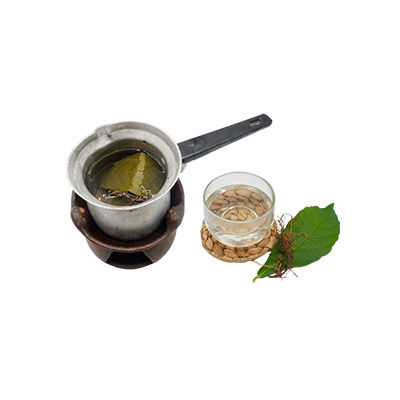
2. Fever
- Take an adequate amount of alchorn tree root and leaves and wash until clean.
- Boil until it boils.
- Let it cool to warm, strain then drink.
Reference Sources
- Royal Botanic Gardens, Kew. 2023. Plants of the World Online: Alchornea rugosa (Lour.) Müll.Arg. Alchornea rugosa (Lour.) Müll.Arg. | Plants of the World Online | Kew Science. 17-10-2023.
- PROSEA. 2016. Alchornea rugosa (PROSEA). Alchornea rugosa (PROSEA) - PlantUse English (plantnet-project.org).17-10-2023.
- Thi-Phuong Doan, Eun-Jin Park, Byeol Ryu, Hyo-Moon Cho, Sang-Jun Yoon, Gwan-Young Jung, Phuong-Thien Thuong, Won-Keun Oh. 2023. Unique guanidine-conjugated catechins from the leaves of Alchornea rugosa and their autophagy modulating activity. Phytochemistry. Volume 206, February 2023, 113521. Unique guanidine-conjugated catechins from the leaves of Alchornea rugosa and their autophagy modulating activity - ScienceDirect. 17-10-2023.
- Tropical Plants Database, Ken Fern. 2023. Alchornea rugosa. Alchornea rugosa - Useful Tropical Plants (theferns.info)
- Pham Van Huyen, Nguyen Thi Thu Hien, Nguyen Huu Huong Duyen, Nguyen Thi Dieu Thuan. 2022. Chemical constituents from the leaves of Achornea rugosa (Lour.) Müll. Arg.(Euphorbiaceae). Vietnam Journal of Science and Technology 60(3):343–349. DOI:10.15625/2525-2518/15442. Chemical constituents from the leaves of Achornea rugosa (Lour.) Müll. Arg.(Euphorbiaceae) | Request PDF (researchgate.net). 17-10-2023.
- Australian Tropical Rainforest Plants. 2020. Alchornea rugosa (Lour.) Mull.Arg. Alchornea rugosa (lucidcentral.org). 17-10-2023.