Aleurites moluccanus (L.) Willd.
Summary
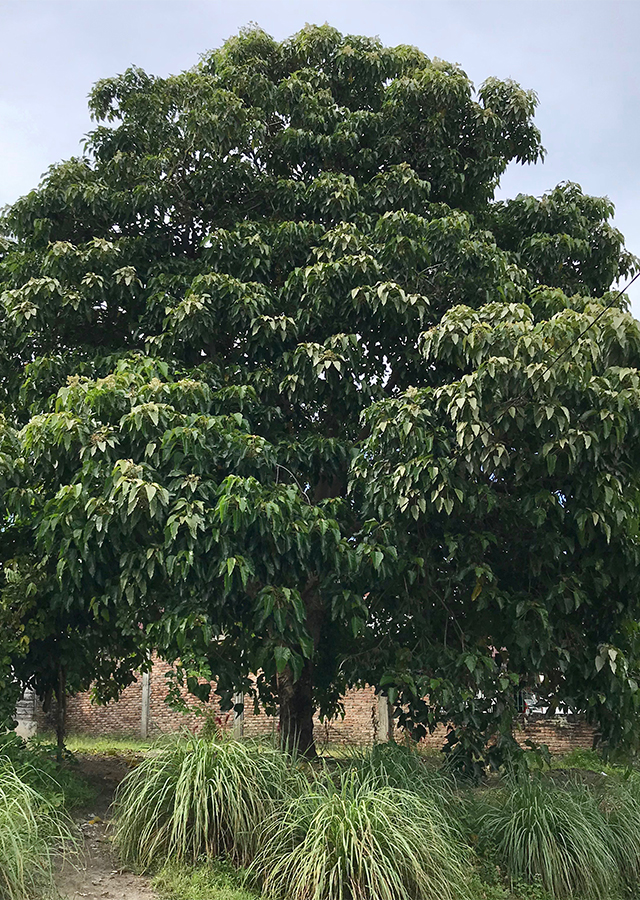
Kemiri or candlenut (Aleurites moluccanus) is a tree up to 30 meters tall of the Euphorbiaceae family, originating from Maluku and spreading to India and China, now the official state tree of Hawaii. Its seeds are an essential cooking spice in Nusantara dishes as well as a source of hair-growth oil and candle material. Traditionally, kemiri is also believed to relieve canker sores, toothache, and cough.
Agroecology
This plant is commonly found in tropical rainforest climate regions up to elevations of 1,200 m above sea level, temperature 19–27 °C and somewhat dry conditions during the dry season. Grows well near rivers with moist soil, annual rainfall ranging 640-4,290 mm/year.
Morphology
- Stem grayish-brown, somewhat smooth texture with beautiful vertical lines.
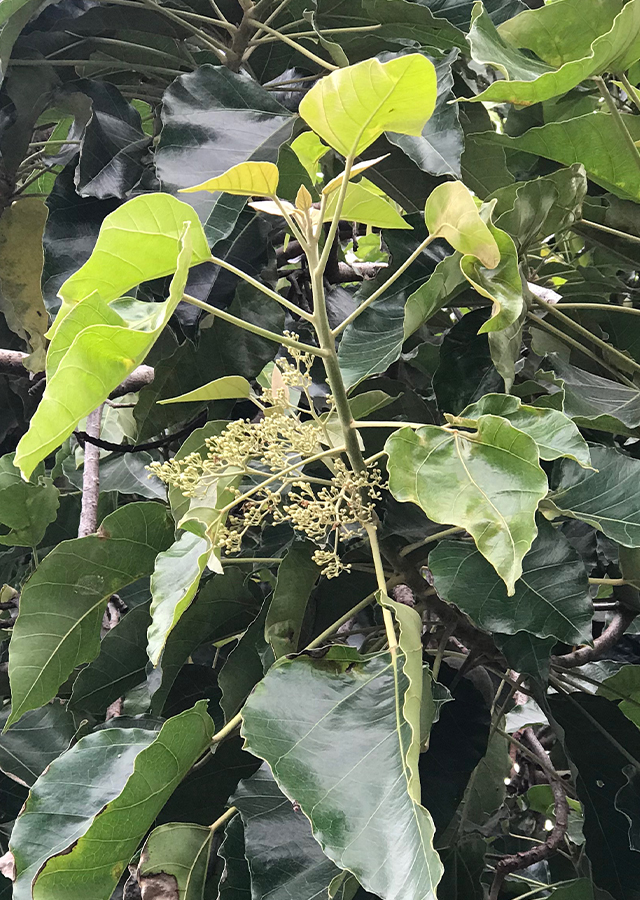
- Leaves single, alternating, dark green, oblong egg-shaped or triangular (when young), heart-shaped base, palmate venation only at first, wavy leaf edges.
- Flowers bisexual, greenish-white, fragrant, white petals.
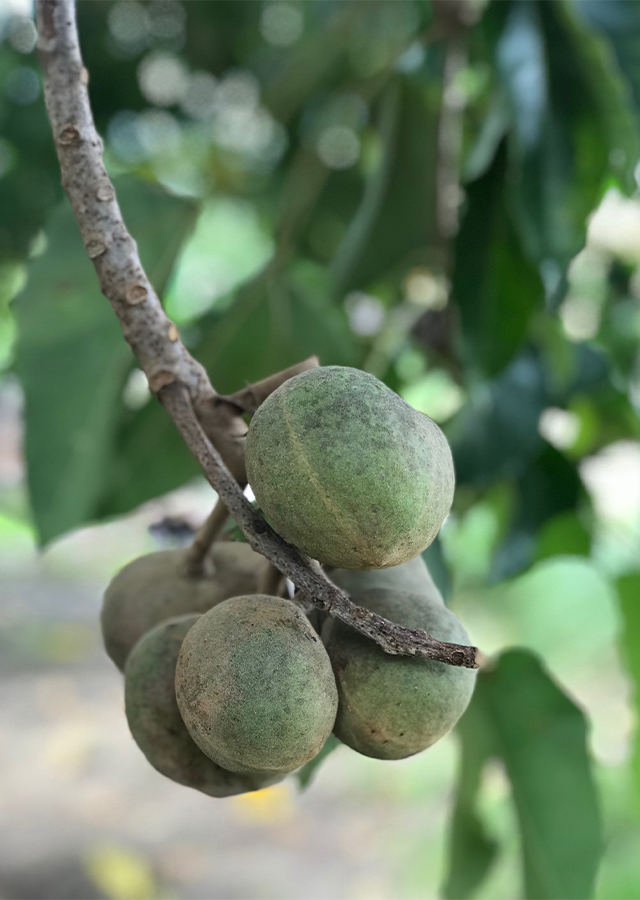
- Fruit somewhat flattened egg-shaped, green with velvety hairs, whitish flesh.
- Seeds rough-skinned, black, hard and thick-shelled, 2 or 1 per fruit.
Cultivation
- Propagated generatively (by seed) and vegetatively (air-layering, top-grafting, budding).
- Seeds are soaked for 15 days first then sown. Sprouts appear after 2 months.
Chemical Content
Oleic acid, linoleic acid, saponin, flavonoids (2-O-rhamnosylswertisin, swertisin), polyphenols, spruceanol, 3-acetyl aleuritolic acid, triglycerides, β-sitosterol, 12-hydroxy-13methoxy-8,11,13-podocarpatrien-3-one.
Benefits
Promotes hair growth, canker sore remedy, toothache, cough, diarrhea, tumor remedy, constipation, headache remedy, fever, boils, joint swelling, and gonorrhea.
Simplisia
- Select fresh, healthy leaves then wash thoroughly with running water. Cut into small pieces then dry.
- Grind the dried material into powder.
- Sift and store in a clean, closed container.
Local Names
Kembiri, Gambiri, Hambiri (Batak), Kemili (Gayo), Kemiling (Lampung), Buah kareh (Nias), Kumbe (Belitung), Miri, Pidekan, Miri (Java), Muncang (Sunda), Tenu (Nusa Tenggara), Kumiri (Maluku), Berau (Sulawesi).
Traditional Recipes
The following recipes reflect traditional knowledge passed down through generations, not a substitute for professional medical diagnosis or advice. Consult a healthcare provider before use.
1. Cough Remedy (Karo Specialty)
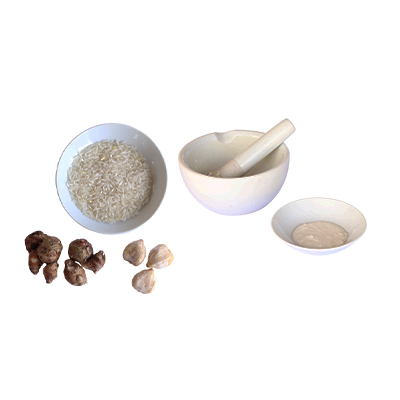
- Prepare 1 candlenut, 1 thumb-segment of kencur and 1 teaspoon rice.
- If the concoction is used for a baby, it's best to soak the rice first so it's not rough when sprayed.
- Clean the candlenut and kencur then chew all ingredients.
- Spray onto the chest area and leave for a while.
Reference Sources
- Adawiyah A. 2017. Analisis kadar saponin ekstrak metanol kulit batang kemiri (Aleuritas moluccana (L.) Willd) dengan metode gravimetri. Universitas Islam Negeri Alauddin. Makasar.
- Arlene A. 2013. Ekstraksi Kemiri Dengan Metode Soxhlet dan Karakteristik Minyak Kemiri. J. Teknik Kimia 2(2): 6-10.
- Hendra D, Darmawan S. 2007. Sifat Arang Aktif Dari Tempurung Kemiri. J. Penel. Hasil Hutan 25(4): 291-302.
- Krisnawati H, Kalilo M, Kanninen M. 2011. Aleurites moluccana (L) Wild.: Ekologi, Silvikultur dan Produktivitas. CIFOR Bogor, Indonesia.