Allamanda schottii Pohl
Summary
Allamanda schottii or fruiting allamanda is native to northeastern Argentina and southern Brazil, first described by Johann Baptist Emanuel Pohl in 1827 on the banks of the Paraíba River. In tropical regions, this plant is often planted as an ornamental hedge, though in some countries it has become a weed, and its white sap that comes out of the stem can cause skin irritation and diarrhea if ingested. Research shows fruiting allamanda has antiproliferative, cytotoxic, and antileishmanial properties with potential for further development.
Agroecology
Fruiting allamanda grows in soil rich in organic matter, moderate moisture, well-drained soil in full sun. Flowers best in full sun. Best performance occurs in hot and humid climates, where nighttime temperatures do not drop below 15.5°C. Prompt deadheading of spent flowers will encourage more blooms to grow.
Morphology
- Stem cylindrical, jointed, with milky sap and sometimes small branches.
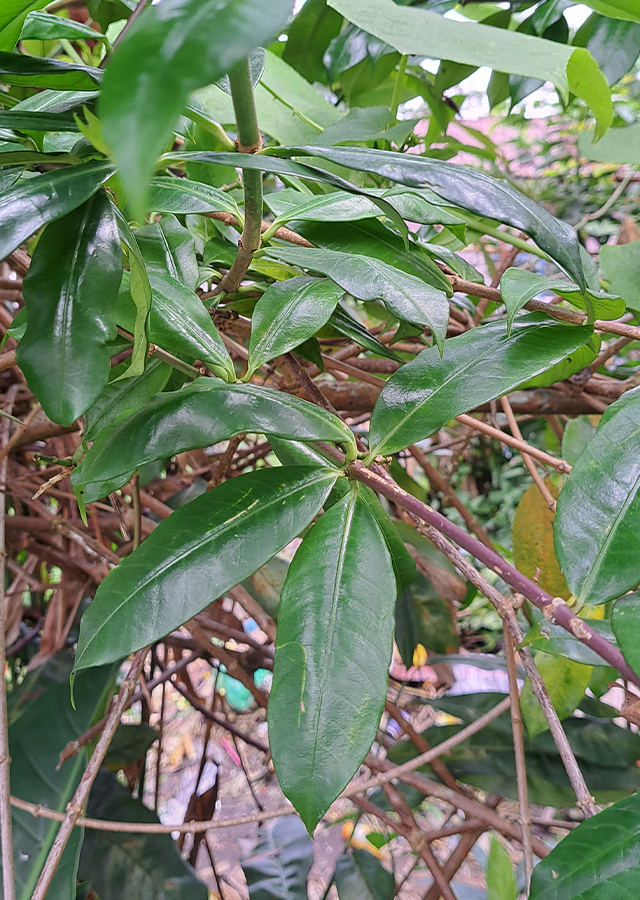
- Leaves narrow, opposite or whorled, 2 to 5 at each node, 8-10 cm long, 2-3 cm wide.
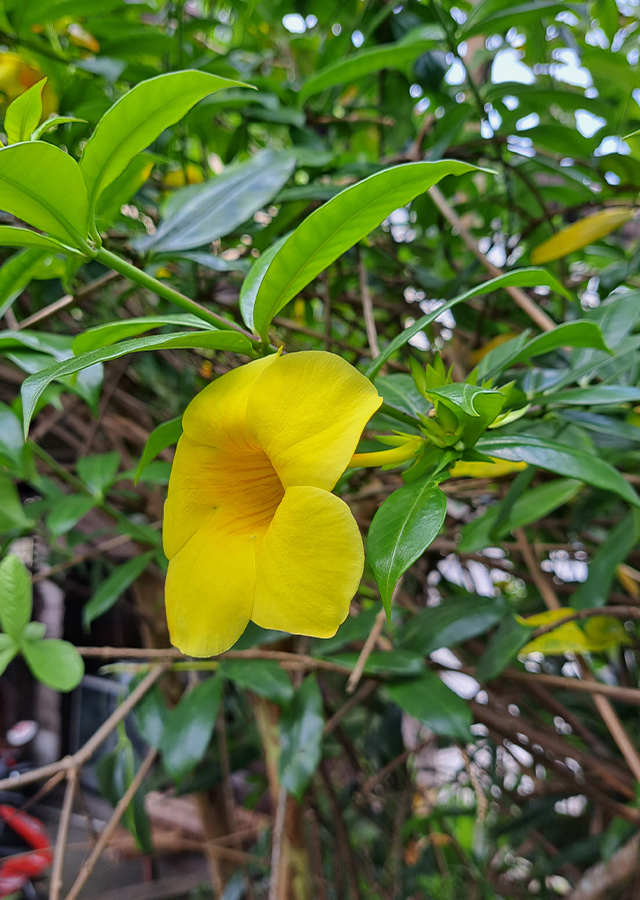
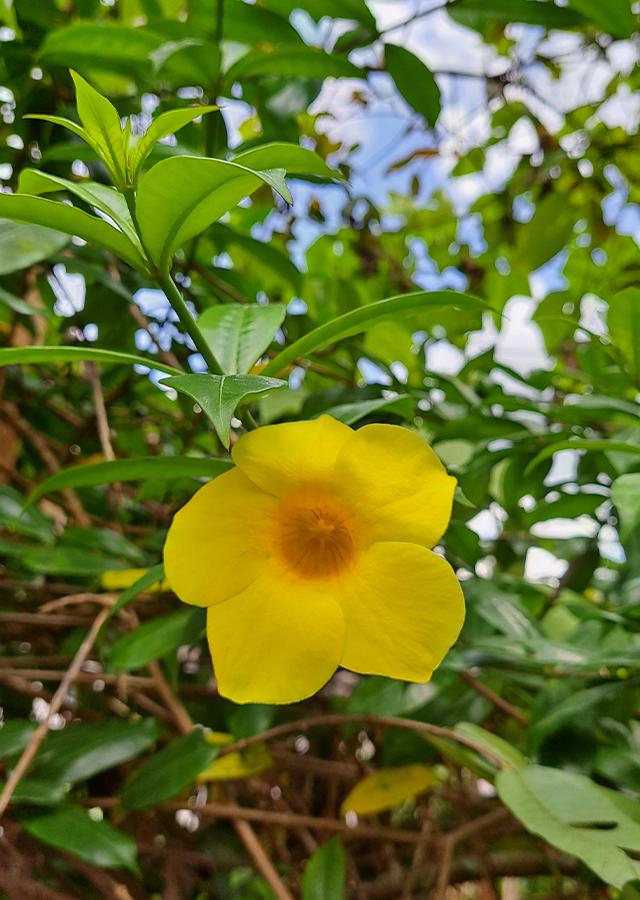
- Flowers bell-shaped with a golden yellow corolla, orange striped at the throat, up to 6 cm, with a short, swollen tube, angled at the base, inflorescence clustered (paniculate).
- Fruit a round, spiny capsule, like a rambutan.
Cultivation
Propagation is done by stem cuttings.
Chemical Content
A mixture of sitosterol and stigmasterol, plumericin, scopoletin, ursolic acid, plumieride, isoplumericin, 1-(3,4-dimethoxyphenyl)-ethane-1,2-diol and scoparone, flavonoids (rutin, kaempferol, and quercetin).
Benefits
Used as a laxative and vermifuge. Research has shown antiproliferative, cytotoxic, antileishmanial properties.
Local Names
Information not found. Further research is needed.
Reference Sources
- Royal Botanic Gardens, Kew. Plants of the World Online: Allamanda schottii Pohl. https://powo.science.kew.org/taxon/urn:lsid:ipni.org:names:76487-1#synonyms. 25-08-2022.
- Stuartxchange. 2018. Yellow allamanda-Allamanda schottii Pohl. http://www.stuartxchange.org/YellowAllamanda. 25-08-2022.
- Missouri Botanical Garden. Allamanda schottii. https://www.missouribotanicalgarden.org/PlantFinder/PlantFinderDetails.aspx?taxonid=254216&isprofile=0&. 25-08-2022.