Allium ascalonicum L.
Summary
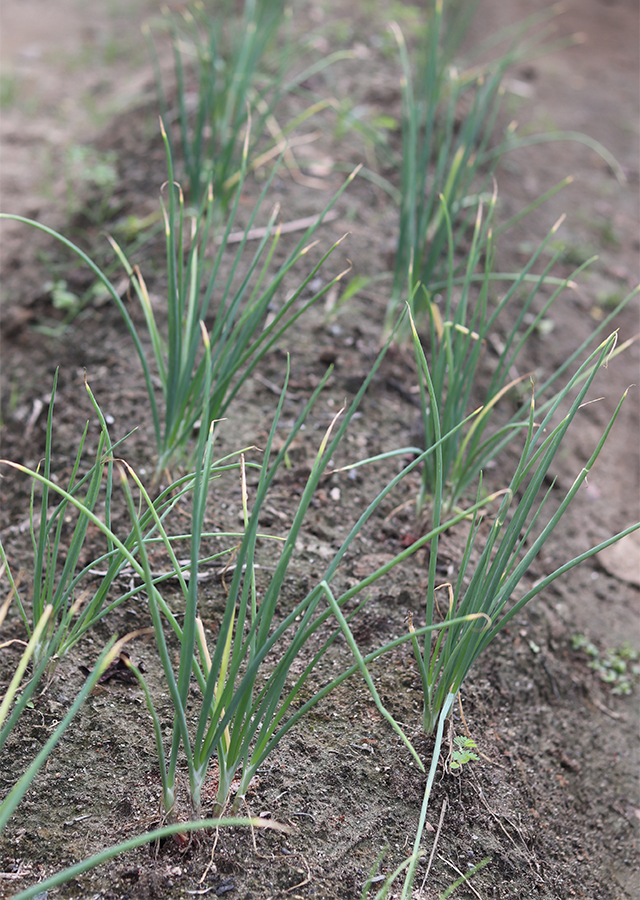
Shallot (Allium ascalonicum) is an annual herb up to 60 cm tall of the Amaryllidaceae family, thought to originate from the Eastern Mediterranean, cultivated since 5,000 years ago with a major production center in Brebes, Central Java. Its allin and allicin content acts as a natural antimicrobial. Shallot is traditionally believed to reduce fever, blood sugar levels, and cholesterol.
Agroecology
Shallot can grow well in both lowlands and highlands (0-900 m above sea level). This plant is vulnerable to high rainfall, where suitable rainfall for its growth is between 300-2,500 mm/year, and temperature ranges between 25-32°C, with relative air humidity between 80-90%. Prefers dry climate regions with somewhat hot temperatures and gets more than 12 hours of sunlight (lighting ± 70%), and open (does not require shade). The best soil types are sandy loam or silty loam with a soil pH of 5.5-6.5, fertile, loose, rich in organic matter, with good drainage and aeration.
Morphology
- Root fibrous, white, shallow root system.
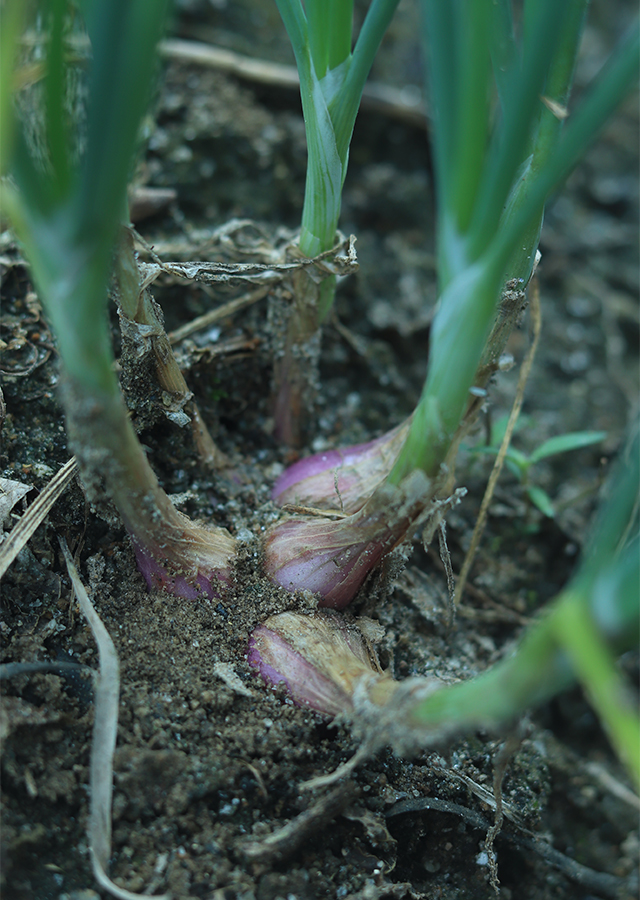
- Bulb layered, purplish-red in color, ovate shaped, strongly aromatic, has cloves, smaller in size than onion.
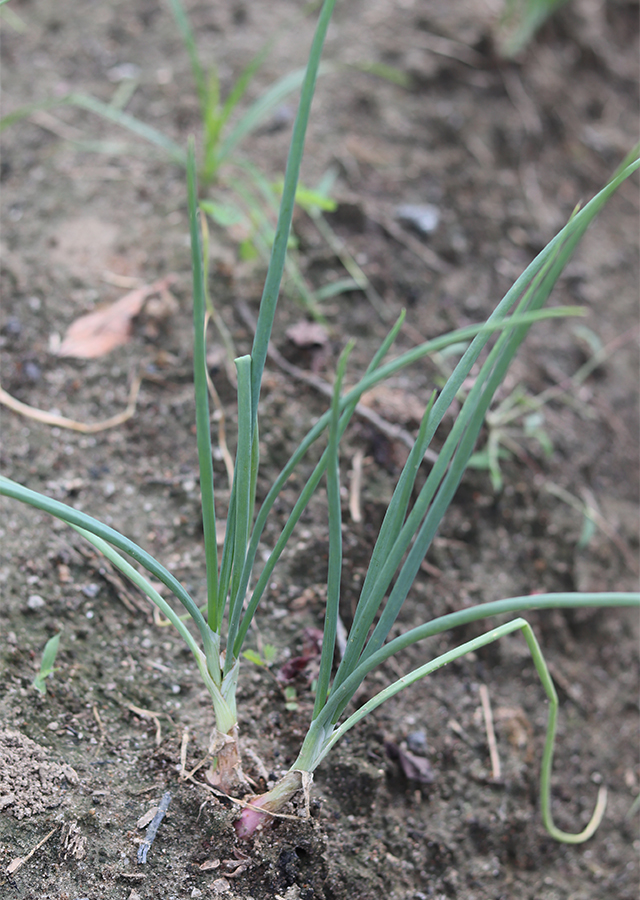
- Stem a pseudostem and is a small part of the overall buds.
- Leaves light green to dark green in color and turning yellow with age, cylindrical shaped, elongated and hollow like a pipe, tapering and subulate tip, grows upright, relatively soft, if crushed will emit a specific smell.
- Flowers compound in a stalked raceme with 50-200 florets. At the tip of the raceme stalk there is a head-shaped part with a somewhat pointed tip, and swollen in the middle, shaped like a hollow pipe inside. Ovate-oblong shaped, white or pale purple in color. Each floret consists of six yellowish-green stamens, and one pistil.
- Fruit round-shaped with a blunt tip.
- Seeds somewhat flat shaped, small in size. Young seeds clear white and turning black with age.
Cultivation
- Propagated generatively (seed) and vegetatively (bulb).
- Selection of good quality seedlings (bulbs) is medium-sized, healthy (glossy color, not porous, undamaged skin, hard), smooth outer skin surface, stored 2-3 months after harvest.
- Planting distance 20 x 15 cm or 15 x 15 cm.
- Harvest time, usually at 80-70 days of age after planting (after signs appear of 60% softened stem neck, plant lodging, and yellowing leaves).
Chemical Content
Alkaloid, anthraquinones, cardiac glycosides, tannin, cyanogenetic glycosides, flavonoid (quercetin, isorhamnetin, quercetin 4'glucoside, quercetin 7-glucoside, quercetin 4'3-diglucoside, isorhamnetin 4'3-diglucoside), furostanol saponins (ascalonicoside A1 and A2 (1,2) and ascalonicoside B (4), allin, allicin, essential oil.
Benefits
Reduces fever, lowers blood sugar and cholesterol levels, prevents thickening and hardening of blood vessels and ulcers, vermifuge, treats diarrhea, lower back pain, headache, earache (ringing ears), sore throat, cough, nerve pain, colds, insect bites, helps heal breast cancer, has aphrodisiac, antioxidant, antifungal properties.
Local Names
Pia (Batak), Bawang abang mirah (Aceh), Bawang beureum (Sunda), Bawang abang (Palembang), Brambang abang (Java), Bhabang mera (Madura), Jasun bang, Jasun mirah (Bali), Lasuna mahamu (North Sulawesi), Bawa rohiha (Ternate).
Traditional Recipes
The following recipes reflect traditional knowledge passed down through generations, not a substitute for professional medical diagnosis or advice. Consult a healthcare provider before use.
1. Breast cancer
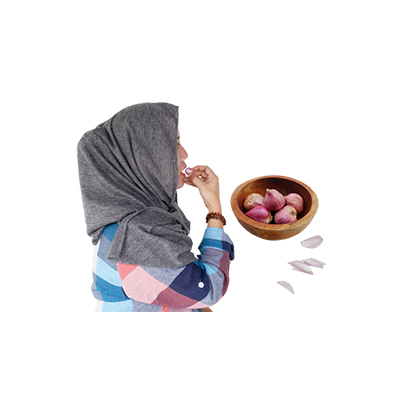
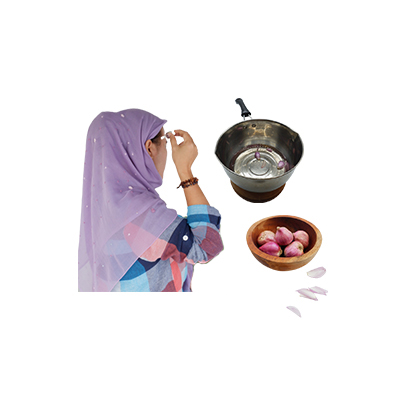
- Peel and wash shallot in running water until clean.
- Chew slowly.
- Consume every day.
2. Ringing ears or insect stings
- Prepare shallot as needed and wash thoroughly.
- Boil until boiling.
- Strain and take the boiled water.
- Drip into the ringing ear or apply to skin stung by an insect.
Reference Sources
- Plants of the World Online. 2021. Allium ascalonicum L. http://www.plantsoftheworldonline.org/taxon/urn:lsid:ipni.org:names:30185627-2. 01-09-2021.
- StuartXchange. 2021. Philippine Medicinal Plants: Sibuyas tagalog. http://www.stuartxchange.org/SibuyasTagalog.html. 01-09-2021.
- Kemendag. Profil Komoditas: Bawang merah. https://ews.kemendag.go.id/sp2kp-landing/assets/pdf/131212_ANL_UPK_BawangMerah.pdf. 01-09-2021.
- Sudarminro Setyo Yuwono. 2015. Bawang merah (Allium ascalonicum L; Synon. A. cepa L. var ascalonicum Backer). https://ews.kemendag.go.id/sp2kp-landing/assets/pdf/131212_ANL_UPK_BawangMerah.pdfhttp://darsatop.lecture.ub.ac.id/2015/12/bawang-merah-allium-ascalonicum-l-synon-a-cepa-l-var-ascalonicum-backer/. 01-09-2021.