Alpinia purpurata (Vieill.) K.Schum
Summary
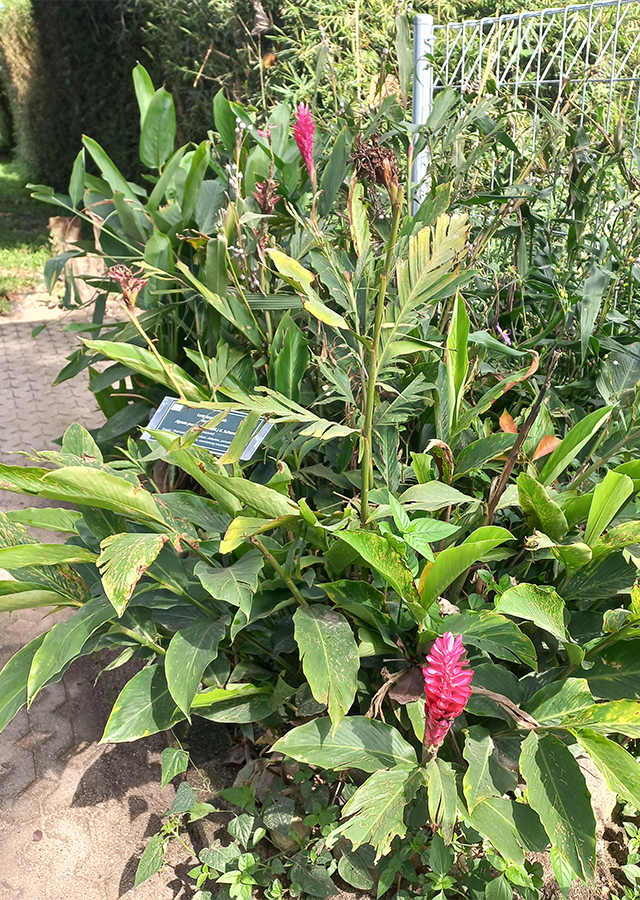
Lengkuas merah (Alpinia purpurata) is an erect herb up to 4 meters tall from the Zingiberaceae family that originates from eastern Indonesia to the Southwest Pacific. Since ancient times, pieces of lengkuas merah have been used to remove tinea versicolor spots on the skin, supported by its antifungal and antibacterial essential oil content. Its leaves also produce a natural yellow dye.
Agroecology
Under natural conditions, lengkuas merah can be found in secondary forests, moist roadsides, riverbanks, mangrove swamp edges, wetlands, lowland to medium-elevation forests, at elevations up to about 500 m asl. Lengkuas merah generally grows well in humid habitats with warm temperatures and high rainfall. Average annual rainfall ranges between 800-4,000 mm. Grows best in partially shaded areas, but is also able to adapt to open areas with full sun. Its growth prefers fertile, loose soil rich in humus, aerated and well-drained, and not waterlogged.
Morphology
- Roots have an aromatic rhizome, spreading in thick clusters, producing aerial shoots when older shoots dry out. Rhizome large, thick, fleshy, cylindrical, branching, the outer part somewhat reddish-brown with reddish scales, hard and glossy, while the inner part of the rhizome is white. The flesh of an old rhizome has coarse fiber and a sharp spicy taste.
- Stem herbaceous, upright, composed of leaf sheaths united to form a pseudostem, greenish-whitish. Young stems emerge as shoots from the base of the old stem.
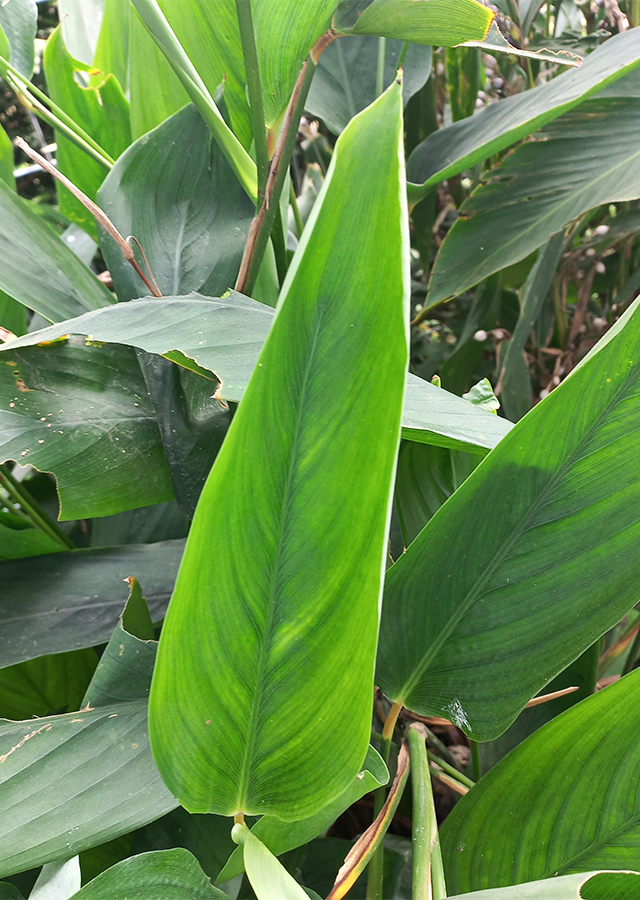
- Leaves single, alternately arranged, elongated lanceolate shape, green, hairless (glabrous), pinnate venation, short-pointed tip, smooth margin, sessile, pubescent, long sheath wrapping the stem, pubescent at the tip and along the sheath margin.
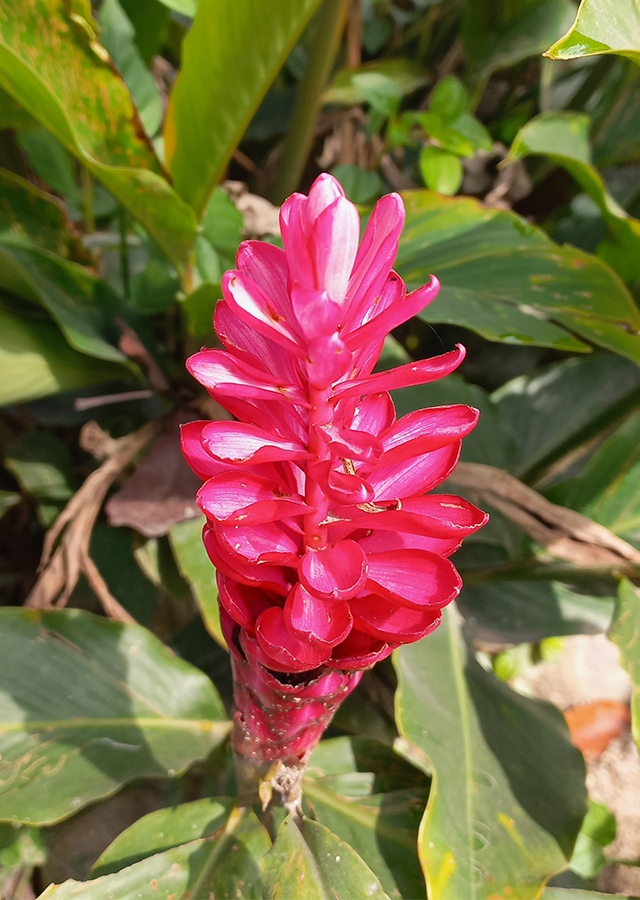
- Flowers small, compound, emerging from red bracts. Bracts ovate to obovate, primary bracts usually red, ovate or broadly ovate, bracteoles reddish, tube-shaped. Calyx reddish, glabrous, each lobe with a subapical spur. Corolla white, forming a cone, funnel or tube, emerging just outside the primary bracts. Stamens 6-7 mm long. Inflorescence a raceme, located at the stem terminal, unbranched.
- Fruit a nearly round capsule, 2-3 cm in diameter, hard. Young fruit is green-yellow, turning blackish-brown when old and splitting when ripe.
- Seeds round, ribbed, about 0.2 cm long, black, with a seed coating, oily.
Cultivation
Propagation can be done using seeds and rhizome division.
Chemical Content
Kumatakenin, sitosteryl-3-O-6-palmitoyl-β-D-glucoside, β-sitosteryl galactoside, essential oil (α-pinene, β-pinene, β-caryophyllene, camphene, 7-epi-α-selinene, 1,8 cineole, chavicol acetate, methyl cinnamate, galangin, eugenol, cis β-farnesene, 1-β-bisabolene, β-elemene), alkaloid, terpenoid, steroid, cardiac glycoside, tannin, 4-morpholinomethyl-7-methoxycoumarin, methanesulfonate (3R,4S)-3-propargyloxy-4-[(R)-1-hydroxy-3-phenyl-3-butenyl]-1-(p-methoxyphenyl)-2-azetidinone, 5-butyl-3-methyl-1,2,3,8a-tetrahydroindolizine, phenol, 4-(3,7-dimethyl-3-ethenylocta-1,6-dienyl)-, methenolone, nonanamide, 5-hydroxy-5-methyl-2-(2-methylpropyl)-N-benzyl-, flavonoid kaempferol-3-O-glucuronide, rutin.
Benefits
Treats stomach ache, colds, skin diseases (tinea versicolor), headaches, wounds, cough symptoms, ear inflammation, bronchitis, pain relief, has anti-inflammatory, antioxidant, antifungal, antibacterial, and anticancer activity.
Local Names
Laja (Sunda), Laos (Java), Langkueueh (Aceh), Lengkues (Gayo), Langkuwas (Banjar).
Traditional Recipes
The following recipes reflect traditional knowledge passed down through generations, not a substitute for professional medical diagnosis or advice. Consult a healthcare provider before use.
1. Stomach disorders (bloating)
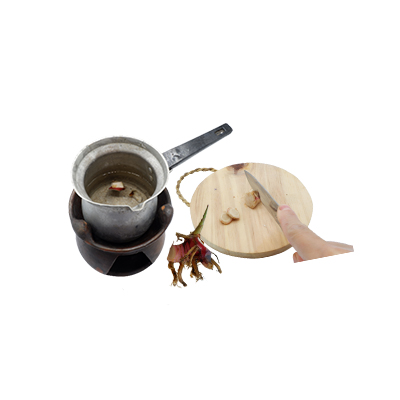
- Take 1 finger-length of lengkuas merah rhizome and wash until clean.
- Slice the rhizome thinly then boil with 3 glasses of water until reduced to 2 glasses of water.
- Strain, then drink morning and evening before eating, 1 glass each.
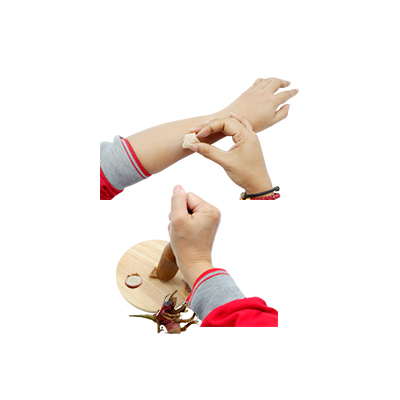
2. Tinea versicolor
- Prepare 1 finger segment of fresh lengkuas merah rhizome and wash until clean.
- Slice the rhizome diagonally then tap the tip until it resembles a brush.
- Rub onto the affected skin.
Reference Sources
- Flora Fauna Web. 2021. Alpinia purpurata. https://www.nparks.gov.sg/florafaunaweb/flora/1/6/1645. 29-10-2021.
- Royal Botanic Gardens. 2021. Plants of the World Online: Alpinia purpurata (Vieill.) K.Schum. http://www.plantsoftheworldonline.org/taxon/urn:lsid:ipni.org:names:795383-1. 29-10-2021.
- Stuartxchange. 2017. Philippine Medicinal Plants: Luyang pula. http://www.stuartxchange.org/RedGinger. 29-10-2021.
- CAB International. 2021. Invasive Species Compendium: Alpinia purpurata (red ginger). https://www.cabi.org/isc/datasheet/4377#toPictures. 29-10-2021.
- Useful Tropical Plants Database. 2021. Alpinia purpurata. http://tropical.theferns.info/viewtropical.php?id=Alpinia%20purpurata. 29-10-2021.
- Sujono H. dkk. 2019. Antifungal activity of red galangal oil (Alpinia purpurata K. SCHUM) against Malassezia furfur. Jurnal Kartika Kimia, 2(2): 86-91.