Alternanthera philoxeroides (Mart.) Griseb.
Summary
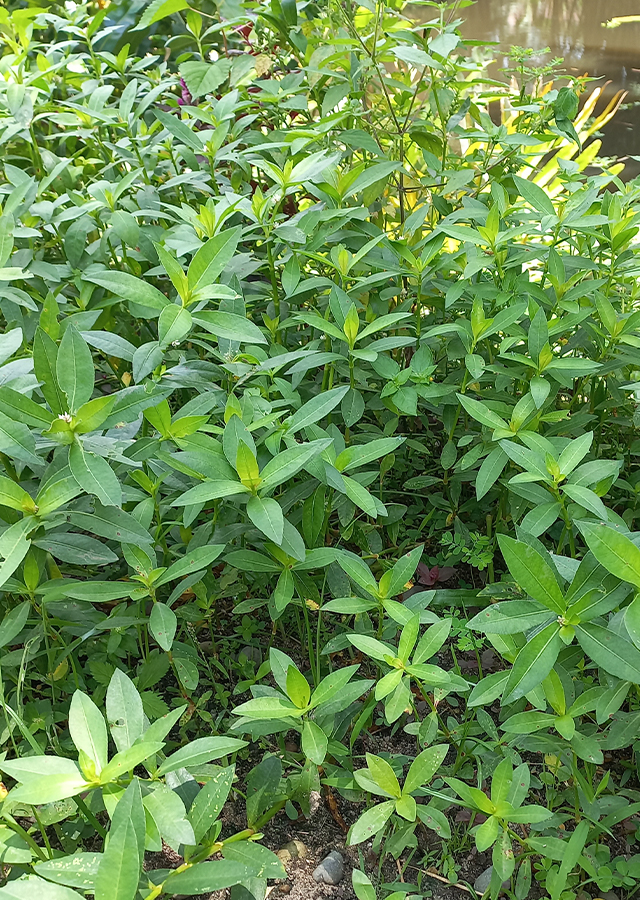
Rumput buaya (Alternanthera philoxeroides) is a herb up to 1 meter tall from the Amaranthaceae family, a weed native to South America now spread across tropical Asia including Indonesia that can disrupt aquatic ecosystems. Its young shoots are eaten as a vegetable in Indonesia, while in the United States it is cultivated as lobster food. Rumput buaya is an important medicinal ingredient in India, particularly for addressing 'women's diseases'.
Agroecology
Rumput buaya grows as a weed, both in aquatic and terrestrial habitats, and often grows at the interface between the two environments. This plant can be found growing along canals, rivers, swamps, lakes, dams, ditches, and wetlands, rooted in soil and emerging floating freely on the water surface. Rumput buaya can grow from lowlands to mountains at elevations of 100-1,500 m asl. Its growth requires an environment with average annual rainfall ranging 300-650 mm, air temperature around 30 °C, and growth will be hindered at temperatures below 7 °C, but tolerates average annual temperatures ranging between 10 to 20 °C. This plant is able to spread in moist soil adjacent to water edges, and soil acidity (pH) ranges between 4.8-7.7. Fairly salt-tolerant and can survive on upper tidal beaches and other saline conditions and grows well in high nutrient (eutrophic) conditions, but can survive in areas with low nutrient availability.
Morphology
- Roots fibrous and yellowish-white.
- Stem spreading, cylindrical, many-branched, jointed, roots present at the lower nodes, hollow with hairy grooves lengthwise on two opposite sides, green, yellow or red.
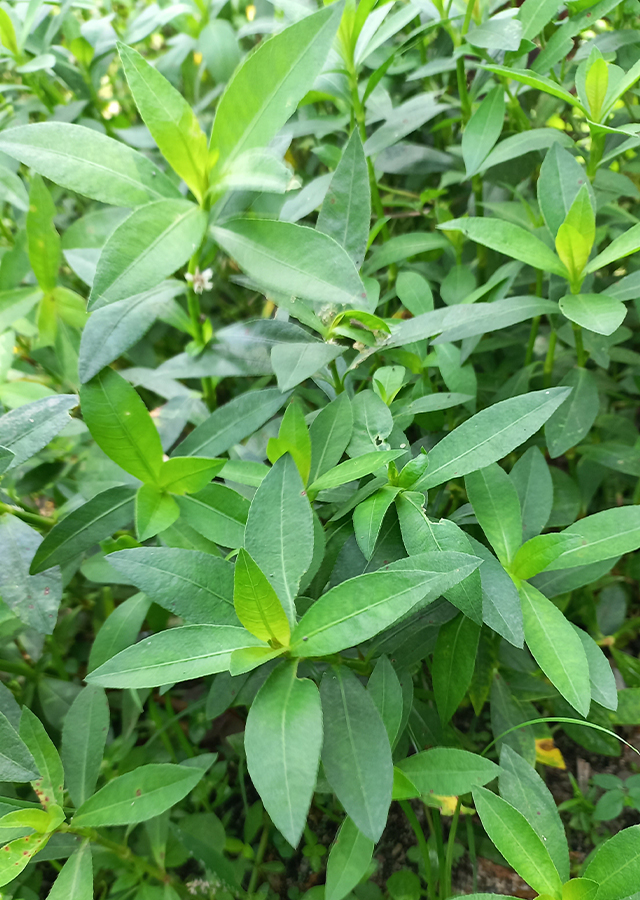
- Leaves single, opposite arrangement, lanceolate to narrowly oblong, tip rounded to pointed, base pointed, smooth margin, slightly fleshy, smooth surface, distinctly pinnate venation, hairless, green. Petiole short.
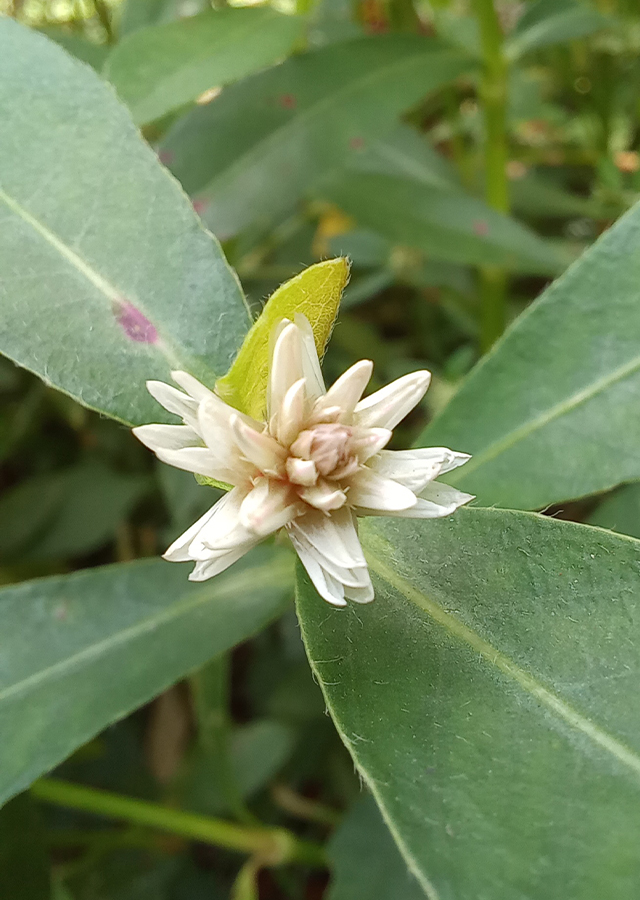
- Flowers compound, in a raceme, ivory white, located at the stem tip, up to 30 cm long, small, thin and round with a diameter of about 1 cm. Calyx green, star-shaped and 5-lobed, corolla smooth surrounding the flower cup where the stamens and pistil are located. Stamens numbering 5, fused below into a tube, appearing on a stalk 2-6 cm long in the leaf axil.
- Seeds lanceolate, small, and brown.
Cultivation
In Indonesia seeds are never produced and propagation is only done vegetatively from axillary shoots at each node.
Chemical Content
Amino acids, cardiac glycosides, steroids, alkaloids, flavonoids, tannins, phenolic compounds, pheophytin a, oleanolic acid, β-sitosterol, 3β-hydroxystigmast-5-en-7-one, α-spinasterol, 24-methylene cycloartanol, cycloeucalenol, phytol, alternanthin B, and N-trans-feruloyl-3,5-dimethoxytyramine.
Benefits
Treats bruises, coughing blood due to tuberculosis, hematuria (bloody urine), measles, stranguria with cloudy urine, eczema, venomous snake bites, has diuretic properties (promoting urination), has preventive and therapeutic effects against influenza.
Local Names
Tolod, Bayem empo, Bayem lemah (Java), Bayem hayu, Bayem kotok (Sunda), Ternak lakek (Madura), Bayam dempo.
Traditional Recipes
The following recipes reflect traditional knowledge passed down through generations, not a substitute for professional medical diagnosis or advice. Consult a healthcare provider before use.
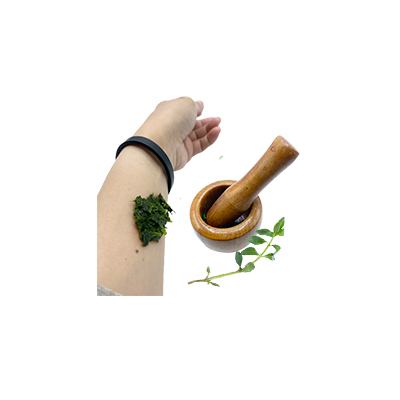
1. Bruises
- Take fresh rumput buaya leaves as needed and wash until clean.
- Mash the leaves into a paste.
- Apply the leaf paste to the bruised skin.
2. Diuretic
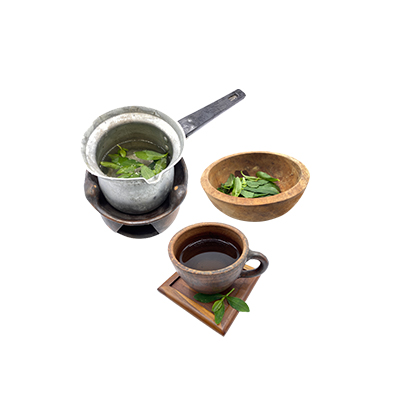
- Prepare rumput buaya leaves as needed and wash until clean.
- Boil the leaves until boiling.
- Strain the decoction.
- Drink while warm.
Reference Sources
- IPBIOTICS. 2014. View TumbuhanObat#Alternanthera philoxeroides. http://ipbiotics.apps.cs.ipb.ac.id/index.php/tumbuhanObat/799. 03-10-2021.
- Useful Tropical Plants Database. 2021. Alternanthera philoxeroides. http://tropical.theferns.info/viewtropical.php?id=Alternanthera%20philoxeroides. 03-10-2021.
- PROSEA. 2016. Alternanthera philoxeroides (PROSEA). https://uses.plantnet-project.org/en/Alternanthera_philoxeroides_(PROSEA). 03-10-2021.
- Royal Botanic Gardens. 2021. Alternanthera philoxeroides (Mart.) Griseb. http://www.plantsoftheworldonline.org/taxon/urn:lsid:ipni.org:names:1024156-2. 03-10-2021.
- CAB International. 2021. Invasive Species Compendium: Alternanthera philoxeroides (alligator weed). https://www.cabi.org/isc/datasheet/4403#tohistoryOfIntroductionAndSpread. 03-10-2021.
- Pulipati S., Babu S, Devi B.S., Devi G.R., Bhanuja M. 2015. Pharmacognostic Studies of Alternanthera philoxeroides (Mart.) Griseb. Journal of Pharmacognosy and Phytochemistry 4(2): 202-204.
- Setyawati,T., Narulita, S., Bahri I.P., Rahardjo,G.T. 2015. A Guide Book to Invasive Alien Plant Species in Indonesia. Research, Development and Innovation Agency. Ministry of Environment and Forestry.