Amaranthus tricolor L.
Summary
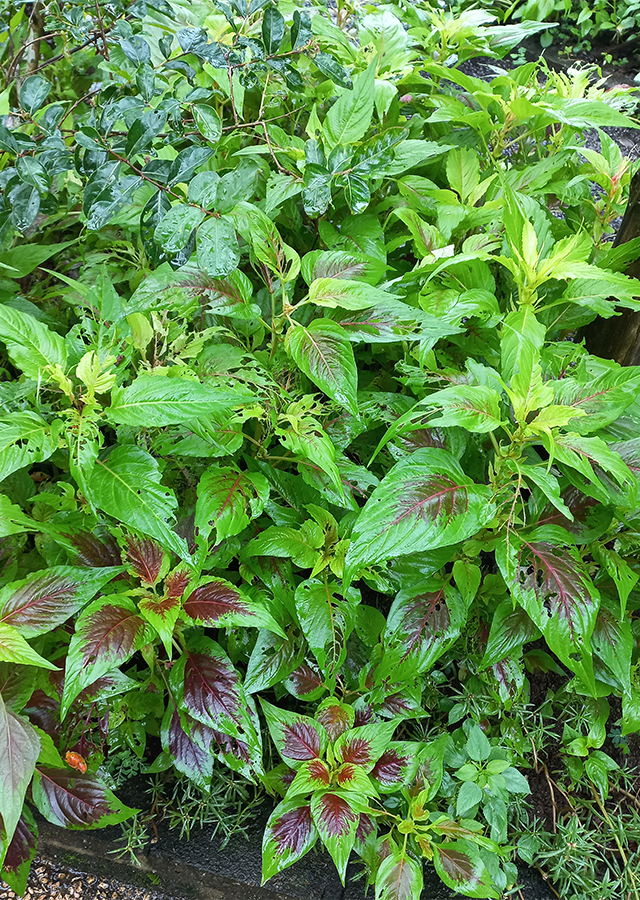
Bayam gajah (Amaranthus tricolor) is an erect annual herb up to 125 cm tall from the Amaranthaceae family that originates from tropical Asia, popular as a leafy vegetable in Indonesia and Malaysia. In India, its stem is steamed and tastes like asparagus, while its white root has a milk-like taste. In Ayurveda and Siddha, bayam gajah is traditionally used to treat menorrhagia and diarrhea.
Agroecology
Amaranthus tricolor weeds can sometimes be found on farmland, floodplains, roadsides, at elevations from sea level up to 1,000 m asl. Grows best in areas where annual daytime temperatures are in the range of 22-30 °C, but can tolerate temperatures of 8-45 °C, and average annual rainfall in the range of 1,200-1,500 mm, but can tolerate 300-2,700 mm. This plant prefers full-sun conditions and its growth is suited to loamy or muddy soil texture with good water-holding capacity, but is able to adapt to various soil types with a soil acidity (pH) in the range of 5.5-7.5, tolerating soil pH at 4.3 to 8. This plant is also tolerant of soil with high aluminum levels as well as drought.
Morphology
- Roots taproot, cylindrical shape, yellow.
- Stem many-branched, angular, hairless, purplish-pink with longitudinal streaks and grooves, brittle.
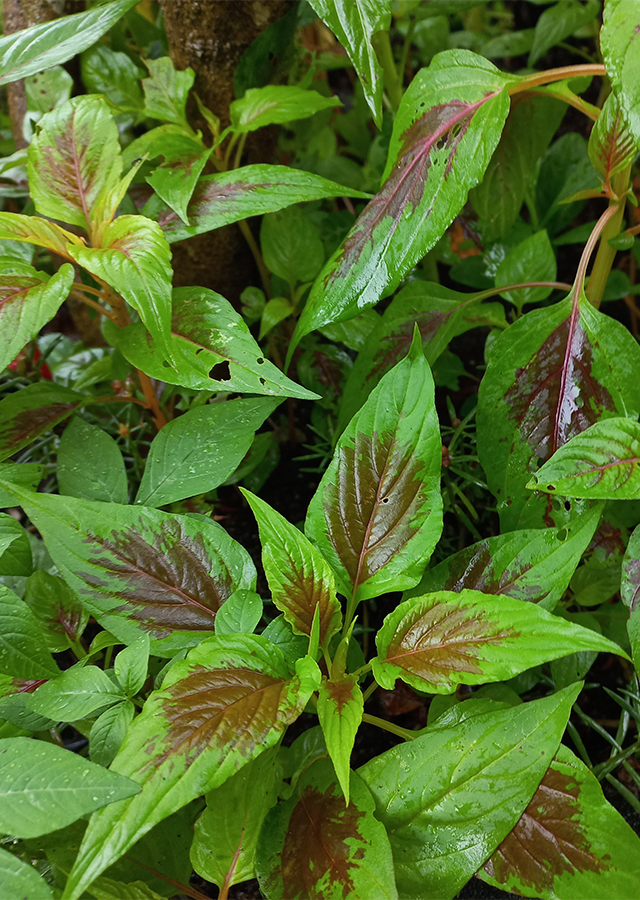
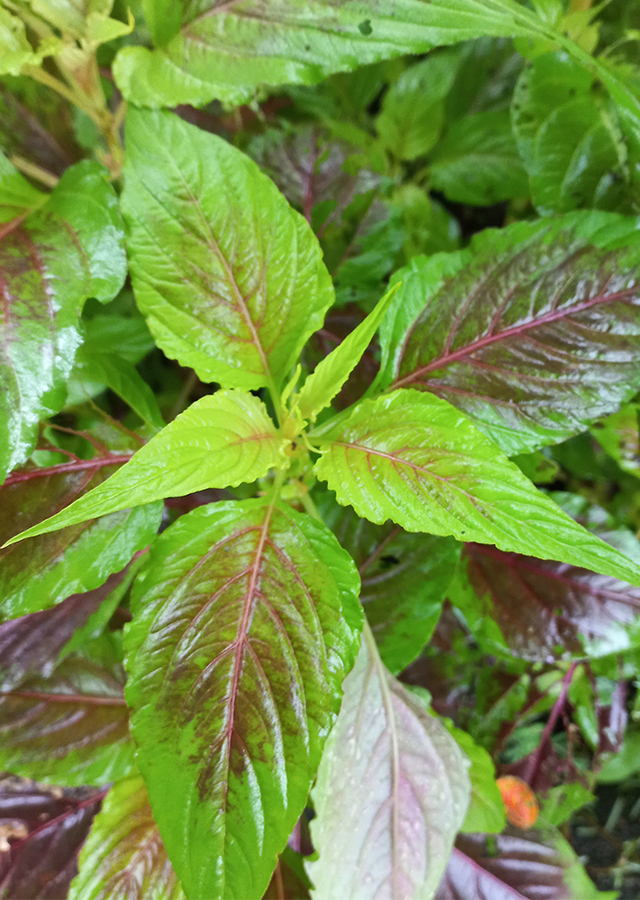
- Leaves alternately arranged or scattered, simple, broadly ovate, elliptical to lanceolate, petiolate, smooth-wavy leaf margin, tip pointed (acute), base tapering (cuneate). Leaf color dark green, light green or red.
- Flowers pink, purple, and red. Sepals numbering three. Male flowers have three stamens, female flowers have a superior single-celled ovary with three stigmas. Appear in round clusters in the leaf axils. Inflorescence occurs near the stem tip usually short, but sometimes longer.
- Fruit an ovate-urceolate capsule, circumscissile below the middle, 3 mm long with a single seed.
- Seeds ovate, brown or black, finely or faintly reticulate, lenticular shape.
Cultivation
- Propagation by seed (generative) and stem cuttings (vegetative).
- Seeds are sown in a nursery first then transferred to a permanent position after 2-3 weeks.
Chemical Content
Squalene, saponin, amaranthine, isoamaranthine, amino acids, steroid, cardiac glycosides, alkaloid, tannin, flavonoids (kaempferol and quercetin), ascorbic acid, betalain pigments (betacyanin and betaxanthin), phenolic acids, linoleic acid, linolenic acid, palmitic acid, sterol, spinasterol, 24-methylenecycloartenol.
Benefits
Treats pain, anemia, dysentery, skin diseases, diabetes, cleanses the blood, treats hemorrhoids, bladder problems, toothache, controls bleeding after abortion, improves vision, strengthens the liver, treats external inflammation and bladder disorders, vaginal discharge, menorrhagia, cough, bronchitis, throat infections, has aphrodisiac, astringent, diuretic properties, hemorrhagic colitis. Has hepatoprotective, antimicrobial, anti-inflammatory, and antihyperglycemic activity.
Local Names
Bayam cabut, Bayam glatik, Bayam kakap (Jakarta), Bayem abrit, Bayam lemah, Bayam ringgit, Bayam sekul (Java), Jawa lufife (South Halmahera), Baya roriha (Ternate), Loda kohori (Tidore).
Traditional Recipes
The following recipes reflect traditional knowledge passed down through generations, not a substitute for professional medical diagnosis or advice. Consult a healthcare provider before use.

1. Controlling bleeding after abortion
- Wash bayam gajah root until clean.
- Boil the root until boiling.
- Let stand until warm/cool.
- Strain, then drink.
2. Improving vision
- Take a mature bayam gajah plant, then wash until clean.
- Boil the plant until boiling.
- Strain the decoction.
- Drink while warm.
Reference Sources
- Royal Botanic Gardens. 2021. Plants of the World Online: Amaranthus tricolor L. http://www.plantsoftheworldonline.org/taxon/urn:lsid:ipni.org:names:327386-2. 11-10-1021.
- CAB International. 2021. Invasive Species Compendium: Amaranthus tricolor (edible amaranth). https://www.cabi.org/isc/datasheet/112199#toPictures. 11-10-1021.
- Flora Fauna Web. 2019. Amaranthus tricolor L. https://www.nparks.gov.sg/florafaunaweb/flora/5/8/5891. 11-10-1021.
- Kumar K, et.al. 2019. Phytochemical and pharmacological aspect of Amaranthus Tricolor linn Review. IJAMSCR, 7(1).