Amorphophallus muelleri Blume
Summary
Porang (Amorphophallus muelleri) is an upright herb up to 1.5 meters tall of the Araceae family, distributed in Indonesia, Myanmar, and Thailand, and once played a role in supporting food security during the Japanese occupation. Its glucomannan-rich tuber is now a raw material for high-value export products like shirataki noodles, jelly, and ice cream thickener. Porang is also believed to help lower cholesterol and blood sugar levels.
Agroecology
Porang can be found in areas up to elevations of 700-900 m above sea level, optimum temperature 25 °C. This plant prefers moist soil conditions with soil pH 6-7.5, well-drained, humus-rich soil and partial shade.
Morphology
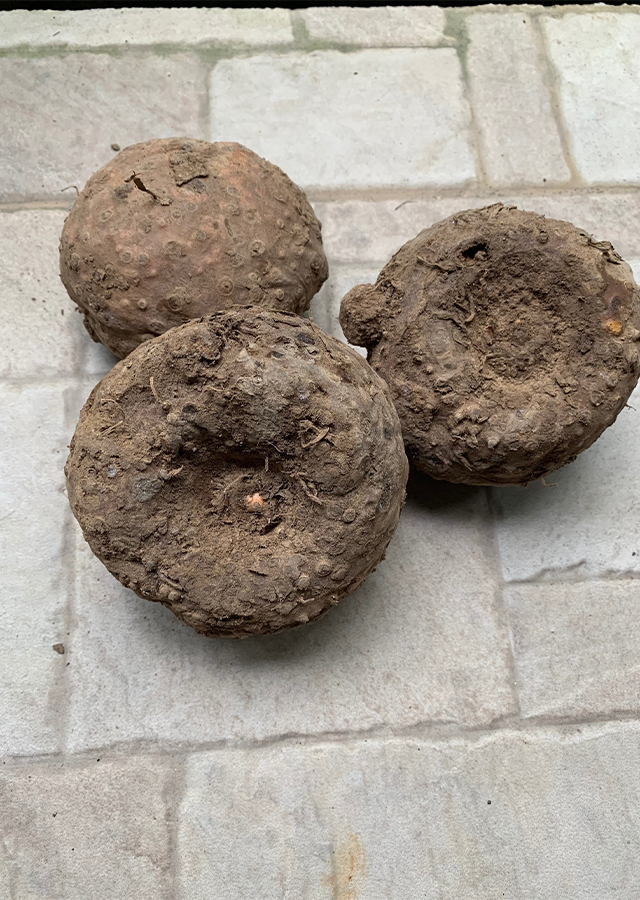
- Tuber diameter up to 28 cm, brown outer color, yellow inside, weight reaching 3 kg.
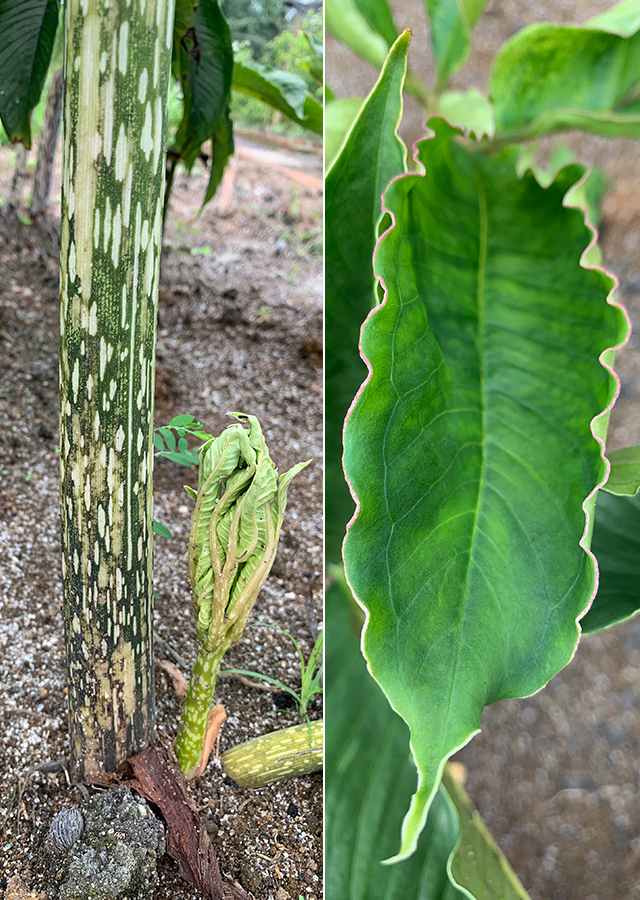
- Stem single, splitting to form secondary stems and leaf stalks, smooth surface (no thorns), green in color, with white spots.
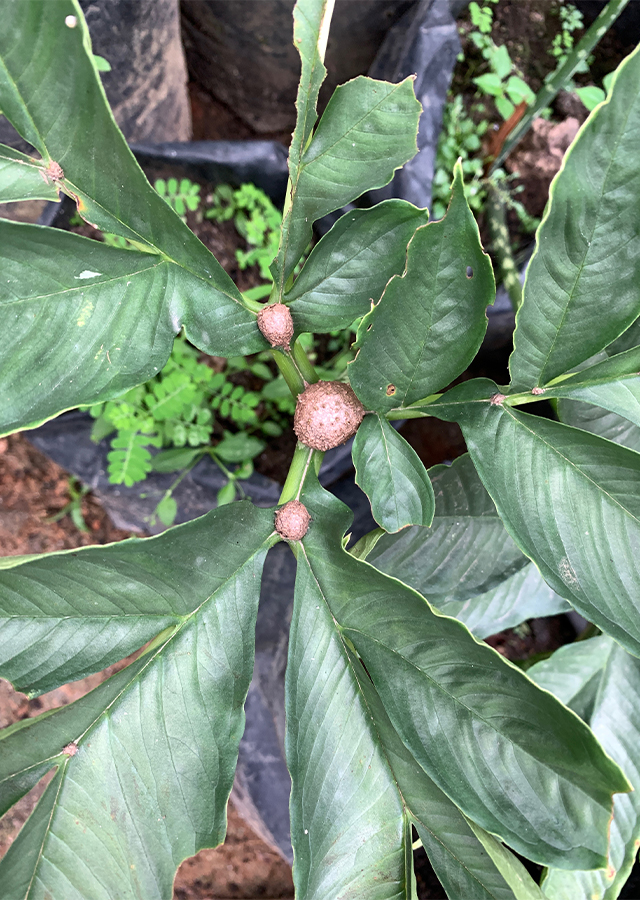
- Leaves elliptical shaped with a tapering tip, wavy, smooth and fine surface, green in color, has pale green spots, at the base of each branching there is a leaf tuber or bulbil.
- Flowers compound, fleshy, green when young, yellowish-green when starting to mature and orange-red when mature.
- Fruit green when young, reddish when mature and turning blackish as a sign it is ready to harvest. One fruit contains 2 seeds.
Cultivation
- Propagated generatively (by seed) and vegetatively (stem tubers, leaf tubers, and leaf cuttings).
- The first harvest is done when the plant is 3 years old and thereafter once a year.
Chemical Content
Calcium oxalate, xylose, arabinose, rhamnose, glucose, galactose, mannose, mannan, glucomannan (β-D-glucose and β-D-mannose).
Benefits
Lowers cholesterol levels, blood sugar (diabetes) and body weight, improves digestive and immune function, addresses constipation, and boils.
Simplisia
- Select good, non-rotten tubers
- Wash thoroughly, remove the skin and slice to a thickness of 0.5 cm.
- Dry the tuber in a drying cabinet at 50 °C until the porang chip condition is easily broken.
- Grind and sift using a 100 mesh sieve to obtain fine porang flour.
- Store the flour in a clean, closed bag.
Local Names
Kerubut (Sumatra), Badur (Java), Acung (Sunda).
Traditional Recipes
The following recipes reflect traditional knowledge passed down through generations, not a substitute for professional medical diagnosis or advice. Consult a healthcare provider before use.
1. Boils
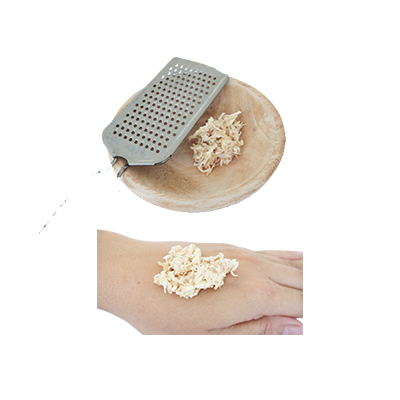
- Wash 5 g fresh tuber thoroughly then grate.
- Apply the grated result to the boil-affected area.
- Side effect: Do not eat this tuber directly as it causes an itching sensation when eaten.
Reference Sources
- Prosea. 2017. Amorphophallus muelleri. https://uses.plantnet-project.org/en/Amorphophallus_(PROSEA) 10-12-2019.
- Impaprasert R, Srzednicki G, Borompichaichartkul C, Zhao J, Yu L. 2013. Improving Production Of Purified Konjac Glucomannan From Amorphophallus Muelleri By Multistage Drying . Acta Hortic. 1011, 155 162, DOI: 17660/ActaHortic. 2013. 1011. 18.
- Keithley JK, Swanson B, Mikolaitis SL, DeMeo M, Zeller JM, Fogg L, Adamji J. 2013. Clinical Study Safety and Efficacy of Glucomannan for Weight Loss in Overweight and Moderately Obese Adults. Journal of Obesity Volume 2013, Article ID 610908, 7 pages http://dx.doi.org/10.1155/2013/610908.