Anacardium occidentale L.
Summary
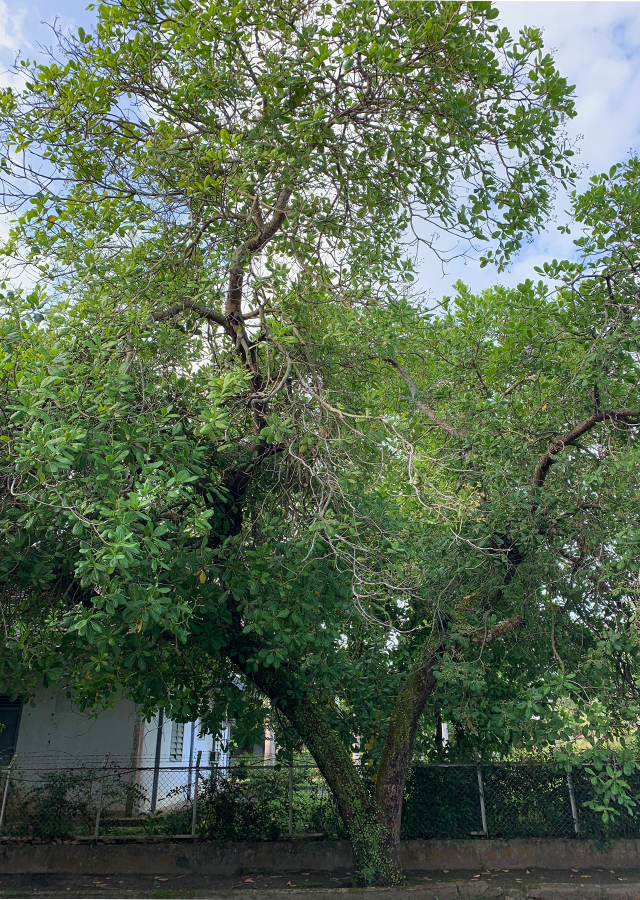
Cashew (Anacardium occidentale) is a tree up to 12 meters tall of the Anacardiaceae family, native to Brazil, carried by Portuguese sailors to India before spreading to Africa and Southeast Asia including Indonesia. Its economically valuable seeds are widely processed in the food industry, while its young leaves are rich in vitamins A and C. Traditionally, cashew is also believed to lower cholesterol and support liver function.
Agroecology
Grows at elevations up to 1,000 m above sea level, average temperature of 27 °C, and favors full sun. Suited for cultivation in areas with 70-80% humidity, rainfall ranging from 1,000-3,500 mm/year with 4-6 dry months. Favors sandy soil, sandy loam, and light sandy soil with a pH between 4.5-6.5.
Morphology
- Trunk woody, cylindrical, straight, rough, heavily branched. Bark is brown.
- Leaves located at the twig tips. Leaf blades stalked, ovate shaped.
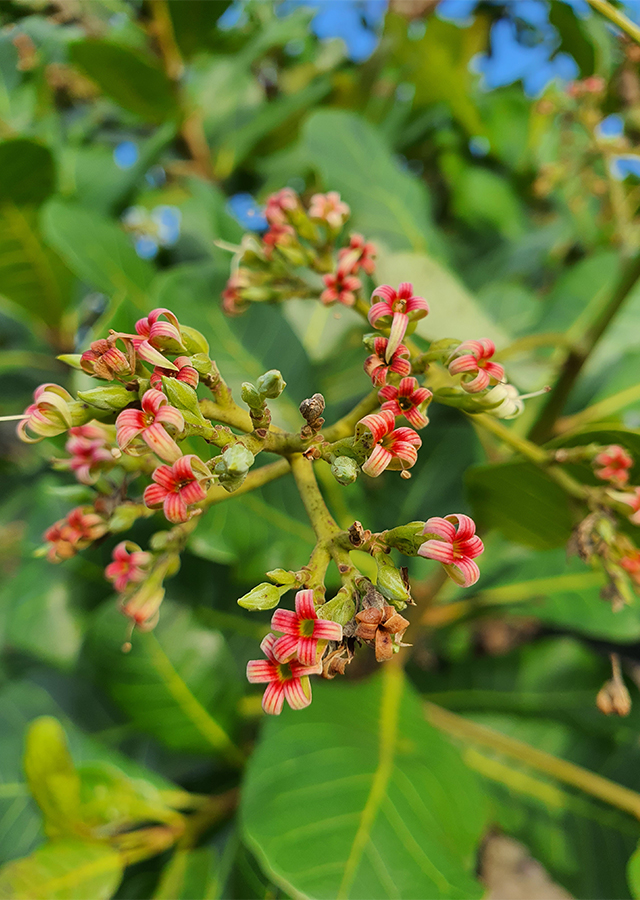
- Flowers compound, gathered in a flat panicle, finely hairy, pointed corolla.
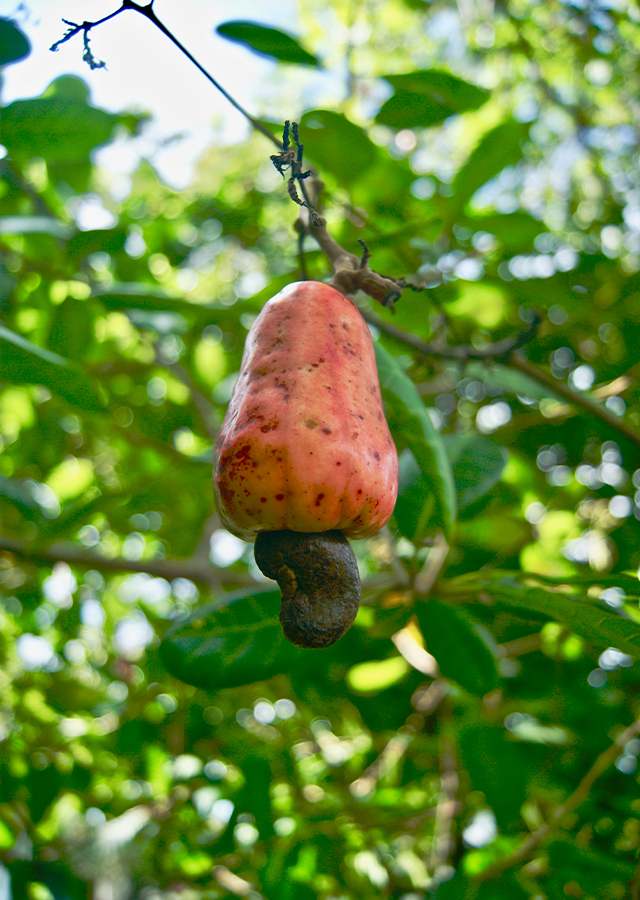
- Fruit consists of a false fruit and a true fruit, a drupe, hard, curved, greenish-brown.
- Seeds long-round, flattened-curved, and brown.
Cultivation
Propagated generatively using seed and vegetatively by air layering, cuttings, and grafting (top grafting).
Chemical Content
Leaves: flavonoids, tannins, anacardic acid, phenolic compounds, glycosides. Wood: ellagic acid, catechin. Seeds: anacardic acid, cardanol, cardol, carotenoid, volatile, lutein, thiamine, stearic acid, oleic acid, linoleic acid, palmitic acid.
Benefits
Fights free radicals; treats cancer and anemia; lowers cholesterol; helps prevent diabetes; boosts the immune system; treats sore throat; supports eye health and liver function.
Local Names
Jambu mede (Sunda), Jambu mente (Java), Jambu monyet (Madura), Jambu dwipa, Jambu jipang, Nyambu monyet (Bali), Jambu dipa (Banjar), Buwah monyet (Timor), Buwah yaki (Manado).
Traditional Recipes
The following recipes reflect traditional knowledge passed down through generations, not a substitute for professional medical diagnosis or advice. Consult a healthcare provider before use.
1. Sore Throat
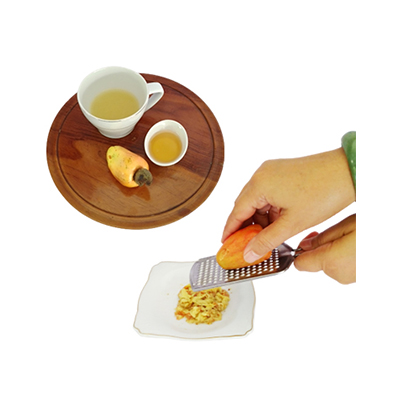
- 5 cashew false fruits (reddish-green, nearly ripe) and 2 tbsp honey.
- Wash the fruit thoroughly, then coarsely grate it. Add 4 tbsp boiled water and mix well. Squeeze the grated mixture until dry, then add honey.
- Use the liquid to gargle and drink. Repeat 3 times a day, 2 tbsp each time.
2. Supporting Liver Function
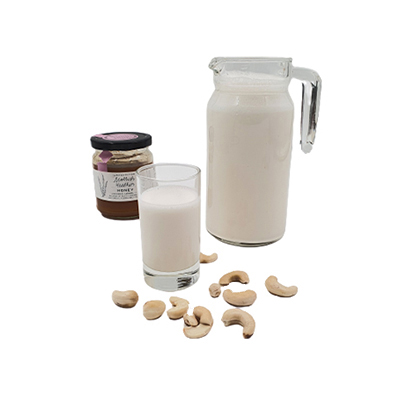
- Prepare 1 cup of cashew nuts soaked overnight, then drain and rinse.
- Blend the cashews with 1 cup of water until smooth, add 2-3 cups of water (depending on the desired thickness) while blending, then stop; once mixed, store in the fridge. Drink with a little honey.
Reference Sources
- CABI. (2019). Invasive Species Compendium. Anacardium occidentale (cashew nut). https://www.cabi.org/isc/datasheet/5064. 12-08-2020.
- Fern, Ken, (2014). Useful Tropical Plants. Anacardium occidentale. http://tropical.theferns.info/viewtropical.php?id=Anacardium+occidentale. 12-08-2020.
- Stuart Xchange. (2016). Philippine Medicinal Plants. Kasuy /Anacardium occidentale (Linn.). http://www.stuartxchange.org/Kasuy.html. 12-08-2020.
- PFAF. (No date). Anacardium occidentale. https://pfaf.org/user/Plant.aspxLatinName=Anacardium+occidentale. 12-08-2020.
- Kuntarti Nurul. Resep Herbal Radang Tenggorokan : Bayam Duri, Bandotan & Jambu Mede. https://www.deherba.com/resep-herbal-radang-tenggorokan.html 12-06-2020.
- HealtsBenefits. Cashew. https://www.healthbenefitstimes.com/health-benefits-of-cashew-nuts/ 12-06-2020.