Annona muricata L.
Summary
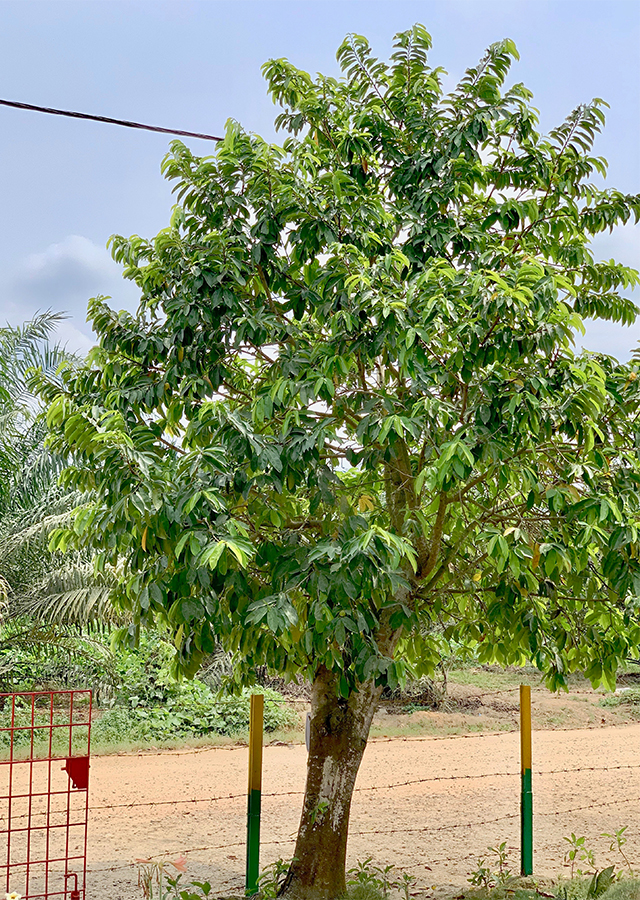
Soursop (Annona muricata) is a tree up to 7 meters tall of the Annonaceae family, native to tropical America, introduced to the Philippines after Columbus's voyages before spreading throughout tropical regions. Its leaves are widely believed to have anticancer properties due to annonaceous acetogenin content that can inhibit cancer cell development. Soursop is also traditionally used to relieve gout and lower high blood pressure.
Agroecology
Grows well in regions with elevations of 100-1,000 m above sea level, air temperature 22-32°C, rainfall 1,500-3,000 mm/year. Soursop can grow in various soil textures from sandy loam to loam provided the soil has good drainage. This tree generally grows in slightly acidic soil with an optimal pH of 5-6.5.
Morphology
- Root a taproot.
- Stem sturdy, cylindrical, rough surface, dark brown in color, grows perpendicular.
- Leaves round elongated, short tapering tip, mature leaves glossy green, young leaves yellowish-green, thick, and somewhat stiff. Pinnate venation.
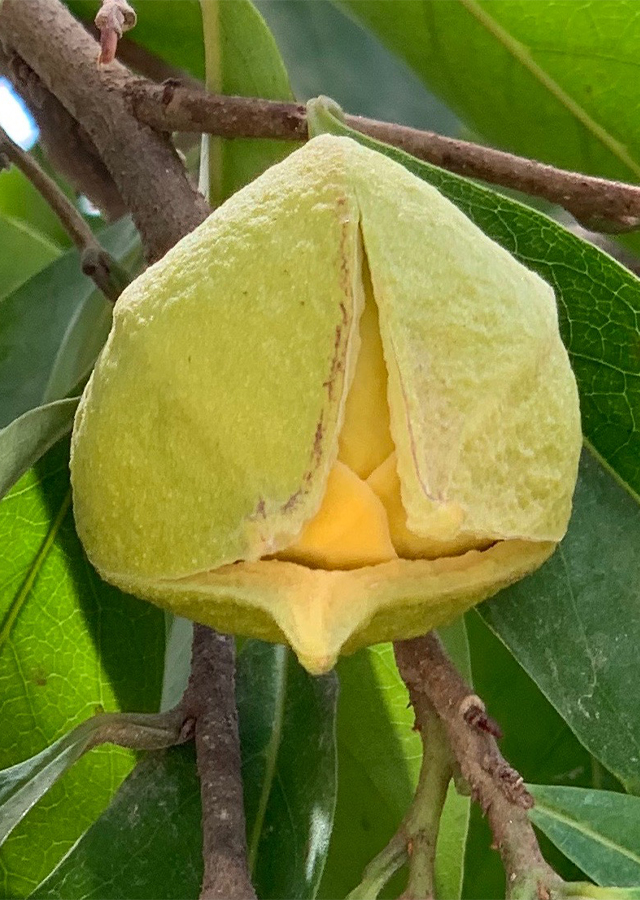
- Flowers large, thick yellow corolla. Corolla arranged in layers.
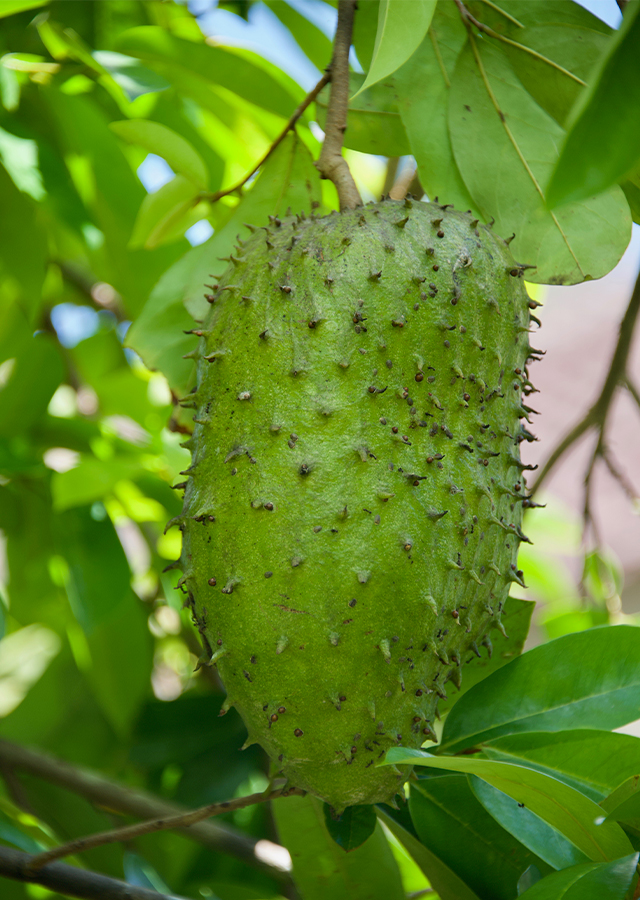
- Fruit a false fruit, yellowish-green skin. Fruit flesh white, glossy, soft, fibrous.
- Seeds flat and black in color.
Cultivation
Propagated generatively (seed) and vegetatively (grafting, budding).
Chemical Content
Annonaceous acetogenin, saponin, tannin, quinone, steroid, triterpenoid, flavonoid, alkaloid (reticuline, coclaurine, coreximine), kaempferol compound, essential oil, annomuricatin.
Benefits
Anticancer, anti-acne, treats gout, lower back pain, diabetes, rheumatism, expectorant, hemorrhoids, lowers high blood pressure.
Simplisia
- Choose and pick soursop leaves starting from the fourth leaf from the shoot to the base of the twig, wash thoroughly.
- Dry by air-drying at room temperature for 3 days without direct sun exposure or use an oven at 40°C until dry (if crushed by hand it becomes leaf fragments).
- Store the leaf simplisia in a closed package/place at room temperature.
Local Names
Deureuyan belanda (Aceh), Jambu landa (Lampung), Nangka walanda (Sunda), Nongko sebrang (Java), Nangka buris (Madura).
Traditional Recipes
The following recipes reflect traditional knowledge passed down through generations, not a substitute for professional medical diagnosis or advice. Consult a healthcare provider before use.
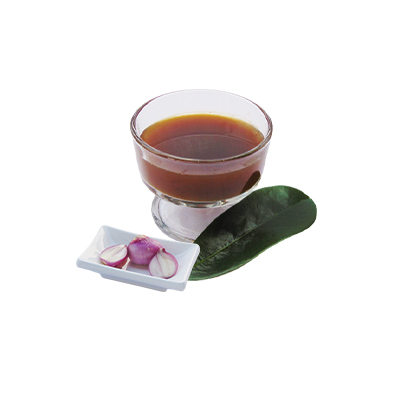
1. Expectorant
- Wash 7 soursop leaves and 1 single shallot.
- Knead the leaves together with the shallot and ¼ tsp salt then strain.
- Drink once a day. Phlegm will come out like vomit.
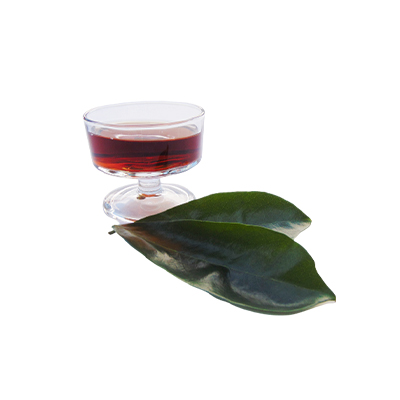
2. Cancer healing
- Boil 10 mature soursop leaves (dark green color) with 3 glasses of water until boiling and reduced to 1 glass of water, cool and strain.
- Drink twice a day, ½ glass each time.
Reference Sources
- Elidar Y. 2017. Budidaya tanaman sirsak dan manfaatnya untuk kesehatan. Jurnal Abdimas Mahakam 1(1).
- Mustariani BAA. 2011. Potensi kaempferol daun Sirsak sebagai penghambat proliferasi sel kanker raji. Tesis. Sekolah Pasca Sarjana. Institut Pertanian Bogor. Bogor.
- Patel S, Patel JK. 2016. A review on a miracle fruits of Annona muricata. Journal of Pharmacognosy and Phytochemistry 5(1): 137-148.
- Setyorini HA et al. 2016. Karakterisasi mutu ekstrak daun sirsak (Annona muricata L.) dari tiga tempat tumbuh. Buletin Penelitian Kesehatan 44(4): 279-286.
- Sudjijo. 2008. Petunjuk teknis budidaya sirsak. Balai Penelitian Tanaman Buah Tropika.
- Vijayameena C, Subhashini G, Loganayagi M, Ramesh B. 2013. Phytochemical screening and assessment of antibacterial activity for the bioactive compounds in Annona muricata. Int.J.Curr.Microbiol.App.Sci 2(1): 1-8.
- Wahab SMA, Jantan I, Haque MdA, Arshad L. 2018. Exploring the leaves of Annona muricata L. as a source of potential anti-inflammatory and anticancer agents. Agents. Front. Pharmacol. 9: 661-681.
- Yulianti R. 2015. Formulasi krim anti jerawat kombinasi ekstrak daun sirsak (Annona muricata L) dan daun jambu biji (Psidium guajava L.). Jurnal Kesehatan Bakti Tunas Husada 14(1).