Ardisia crenata Sims
Summary
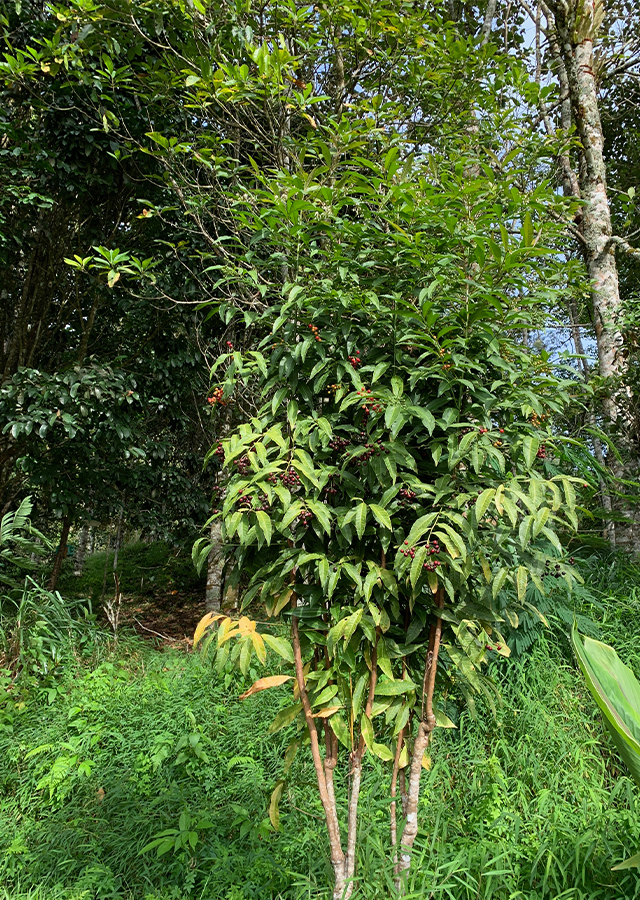
Coral berry (Ardisia crenata) is a shrub up to 3 meters tall of the Primulaceae family, native to the western coast of India, Sri Lanka, and Indo-China, and widely distributed across the Nusantara. Its sweet fruit can be eaten directly, while its leaves are often mixed into salads. Beyond that, coral berry is traditionally used to treat herpes, measles, and rheumatism.
Agroecology
This plant can grow at elevations of 0-550 m above sea level. Thrives in phosphorus-rich soil with optimal sunlight of 18-45% and requires shade.
Morphology
- Stem single, woody, blackish-brown.
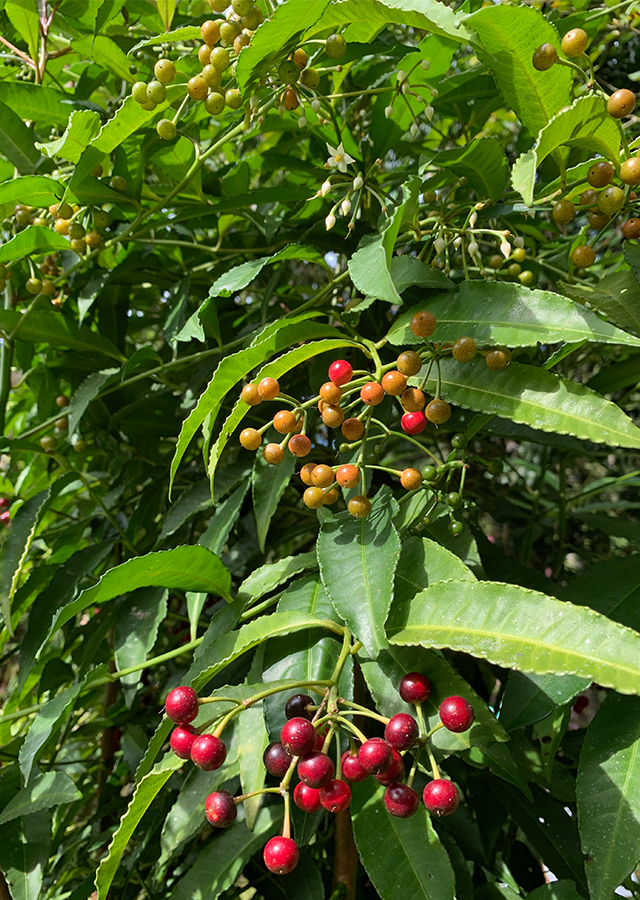
- Leaves simple, scattered, elongated with a pointed tip, wavy margins, reddish-purple when young, and up to 20 cm long. Short-stalked.
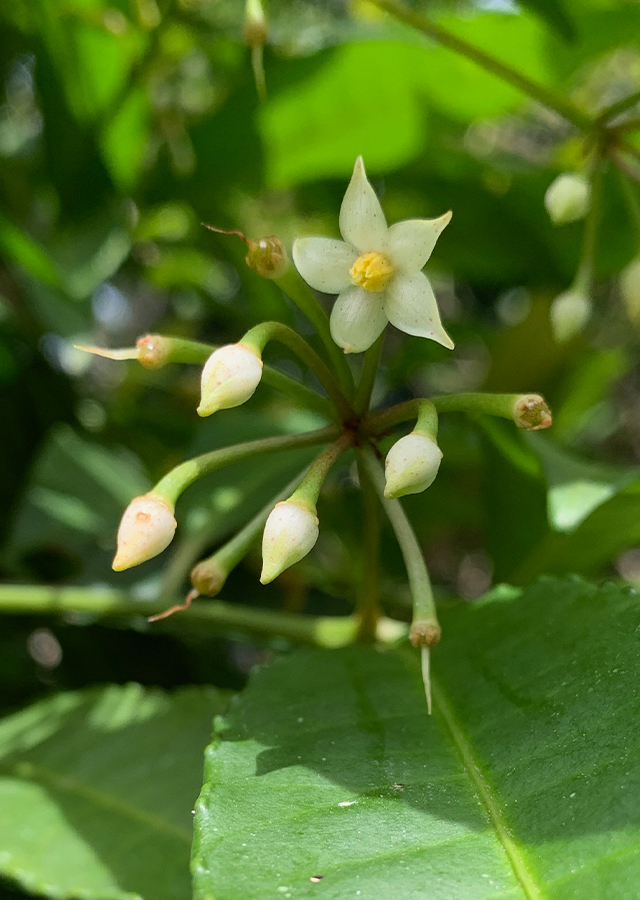
- Flowers have 5 petals forming a star and tube shape.
- Fruit round with the seed surrounded by fruit flesh. About 2.5 cm wide, red to black when ripe.
- Seeds round, about 2.5 mm in diameter, red.
Cultivation
- Propagated generatively (by seed) or vegetatively (by cuttings and air layering).
- Cuttings are made by cutting a healthy stem 15-20 cm long, stripped of all leaves except a few at the top.
Chemical Content
Bergenin, rapanone, spinasterol, norbergenin, β-sitosterol, β-D-glucoside, ardicrenin, carotene, cyclamiretin, friedelin, ardisicrenosides A-L.
Benefits
Treats herpes and measles, rheumatism, cough, fever, diarrhea, fractures, animal bites; inhibits cancer cells and tumors; improves blood circulation.
Simplisia
- Select fresh coral berry leaves. Remove any adhering debris. Wash and drain.
- Slice the leaves and place on a tray, then cover with a thin dark cloth. Sun-dry for several days.
- Once dry, place in clean, tightly sealed, airtight plastic.
Local Names
Tapinoh (Lampung), Mata ayam (Bangka), Buni keraton.
Traditional Recipes
The following recipes reflect traditional knowledge passed down through generations, not a substitute for professional medical diagnosis or advice. Consult a healthcare provider before use.
1. Herpes and Measles
- Select a sufficient amount of fresh coral berry leaves.
- Wash thoroughly under running water.
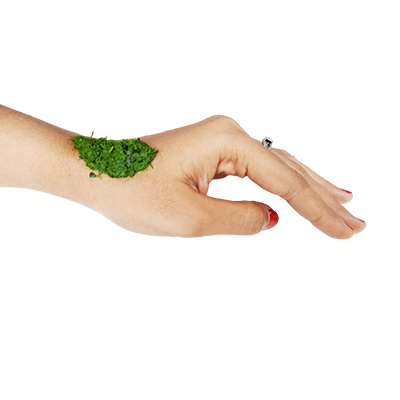
- Pound the leaves into a paste.
- Apply to the affected area.
Reference Sources
- Ling Koh Hwe, dkk. 2009. A Guide to Medicinal Plants. World Scientific.