Asplenium nidus L.
Summary
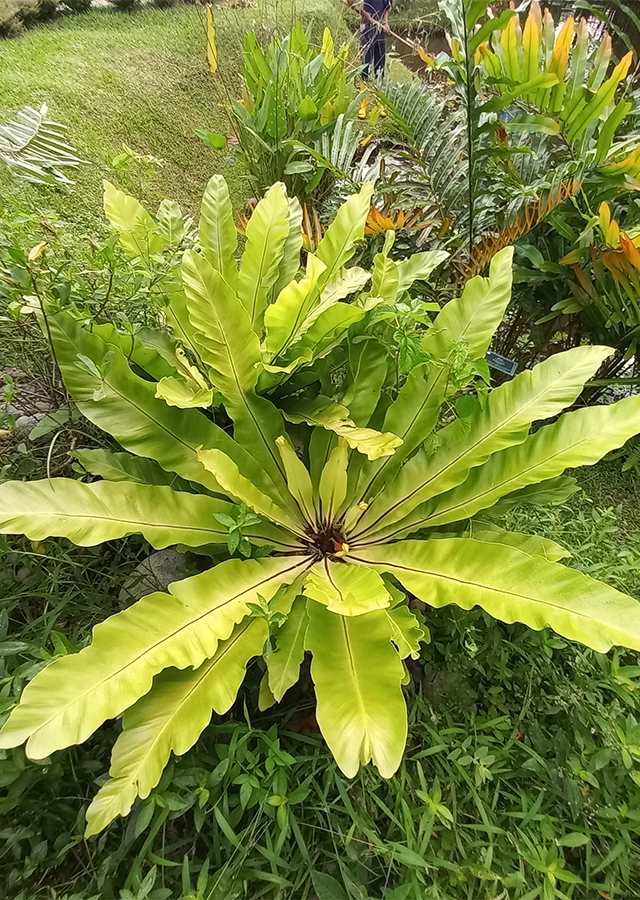
Kadaka (Asplenium nidus) is an epiphytic fern up to 1 meter tall from the Aspleniaceae family widely distributed from East Africa to Australia and Hawaii. Its leaf shape resembling a bird's nest earns it the nickname 'Bird's Nest Fern', while in Malaysia it is believed to be the home of the ghost of a woman who died in childbirth. Kadaka is traditionally used to promote hair growth and relieve labor pain.
Agroecology
Kadaka can grow terrestrially in soil, or epiphytically on trees and sometimes on rocks, at elevations from sea level up to 1,700 m asl. This plant can live in areas with high organic matter content, high soil and environmental humidity, but its leaves turn yellow if the roots are too wet, air temperature 16-24 °C, and prefers shade.
Morphology
- Roots a sturdy, upright rhizome. The rhizome is covered with fine, dense, brown scales.
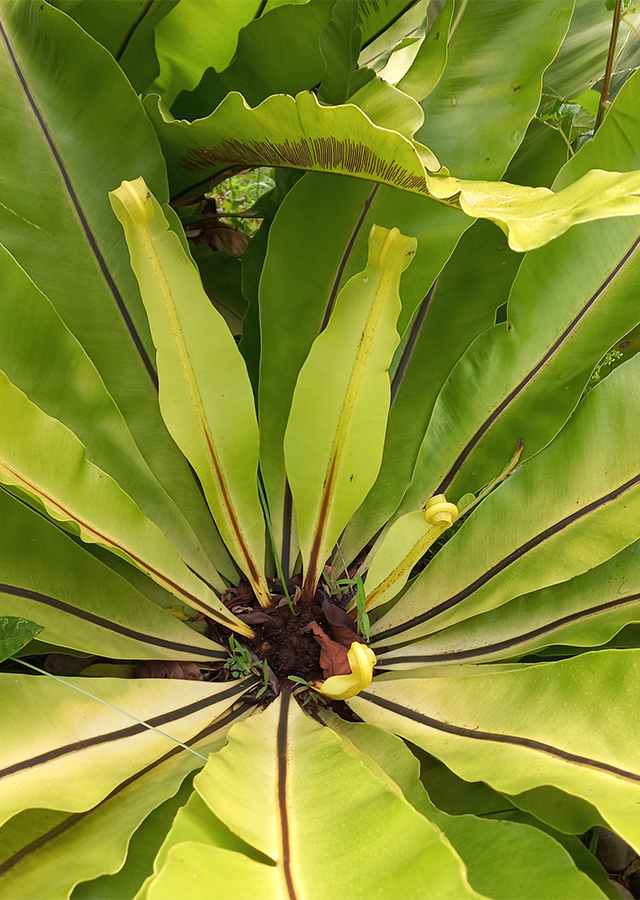
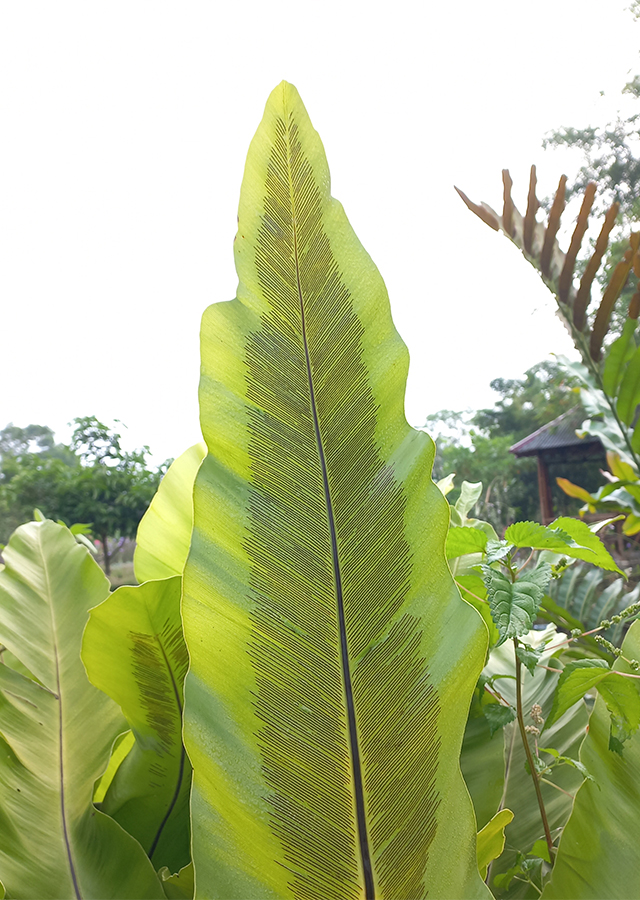
- Leaves single, emerging from the center of the plant forming an inverted cone or rosette resembling a bird's nest, blade elliptical like a sword narrowing or tapering toward both ends, approximately 50-120 cm long, and 10-20 cm wide, smooth margin with a wavy/wrinkled and glossy leaf surface, green, underside paler with brown lines along the midribs arranged in a circle. Venation single pinnate. Midrib prominent above, flat below, dark brown on old leaves. Petiole pale yellow to glossy black, grooved above, with 2 vascular strands at the base uniting upward into a single 4-armed strand.
- Sori usually somewhat long, line-shaped, arranged pinnately on each leaf blade, arranged following the venation or midribs, protected by a narrow indusium on the underside of the leaf, opening normally toward the frond, dark brown in color.
- Spores with irregular, thickened wings, transparent pale brown when fresh, turning dark brown. Sporangium small and stalked.
Cultivation
Propagation using spores. Spore germination is easier and more effective when grown in vitro.
Chemical Content
Alkaloids, tannins, oxalic acid, phenols, flavonoids (gliricidin7-O-hexoside, quercetin-7-O-rutinoside, kaempferol 3-gentiobioside-7,4'-diglucoside, kaempferol 3-vicianoside, kaempferol 3-O-glycoside, and myricetin-3-O-rhamnoside).
Benefits
Promotes hair growth, eases childbirth, relieves labor pain, reduces fever, addresses chest pain, boils, wounds, asthma, elephantiasis, weakness, treats colds, jaundice, malaria, canker sores, halitosis (bad breath), has depurative (blood-cleansing), sedative, contraceptive, antioxidant, anticancer, antibacterial, and antiviral properties.
Local Names
Lokot (Kalimantan), Bird's nest fern.
Traditional Recipes
The following recipes reflect traditional knowledge passed down through generations, not a substitute for professional medical diagnosis or advice. Consult a healthcare provider before use.
1. Relieving labor pain
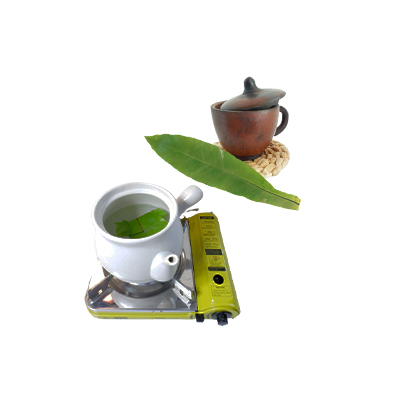
- Prepare kadaka leaves as needed and wash until clean.
- Boil the leaves until boiling.
- Strain the decoction.
- Drink while warm.
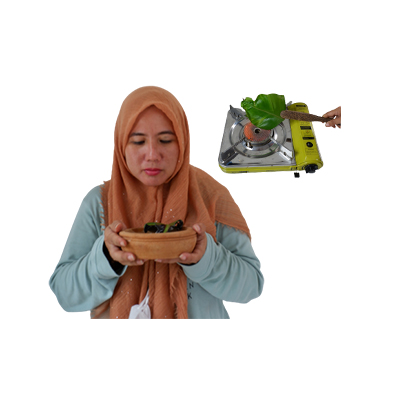
2. Colds
- Take kadaka leaves as needed.
- Burn the leaves until they produce smoke.
- Inhale the smoke from the burning leaves, repeat until the cold symptoms decrease.
Reference Sources
- Royal Botanic Gardens. 2021. Plants of the World Online: Asplenium nidus L. http://www.plantsoftheworldonline.org/taxon/urn:lsid:ipni.org:names:17048040-1. 24-09-2021.
- Stuartxchange. 2019. Philippine Medicinal Plants: Pakpak-lauin. http://www.stuartxchange.org/Pakpak-Lauin.html. 24-09-2021.
- Flora Fauna Web. 2019. Asplenium nidus. https://www.nparks.gov.sg/florafaunaweb/flora/1/5/1541. 24-09-2021.
- PHYTOMED NEPAL. 2021. Asplenium nidus L. https://phytomednepal.com/plant/asplenium-nidus-l. 24-09-2021.
- BALITHI. 2020. Klasifikasi dan Deskripsi Botani Asplenium nidus L. http://balithi.litbang.pertanian.go.id/berita-591-klasifikasi-dan-deskripsi-botani-asplenium-nidus-l.html. 24-09-2021.
- Useful Tropical Plants Database. 2021. Asplenium nidus. https://tropical.theferns.info/viewtropical.php?id=Asplenium+nidus. 24-09-2021.
- Tropical Biodiversity. 2014. Asplenium nidus. https://blogs.reading.ac.uk/tropical-biodiversity/2014/01/asplenium-nidus-2/. 24-09-2021.
- PROSEA. 2016. Asplenium (PROSEA). https://uses.plantnet-project.org/en/Asplenium_(PROSEA). 24-09-2021.
- Jarial R et al. 2018. Potent anticancer, antioxidant and antibacterial activities of isolated flavonoids from Asplenium nidus. Journal of King Saun University-Science 30(2): 185-192.