Backhousia citriodora F. Muell.
Summary
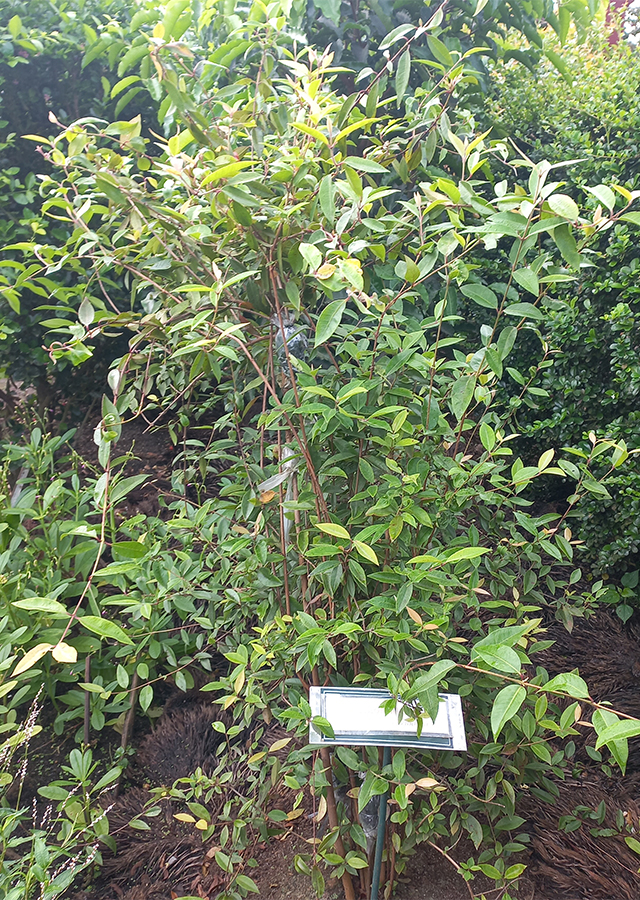
Lemon myrtle (Backhousia citriodora) is a shrub or small tree 5 meters tall from the Myrtaceae family, a plant endemic to the subtropical rainforests of Queensland, Australia. Its leaves are rich in citral, producing a high-quality essential oil for perfumes and food flavoring that even surpasses lemongrass oil. Lemon myrtle is known as a powerful antiseptic and antiviral agent used to treat colds, sore throats, and acne.
Agroecology
Lemon myrtle is a plant from the subtropical to tropical zone, and can also thrive in frost-free climate regions. Mature plants can tolerate some frost, but younger plants need protection. The plant grows naturally in areas with rainfall of 800 mm or more per year. It prefers fertile, moist but well-drained soil and a position in full sun. Large/established plants tolerate all but the poorest draining soils. Requires circumneutral soil and is prone to yellowing under alkaline conditions. Established plants are fairly drought-tolerant. Plants need protection from strong winds as they can easily break at the base of the trunk.
Morphology
- Roots taproot.
- Stem woody.
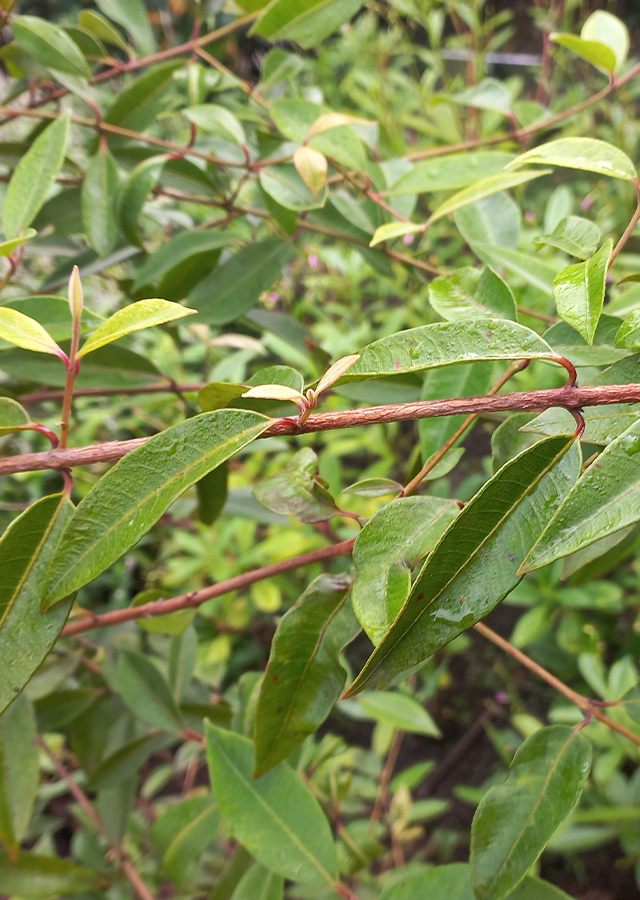
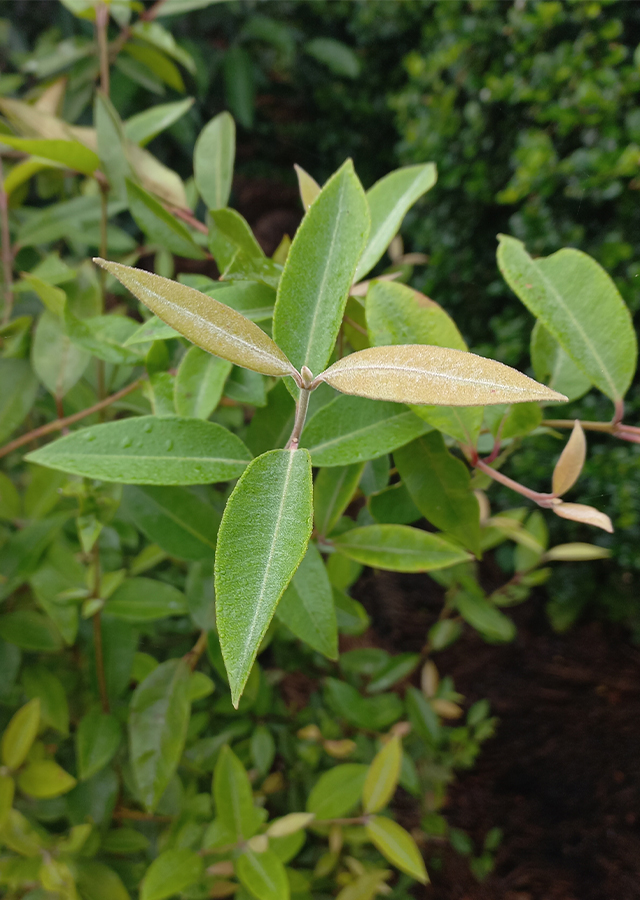
- Leaves opposite, coriaceous, petiole up to 1.5 cm long, blade ovate-lanceolate, 7.5-12.5 cm long.
- Flowers with an axillary cyme inflorescence, umbel-like with a cluster of many small flowers at the tip of branches, peduncle 2.5-3 cm long, pedicel longer than 1 cm. Calyx tube-shaped, broadly rounded, 4-lobed, petals 4, shorter than the calyx lobes, pistil with 2 ovaries, each locule with 6-8 pendulous ovules, style filiform, stigma small.
- Fruit an indehiscent capsule, surrounded by a persistent calyx.
Cultivation
- Propagation can be done generatively (seed) and vegetatively (stem cuttings and separation of offshoots from the parent).
- Propagation by seed is difficult because germination is difficult. Sow onto a moist medium, place the seed tray in almost half the depth of clean water and maintain a temperature of around 16-18°C. Seedlings take about 12 months to develop fully. When the seedlings are about 5 mm tall, remove the tray from the water, let it sit for 4-5 days and then plant the seedlings into individual containers.
- For cuttings, use semi-hardwood, though it is slow to root, and the lower small branches often touch the ground and form roots. These can be separated from the parent plant, and planted elsewhere.
Chemical Content
Essential oil (citral A, citral B, B-Myrcene, lynalool, citronellal, iso-neral, iso-geranial, trans-geraniol).
Benefits
Lemon myrtle has a reputation as a powerful antiseptic and antiviral agent that can destroy disease-carrying microorganisms. Has been used to treat allergies, colds, sore throats, stomach disorders and infections, relieve headaches, fever, muscle cramps and spasms, boost a healthy immune system, treat problems such as warts, cold sores, and acne. Has activity as a very potent antioxidant that can help fight diseases such as cancer.
Simplisia
- Prepare lemon myrtle leaves, wash clean with running water then drain.
- Dry under the sun or with an oven at 40°C until the moisture content reaches 10%.
- Grind using a blender until it becomes powder.
- Store in a clean, airtight container.
Local Names
Limau lemon, Limau wangi lemon, Kayu besi wangi lemon.
Traditional Recipes
The following recipes reflect traditional knowledge passed down through generations, not a substitute for professional medical diagnosis or advice. Consult a healthcare provider before use.
1. Sore throat
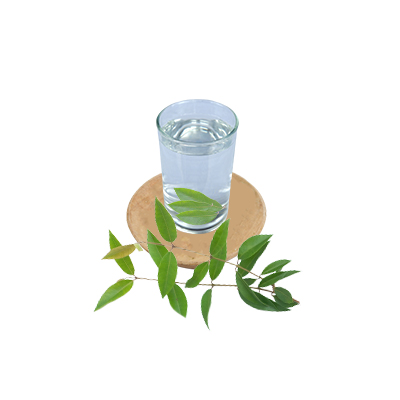
- Prepare fresh lemon myrtle leaves and wash until clean.
- Soak in water and wait for a while.
- Strain then gargle to relieve sore throat.
Reference Sources
- Royal Botanic Gardens. 2017. Backhousia citriodora F.Muell. http://www.plantsoftheworldonline.org/taxon/urn:lsid:ipni.org:names:59106-1. 15-11-2021.
- Useful Tropical Plants. 2021. Backhousia citriodora. https://tropical.theferns.info/viewtropical.php?id=Backhousia+citriodora. 15-11-2021.
- PROSEA. 2021. Backhousia citriodora. https://uses.plantnet-project.org/en/Backhousia_citriodora_(PROSEA). 15-11-2021.
- Murray, Michael T. 1997. Shneider, Rob. Mengapa Minum Teh Lemon Myrtle?. Encyclopedia of Natural Medicine. Menurut Go Wild Harvest LLC di http://www.gowildaustralia.com/uploads/LemonMyrtlepresentation_1.pdf.
- Burke, Briant E., Baillie, Jon-Eric dan Olson, Richard D. Minyak esensial dari lemon myrtle Australia (Backhousia citriodora) dalam pengobatan moluskum kontagiosum pada anak-anak. Biomedis & Farmakoterapi, Vol. 58, Edisi 4, Mei 2004, halaman 245-247.15-11-2021.
- Herbawisdom.com. 2021. Lemon Myrtle. Backhousia Citriodora. https://www.herbwisdom.com/herb-lemon-myrtle.html.15-11-2021.