Thunbergia erecta (Benth.) T.Anderson
Summary
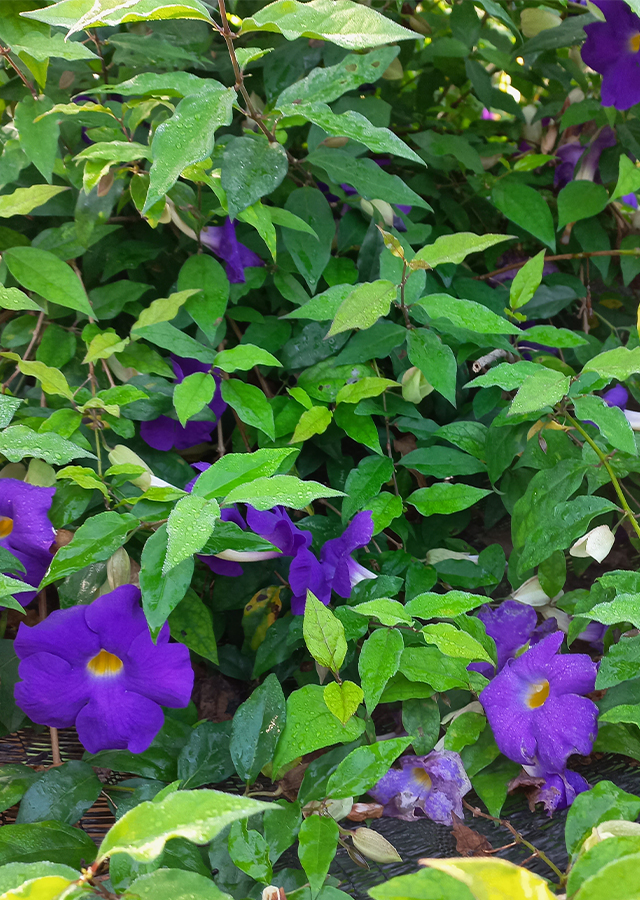
Terompetan ungu (Thunbergia erecta) is a shrub up to 3 meters tall from the Acanthaceae family that originates from tropical West Africa, now widely cultivated as an ornamental to the point of frequently escaping gardens and growing wild. In Bangladesh, this plant is known as 'nilghonta' and is the most abundant traditional remedy for insomnia, depression, and anxiety. Terompetan ungu is also recommended as an antidiabetic agent in modern research.
Agroecology
Thunbergia erecta is a garden ornamental that has escaped cultivation and can be found naturalized along roadsides and footpaths, in disturbed locations, abandoned gardens near human settlements, thickets and forest edges, at elevations from near sea level to about 1,000 m asl. Thunbergia erecta prefers to grow in moist soil but can tolerate drought. It is also fairly salt and wind tolerant. This plant can grow in full sun or in shade. However it grows better in partial shade than full shade and flowers slightly less in full shade. This plant can grow in various soil types, including acidic and alkaline sandy soil, loam and clay.
Morphology
- Stem upright, woody and hard, square, branching.
- Leaves with a hairless petiole 5 mm long, blade elliptical, 1.5-6.5 (8.5) cm long, 0.8-2.6 (4.3) cm wide, tapering at the apex, tapering base, wavy margin, hairless to subglabrous on both surfaces.
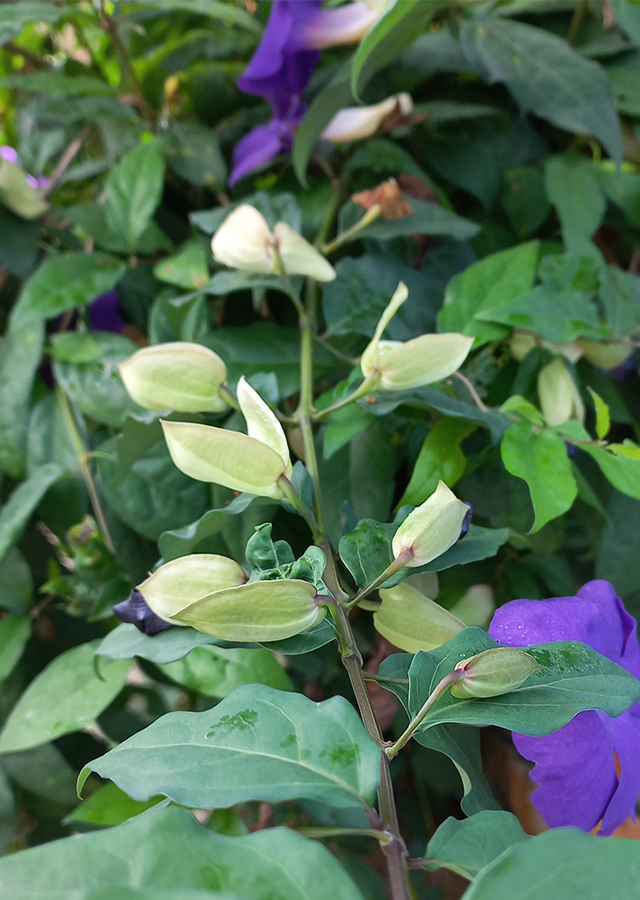
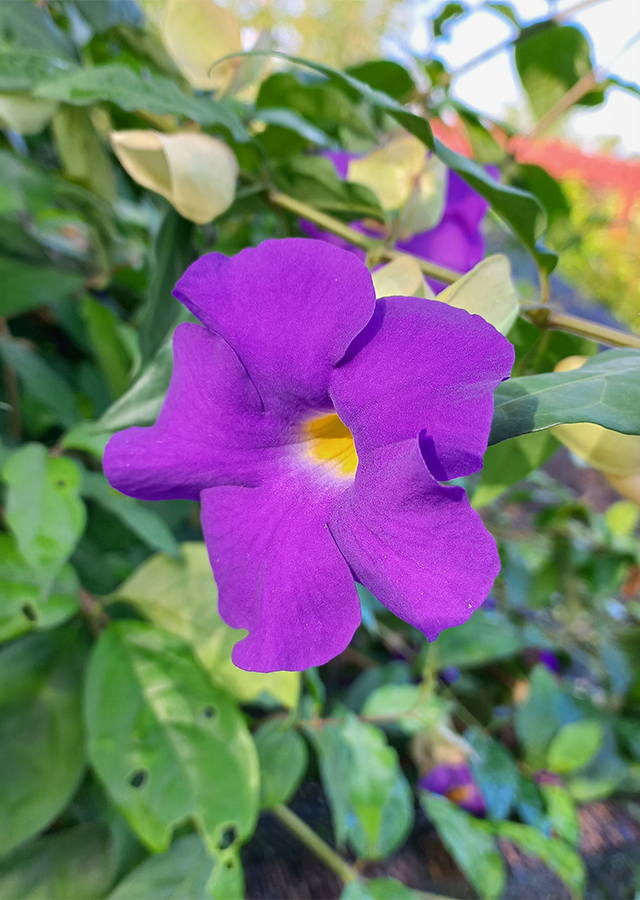
- Flowers solitary in the leaf axils, stalk up to 2.8 cm, hairless. Bracts oblong-ovate, 10-20 mm long, 5-8 mm wide, tapering at the apex, blunt at the base, hairless to slightly pubescent at the tip. Flowers with a calyx reduced to 10-16 subulate teeth, 3 mm long, glandular-puberulous. Corolla lobes all white or dark purple with a yellowish throat, broadly salver-shaped, hairless, 6-8 cm long, 6-8 mm wide narrowing to 2-3 mm wide right above the ovary, widening to 15-20 mm at the throat, lobes suborbicular, 15-25 mm in diameter. Anther cells unequal, the base and margin of the anther cells are pubescent.
Cultivation
- Plant propagation is generally through cuttings, because Thunbergia erecta does not produce seeds very often in cultivation. Take shoot cuttings from branches that have finished flowering or that have not yet formed flowers. Remove the lower leaves but leave the remaining leaves intact. Apply a rooting hormone formulated for woody cuttings and place the cutting in a moist cutting medium, such as perlite. Keep the medium moist and try to keep the humidity around the cutting high and place the cutting in partial to full shade. Roots will form within four to six weeks and cuttings can be transplanted to a potting mix as soon as roots have formed.
- This plant grows quite quickly when young and new plants can be placed in the garden once they reach a height of 1 foot, within about six months. Flowers should form within a year.
Chemical Content
β-Sitosterol-3-O-β-D-glucoside, apigenin, apigenin-7-O-β-D-glucoside, 3-methoxy-4-hydroxy benzoic acid (vanillic acid), trans-ferulic acid, 3,4,5-trimethoxyphenol-1-O-β-D-glucoside, acacetin-7-O-β-D-glucoside, acacetin 7-O-(α-D-apio-furanosyl)(1→6)-β-D-glucoside, benzyl-7-O-β-xylopyranosyl(1″→2′)-β-D-glucoside, rosmarinic acid.
Benefits
Treats insomnia, depression and anxiety, recommended as an Alzheimer's remedy and as an antidiabetic agent, treats worms and wound care, addresses gallbladder disorders, a poultice for headaches.
Local Names
Thunbergia tegak, Semak semak, Mantel raja and Semak kentang.
Traditional Recipes
The following recipes reflect traditional knowledge passed down through generations, not a substitute for professional medical diagnosis or advice. Consult a healthcare provider before use.
1. Headache
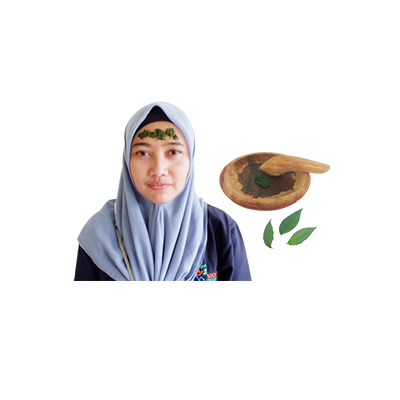
- Prepare fresh terompetan ungu leaves and wash until clean.
- Mash into a paste.
- Apply the leaf paste as a poultice on the forehead to relieve headaches.
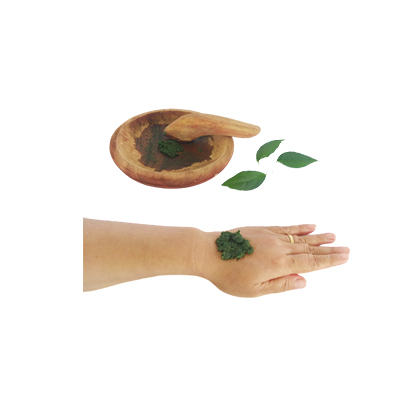
2. Wounds
- Take fresh terompetan ungu leaves and wash until clean.
- Mash into a paste.
- Apply the leaf paste as a poultice on the wound.
Reference Sources
- Royal Botanic Gardens. 2017. Plants of the World Online : Thunbergia erecta (Benth.) T.Anderson. http://powo.science.kew.org/taxon/urn:lsid:ipni.org:names:56259-1. 05-10-2021.
- CAB International. 2021. Thunbergia erecta (bush clockvine). https://www.cabi.org/isc/datasheet/34314768. 05-10-2021.
- Mohamed S. Refaey, Reda A. Abdelhamid, Hanan Elimam, Yaseen A.M.M. Elshaier , A. A. Ali , Mohamed A.A. Orabi. 2021. Bioactive constituents from Thunbergia erecta as potential anticholinesteraseand anti-ageing agents: Experimental and in silicostudies. Jurnal Bioorganic Chemistry 108 (2021) 104643. https://www.academia.edu/45567885/Bioactive_constituents_from_Thunbergia_erecta_as_potential_anticholinesterase.
- Flora Fauna Web. 2020. Thunbergia erecta. https://www.nparks.gov.sg/florafaunaweb/flora/2/5/2509. 05-10-2021.
- Hawaii Horticulture. 2012. Not All Thunbergia are Vines. http://hihort.blogspot.com/2012/06/not-all-thunbergia-are-vines.html#:~:text=Since%20Thunbergia%20erecta%20does%20not,have%20not%20yet%20formed%20flowers. 05-10-2021.
- Bagum Anawara, Abul Hossen, Ayasha Akter Moly, Md. Mahbubur Rahman Bhuiyan, Md. Shahed-Al-Mahmud. 2019. In Vivo Sedative and Anxiolytic Activities of Thunbergia erecta (Acanthaceae) Leaves Activate Gamma-Aminobutyric Acid (GABA) Mediated Hyperpolarization in Swiss Albino Mice. Pharmacology & Pharmacy, 10, 177-193. https://file.scirp.org/pdf/PP_2019041716131167.pdf. 05-10-2021.