Thunbergia grandiflora Roxb.
Summary
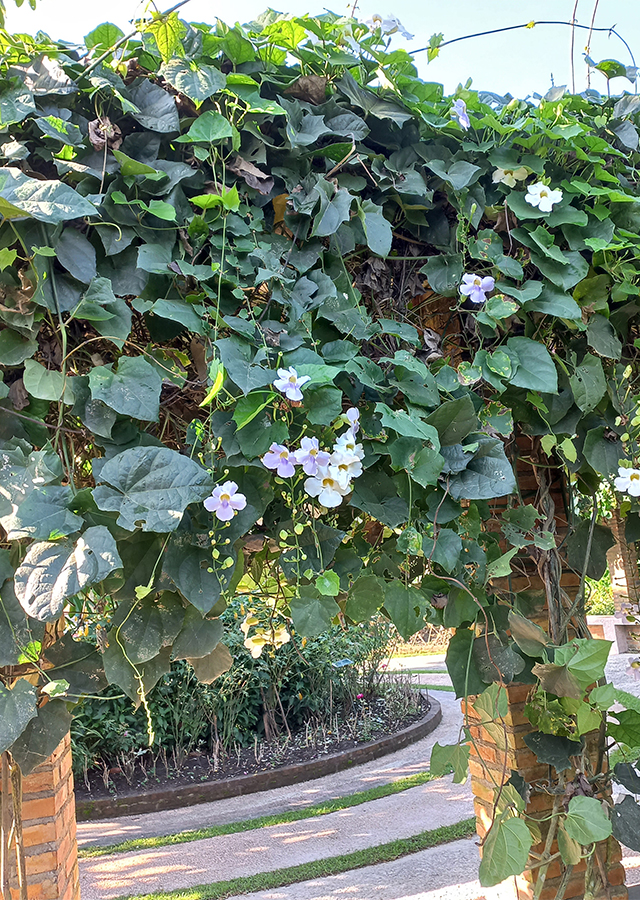
Thunbergia (Thunbergia grandiflora) is a vine 10-20 meters long from the Acanthaceae family that originates from India and China, now considered a dangerous weed in Australia despite being a popular ornamental hedge plant. In Tanzania and Uganda, this plant is used as green manure and firewood. Thunbergia is traditionally used to treat snake bites, dysentery, and diabetes in Asia and Africa.
Agroecology
Thunbergia grandiflora can usually be found growing along forest edges, roadsides, riverbanks, open forests, and plantations in tropical and subtropical regions, at elevations of 200-1,300 m asl. Its growth requires a full-sun position and is not tolerant of shaded conditions, with average annual rainfall ranging between 500-3,500 mm. This plant prefers fertile, moist, but well-drained soil.
Morphology
- Roots have tuberous roots with a deep taproot, continuously producing shoots.
- Stem cylindrical, 4-angled, striated, pubescent, cross-section with a hollow pith. Young stems are green while older stems are quite thick, turning brown and becoming somewhat rounder in shape.
- Leaves opposite, blade shape varying, ovate to triangular-ovate, tip pointed to tapering, base heart-shaped (cordiform), sharply toothed margin. Upper surface dark green, glossy, pubescent, veins slightly prominent. Lower surface pale green, dull, hairless or pubescent, with prominent veins.
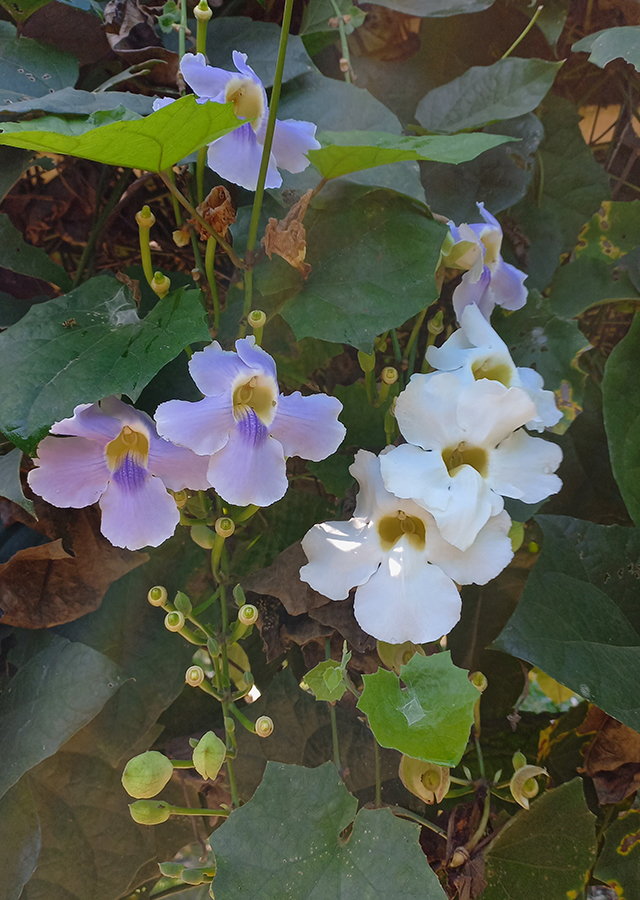
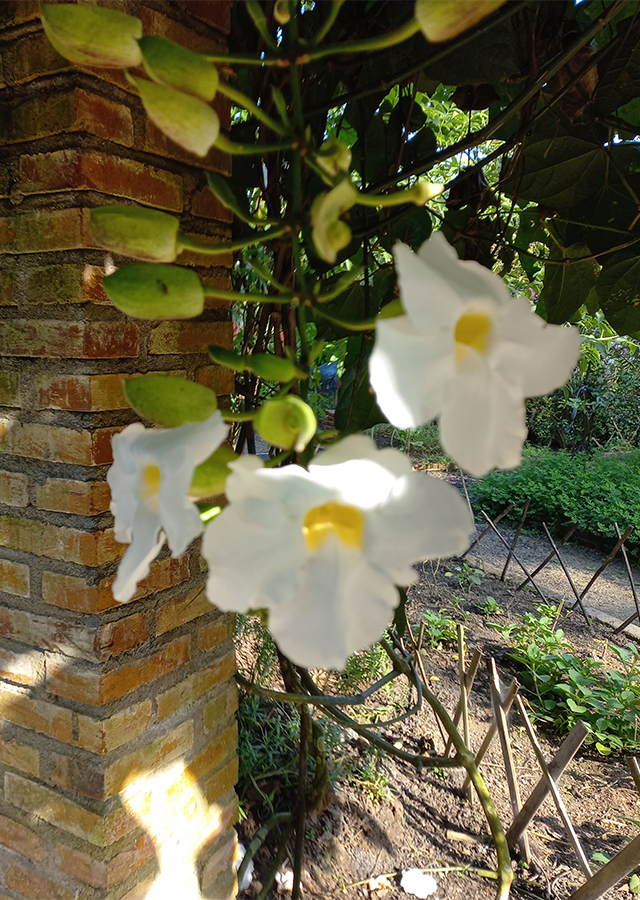
- Flowers large, trumpet-shaped, solitary, paired in the leaf axils or arranged in terminal, drooping (hanging) racemes with 2-4 flowers per node. Calyx green, ring-shaped, corolla purplish-blue or white, with 5 lobes, tube length 6-7 cm, pale yellow inside, narrowing at the base.
- Fruit a capsule, pubescent, subglobose at the base, upper part beak-shaped, splitting into two parts.
- Seeds small, ovate, flattened, covered with brown scales.
Cultivation
Propagation is done generatively (seeds) and vegetatively (stem cuttings, stolons).
Chemical Content
Alkaloids, phenols, iridoid glycosides, isounedoside, grandifloric acid, essential oil (α-3-octanol, 3,7 dimethyl 1,6-octadien-3-ol, 2-methoxy-3-(2-propenyl) phenol, methyl salicylate, isopropyl hexadecanoate).
Benefits
Treats snake bites, swelling from falls or broken bones, dysentery, cataracts, diabetes, gout, malaria, marasmus (energy and protein deficiency), ophthalmia (eye inflammation), postpartum preeclampsia, rheumatism, elephantiasis, heart disease, stomach complaints, menorrhagia (excessive menstruation), ear infections, treats drug and alcohol abuse, has antipyretic, anthelmintic, antioxidant, and anti-inflammatory activity.
Simplisia
- Prepare fresh thunbergia leaves as needed, wash clean with running water.
- Dry under sunlight or with an oven at 40 °C until moisture content reaches 10%.
- Blend into powder.
- Store in a clean, airtight container.
Local Names
Bunga madia (Jakarta)
Traditional Recipes
The following recipes reflect traditional knowledge passed down through generations, not a substitute for professional medical diagnosis or advice. Consult a healthcare provider before use.
1. Snake bite remedy
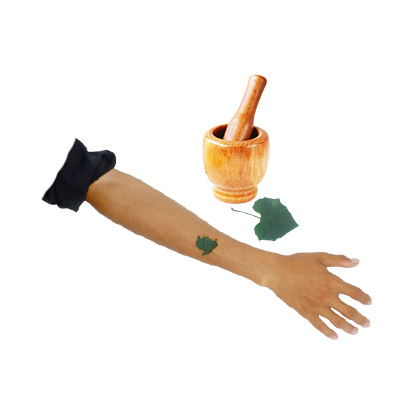
- Prepare thunbergia leaves as needed and wash until clean.
- Mash into a paste.
- Apply to the snake bite wound.
Reference Sources
- Royal Botanical Garden. 2017. Plant of the World Online: Thunbergia grandiflora Roxb. http://powo.science.kew.org/taxon/urn:lsid:ipni.org:names:117460-3. 19-09-2021.
- CAB International. 2021. Invasive Species Compendium: Thunbergia grandiflora (Bengal trumpet). https://www.cabi.org/isc/datasheet/117524. 19-09-2021.
- Useful Tropical Plants Database. 2021. Thunbergia grandiflora. http://tropical.theferns.info/viewtropical.php?id=Thunbergia+grandiflora. 19-09-2021.
- Setyawati T., Narulita S., Bahri I.P., and Rahardjo G.T., 2015. A Guide Book to Invasive Alien Plant Species in Indonesia. Research, Development and Innovation Agency. Ministry of Environment and Forestry.
- Flora Fauna Web. 2021. Thunbergia grandiflora. https://www.nparks.gov.sg/florafaunaweb/flora/1/5/1520. 19-09-2021.
- Herbpathy. 2021. Thunbergia gradiflora Herb Uses, Benefits, Cures, Side Effects Nutrients. https://herbpathy.com/Uses-and-Benefits-of-Thunbergia-Grandiflora-Cid6173. 19-09-2021.
- Mbachu K.A., Moronkola D.O. 2017. Compositions of Thunbergia grandiflora Leaf and Root Essential Oils. Journal of Advances in Medical and Pharmaceutical Sciences 15(1): 1-8. DOI: 10.9734/JAMPS/2017/35836.