Tradescantia pallida (Rose) D.R.Hunt
Summary
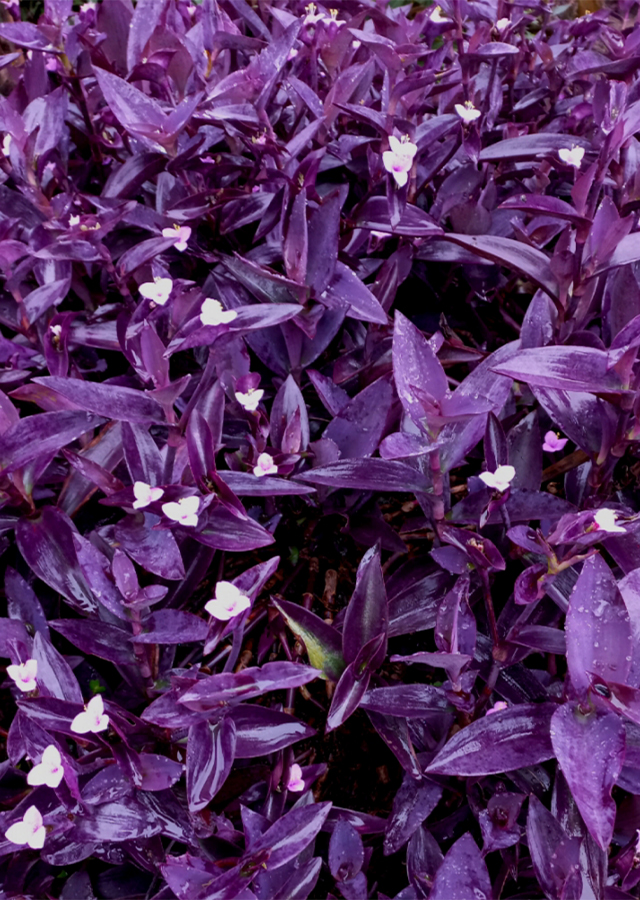
Hati ungu (Tradescantia pallida) is a herb 30-45 cm tall from the Commelinaceae family that originates from Mexico, popular as an indoor ornamental because it effectively filters air pollutants. Its distinctive purple leaf color makes it a favorite ground cover in tropical gardens. The Ayta community in Malaysia traditionally uses hati ungu to treat eye pain and improve blood circulation.
Agroecology
Hati ungu is a species that can be found growing under disturbed forests, along roadsides, riverbank border areas and coastal forests. Grows in tropical and subtropical regions with warm temperatures. Prefers a position in full sun to shade (partial shade), with average annual rainfall ranging between 800-3,500 mm. In locations exposed to sunlight, the leaves will be more strikingly colored. Hati ungu does not grow well in locations with air temperatures below 8-10 °C. Heat-tolerant, but damaged by freezing conditions and winter. This plant is able to grow and adapt to various soil types (loam, sandy loam, and limestone), but optimal growth occurs in moist soil with a pH ranging between 5 to 7.8, and well-drained, but drought-tolerant.
Morphology
- Roots fibrous.
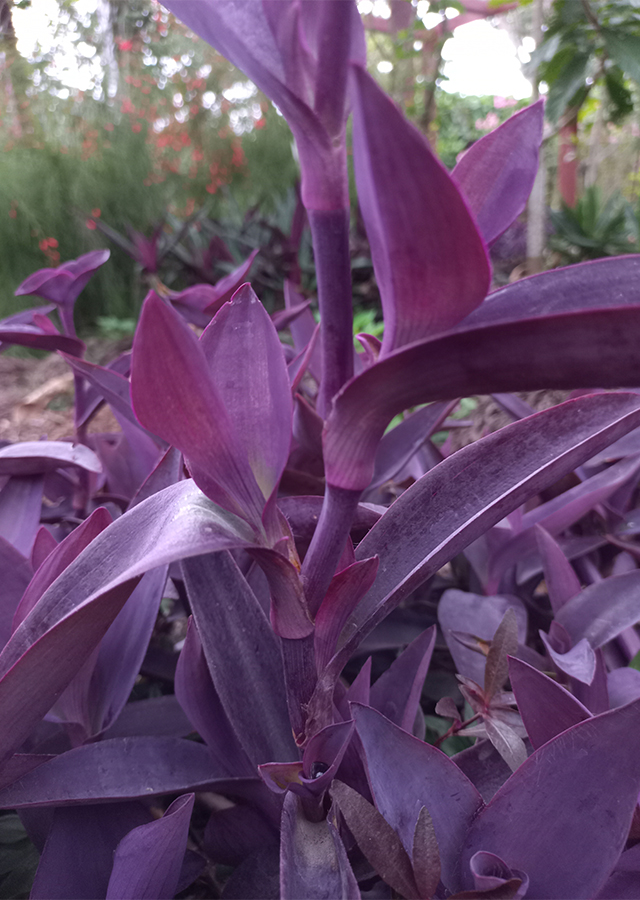
- Stem round, succulent, fleshy, dark purple, upright at first, then creeping on the ground.
- Leaves a clasping sheath, ciliate, leaf blade oblong, tip tapering, upper leaf surface dark deep purple while the underside of the leaf is bright purple shading toward pink, leaf base wraps and encircles the stem, covered with fine soft hairs. Leaves located at the top are somewhat smaller.
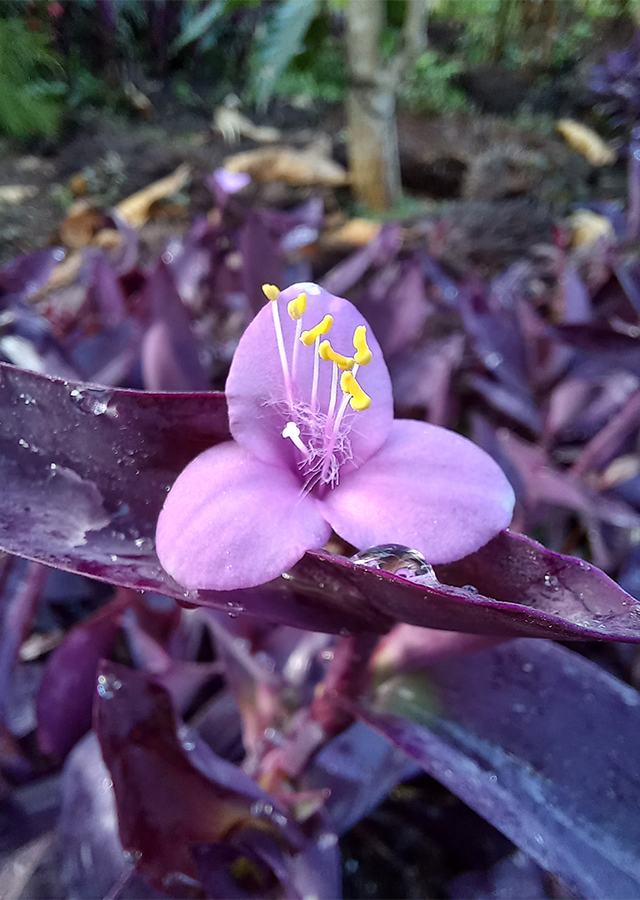
- Flowers in small, dense cymose clusters with 2 or 3 bracts. Pedicels umbellate, pilose toward the tip. Sepals oblong. Petals numbering 3, ovate and pink to rose-purple, stamens numbering 6, with 3 epipetalous filaments and 3 attached to the corolla margin, hairless or variably pubescent. Inflorescence terminal and in the axils of the upper leaves. Opens only in the morning.
- Fruit a hairless capsule, 3.5 mm in size.
- Seeds very small (2.5-3 mm).
Cultivation
Propagation is done vegetatively (stem cuttings and root fragments).
Chemical Content
Anthocyanins, flavonoids, tannins, steroids.
Benefits
Treats eye pain, improves blood circulation. Has antioxidant, antibacterial, anti-inflammatory, and antitoxic activity.
Simplisia
- Prepare hati ungu leaves, wash clean with running water.
- Cut the leaves into small pieces then dry in a shaded place, not exposed to direct sunlight for 4 days.
- Once dry, grind the leaves into powder.
- Store in a closed, airtight place.
Local Names
Adam hawa ungu.
Traditional Recipes
The following recipes reflect traditional knowledge passed down through generations, not a substitute for professional medical diagnosis or advice. Consult a healthcare provider before use.
1. Improving blood circulation
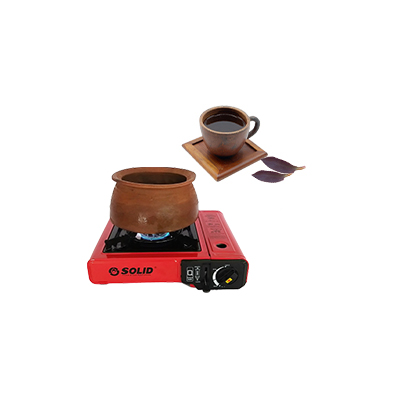
- Prepare hati ungu leaves as needed and wash until clean.
- Boil until boiling.
- Let stand until warm/cool.
- Strain, then drink to improve blood circulation.
Reference Sources
- Royal Botanic Gardens. 2021. Plant of the World Online: Tradescantia pallida (Rose) D.R.Hunt. http://www.plantsoftheworldonline.org/taxon/urn:lsid:ipni.org:names:256037-2. 08-10-2021.
- CAB International. 2021. Invasive Species Compendium: Tradescantia pallida (purple queen). https://www.cabi.org/isc/datasheet/117574#tosummaryOfInvasiveness. 08-10-2021.
- Stuartxchange. 2018. Philippine Medicinal Plants: Purple heart. http://www.stuartxchange.org/PurpleHeart. 08-10-2021.
- Flora Fauna Web. 2019. Tradescantia pallida (Rose) D.R.Hunt. https://www.nparks.gov.sg/florafaunaweb/flora/2/5/2521. 08-10-2021.
- Tan J.B.L., Yap W.J., Tan S.Y., Lim Y.Y., Lee S.M. 2014. Antioxidant Content, Antioxidant Activity, and Antibacterial Activity of Five Plants from the Commelinaceae Family. Antioxidants 3(4): 758–769. doi: 10.3390/antiox3040758.
- Gouri Kumar Dash, Nur Fazzlin Binti Che Hassan, Mohd Haziq Bin Hashim, Ravindran Muthukumarasamy. 2020. Pharmacognostic Study of Tradescantia pallida (Rose) D. R. Hunt leaves. Research J. Pharm. and Tech, 13(1):233-236. doi: 10.5958/0974-360X.2020.00047.5.