Trigonella foenum-graecum L.
Summary
Fenugreek (Trigonella foenum-graecum) is an upright aromatic herb 40-80 cm tall from the Fabaceae family native to the Mediterranean and Western Asia, cultivated since 4000 BC according to the earliest written records. Its seeds serve as a cooking seasoning and a caramel and coffee substitute, as well as a dye source in India. Fenugreek is traditionally used extensively in Chinese medicine, Ayurveda, and Middle Eastern medicine to lower blood sugar and cholesterol.
Agroecology
Fenugreek can be found growing at field edges, uncultivated land, dry grassland, and hillsides. This species can grow well on fertile loamy or sandy well-drained soil types, but also grows fairly well in gravelly and sandy soil, with a suitable soil pH range between 5.3-8.2. Moderately saline soil can be tolerated, but not acidic soil. This species prefers areas where the mean annual daytime temperature is in the range of 13-27°C, but can tolerate 5-32°C, with moderate or low rainfall (500-700 mm per year) and is a sun-loving plant. Fenugreek is fairly drought-tolerant and can tolerate frost down to -15°C (vegetative stage only).
Morphology
- Roots taproot, highly branched, forming root nodules.
- Stem solitary or branched, terete, slightly puberulent, green to purple.
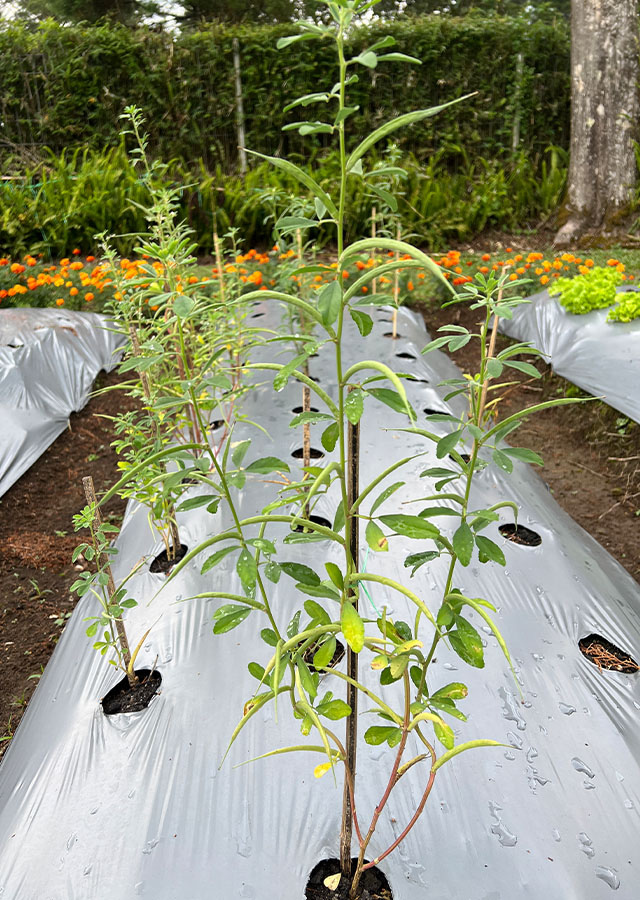
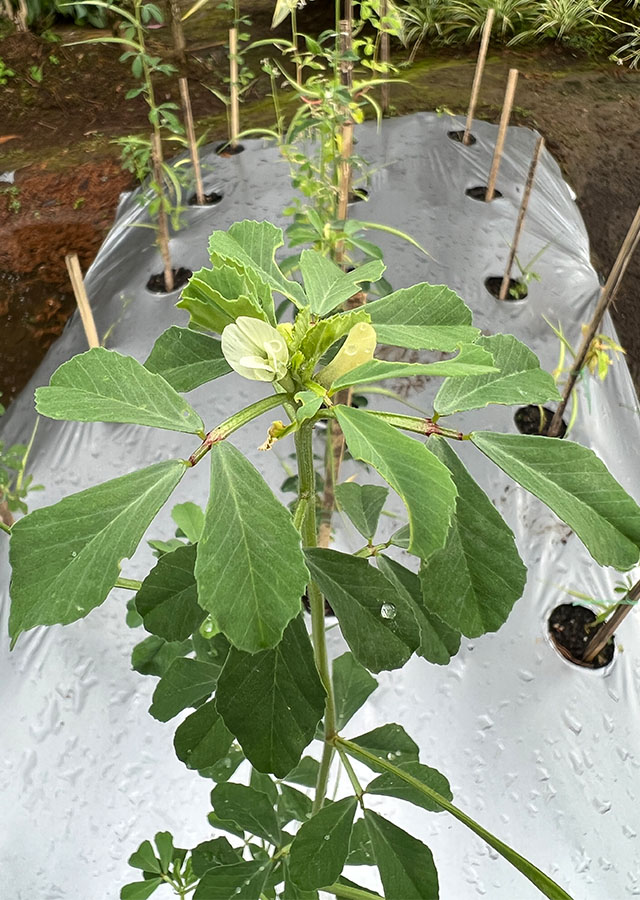
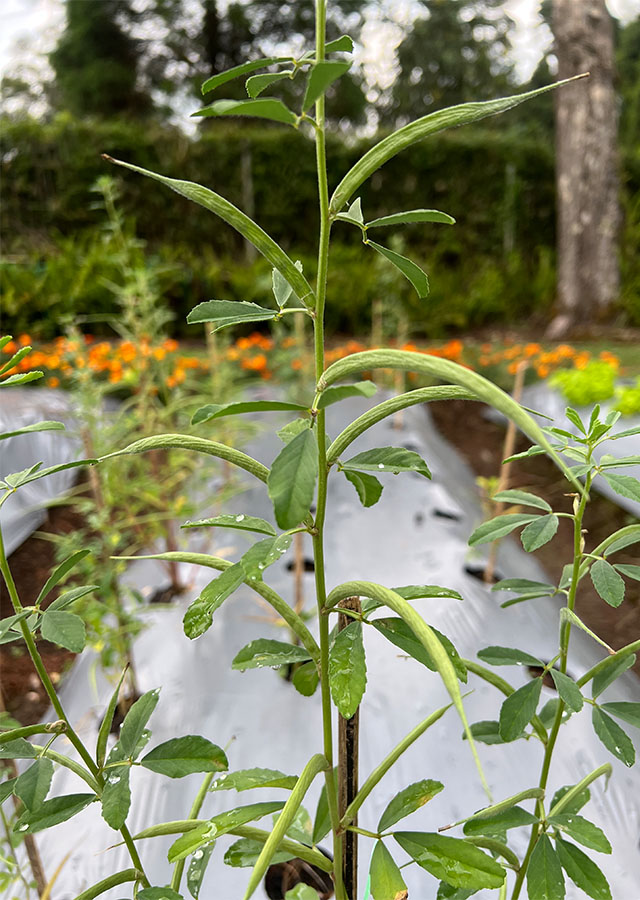
- Leaves alternate, pinnately compound, trifoliate, light green, and petiolate. Leaflets ovate or oblong shaped, leaf margin toothed. Petiole grooved above. Stipules triangular, small, attached to the petiole.
- Flowers small, triangular, axillary and sessile, white and yellow. Calyx puberulent, tube 4.5 mm long, 5-lobed. Stamens diadelphous (9+1), pistil with a sessile ovary, style hairless. Arising from the leaf axil and arranged solitarily or in small paired clusters. Pollen grains can be oval or round shaped. Flowers are hermaphrodite and pollination occurs via insects.
- Fruit a straight to sometimes sickle-shaped pod, narrow, long and oblong, glabrous with fine longitudinal veins. Pod size 80-150 x 2-4 mm and ending in an elongated beak. The pod contains 10-20 small seeds.
- Seeds small, hard, elongated, flat, rectangular shaped with a groove in the middle dividing each seed into 2 unequal parts, corners rounded, somewhat smooth. Seeds yellowish brown, aromatic.
Cultivation
- Propagation is done generatively using seed. Seeds are soaked for 12 hours before sowing. Seeds germinate within 6-8 days after planting. Optimum soil temperature at planting time is >10°C.
- Harvesting is done within 30-40 days for the herb and 105-140 days for the seed. Picking (hand harvesting) is done for the herb and machines are used to harvest the seed.
- In South India, fenugreek is intercropped with coriander, sesame, or beans.
Chemical Content
Quinones, flavones, flavonoids (quercetin), phenolic compounds (coumarin, scopoletin, chlorogenic acid, caffeic acid, and p-coumaric acid), tannins, terpenes and terpenoids (sabinene, 3-carene, menthol, α-pinene, β-pinene, β-terpineol, cineole, anethole, β-terpinyl acetate, carvone, 1-p-menthen-8-yl acetate, 1-pentanol, 1-hexanol, 2-methyl-2-buten-1-ol, 2-methyl-2-butenal, 2-pentylfuran, formic acid, propanoic acid, γ-butyrolactone, 5-alkylated γ-lactones, 3-amino-4,5-dimethyl-2(3H)-furanone), lactones, saponins (fenugrin, diosgenin), alkaloids (trigonelline, gentianine, carpaine), steroidal compounds (choline), amino acids (4-hydroxyisoleucine, arginine), galactomannan, polypeptides.
Benefits
Lowers blood pressure and cholesterol, helps reduce fever, prevents constipation, reduces cardiovascular disease, controls diabetes, protects against cancer, maintains heart health, induces growth and reproductive hormones, cares for long, shiny hair, relieves skin irritation and skin damage, boils, reduces swelling and pain, soothes abscesses and wounds, helps heal sinus and lung disease, eliminates bad breath, treats canker sores and chapped lips, hernia, arthritis, gastric and intestinal ulcers, excessive vaginal discharge, is aphrodisiac. Has antioxidant, antidiabetic, antibacterial, antidiarrheal, anti-inflammatory, hypoglycemic, gastroprotective, and hepatoprotective activity.
Simplisia
- Prepare an adequate amount of fresh fenugreek seeds, wash clean with running water.
- Dry under the sun or with an oven at 40°C until the moisture content reaches 10%.
- Grind using a blender until it becomes powder.
- Store in a clean, airtight container.
Local Names
Klabet (Java).
Traditional Recipes
The following recipes reflect traditional knowledge passed down through generations, not a substitute for professional medical diagnosis or advice. Consult a healthcare provider before use.

1. Boils
- Prepare an adequate amount of fresh fenugreek seeds, wash clean with running water.
- Dry under the sun or with an oven at 40°C until the moisture content reaches 10%.
- Grind using a blender until it becomes powder.
- Mix with a little water then apply as a poultice on the boil.
Reference Sources
- Royal Botanic Gardens. 2021. Plants of the World Online: Trigonella foenum-graecum L. https://powo.science.kew.org/taxon/urn:lsid:ipni.org:names:523957-1. 22-02-2022.
- Ritika. 2016. Trigonella foenum-graecum L. : A REVIEW OF ITS ETHNOBOTANY, PHARMACOLOGY AND PHYTOCHEMISTRY. International Journal of Advance Research in Science and Engineering, 5(9): 192-204.
- PROSEA. 2019. Trigonella foenum-graecum (PROSEA). https://uses.plantnet-project.org/en/Trigonella_foenum-graecum_(PROSEA). 22-02-2022.
- Useful Tropical Plants Database, Ken Fern. 2021. Trigonella foenum-graecum. https://tropical.theferns.info/viewtropical.php?id=Trigonella+foenum-graecum. 22-02-2022.