Uncaria gambir (W.Hunter) Roxb.
Summary
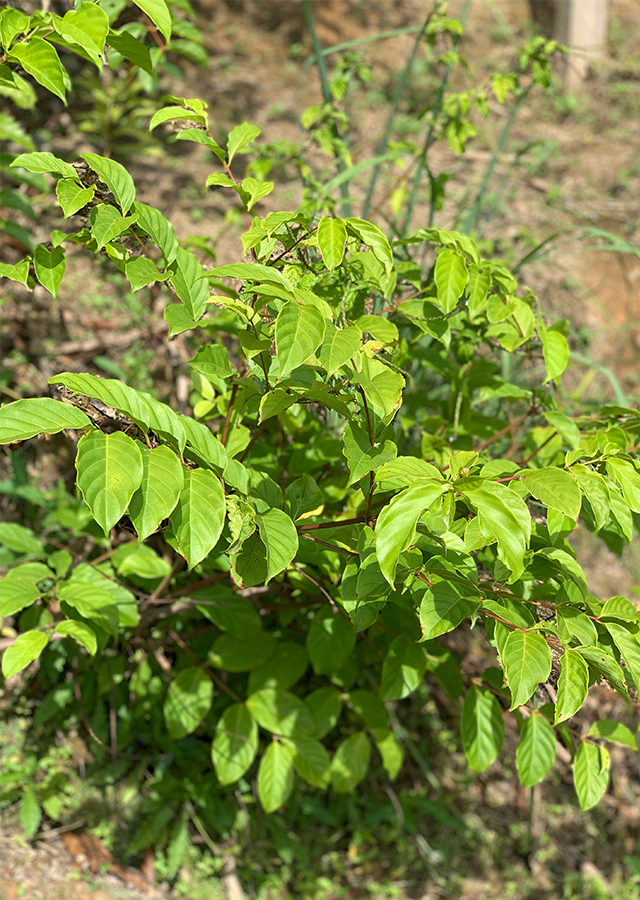
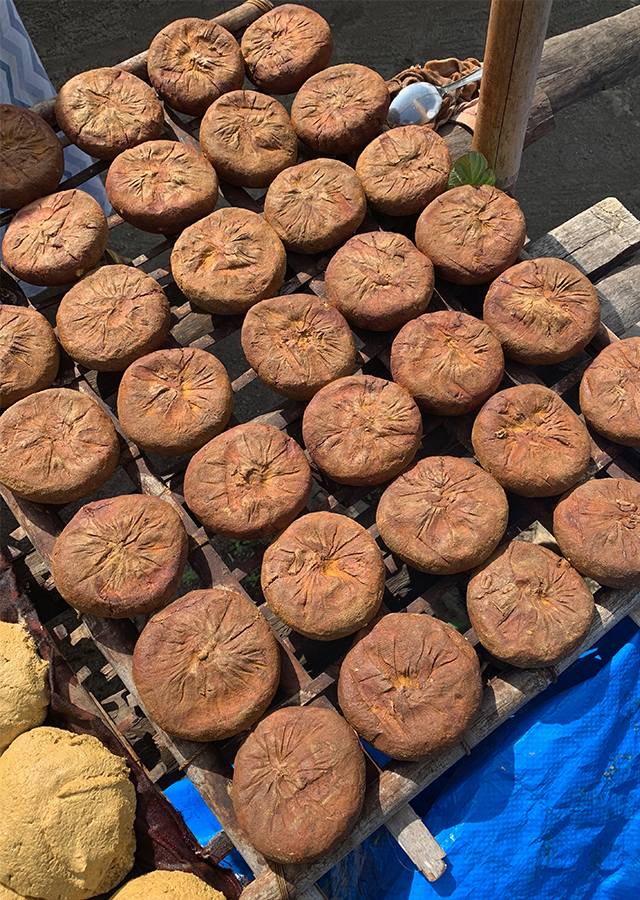
Gambir (Uncaria gambir) is a climbing shrub 1-3 meters tall of the Rubiaceae family, believed to be native to Sumatra and Kalimantan, where wild types are still found growing naturally. The sap from its leaves, processed into a solid extract, has been a characteristic ingredient of Nusantara betel-chewing for around 2,500 years, and is also used as a leather tanning agent and textile dye. In traditional medicine, gambir is believed to relieve sore throat, diarrhea, and wounds.
Agroecology
Grows in secondary forest areas, with soil acidity (pH) ranging from 4.8-5.5. Land slope 15%. Elevation 50-1,100 m above sea level. Rainfall 2,500-3,353 mm/year. Air temperature 20-40 °C and air humidity 70-85%.
Morphology
- Stem upright, with sympodial branching, light brown to reddish-brown.
- Leaves simple, oval, elongated, pointed tip, hairless (smooth) surface, with a short petiole.
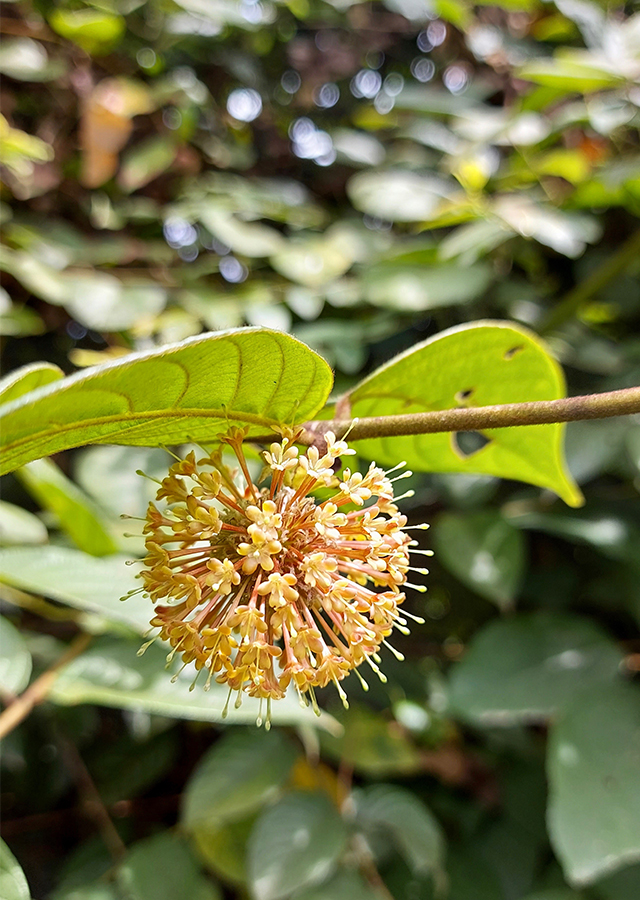
- Flowers compound with a pink or green corolla, 5 cm in size.
- Fruit pod-shaped, a false fruit up to 2 cm across.
- Seeds needle-like, small, yellow.
Cultivation
- Propagated generatively (by seed). Gambir fruit is first sun-dried so the pods split open and the seeds can be collected, then cleaned and stored in an airtight space.
- Vegetative propagation is done by stem cuttings, air layering, and budding.
Chemical Content
Flavonoids (catechin), catechutannic acid, pyrocatechol, gambir fluorescence compounds, red catechu, quercetin, alkaloids (gambirdine), ellagic acid.
Benefits
Cosmetic ingredient; antipyretic, anti-diarrheal; treats headache, stomach pain, wounds, vaginal discharge; helps prevent heart disease; used as a mouthwash to treat sore throat and fungal and bacterial infections.
Simplisia
- Soak gambir leaves in cold water for ± 120 minutes and drain.
- The leaves are then dried by sun-drying or using an oven at 40°C.
- The dried gambir leaves are packed in an airtight container or clean plastic.
Local Names
Also known locally as Gambee (Aceh), Sontang (Batak), Gambe (Nias), Gambie (Minangkabau), Sepelet (Lampung), Santun (Java), Kelare (Kalimantan), Gambele (Sulawesi) Gamer (Maluku).
Traditional Recipes
The following recipes reflect traditional knowledge passed down through generations, not a substitute for professional medical diagnosis or advice. Consult a healthcare provider before use.
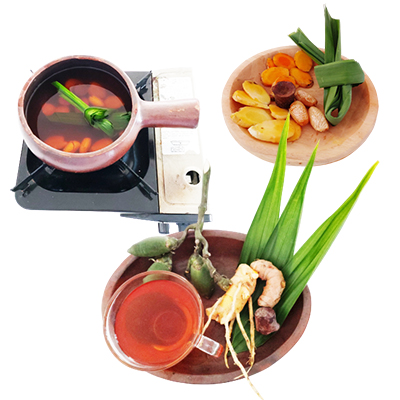
1. Vaginal Discharge
- Take 1 piece of gambir, 3 young areca nuts, 7 slices of turmeric, 3 pandan leaves, and 7 slices of temulawak (Javanese turmeric).
- Wash all ingredients thoroughly, boil in 4 cups of water until boiling and reduced to 2 cups.
- Drink morning and evening, 1 cup each time.
Reference Sources
- Nazir, N. 2000. Gambir: Budidaya, Pengelolaan Dan Prospek Diverivikasinya. Yayasan Hutanku, Padang. https://repository.ipb.ac.id/jspui/ldap-login;jsessionid=D41407F99EE194B674FC621A072F28BF
- Dharma, AP. 1987. Indonesian Medicinal Plants. Balai Pustaka, Jakarta 79 – 80.
- Tropical Plants Database, Ken Fern. tropical.theferns.info. Uncaria gambir . http://tropical.theferns.info/viewtropical.php?id=Uncaria+gambir 20-01- 2021
- BPOM RI. 2011. Formularium Obat Tradisional Indonesia. Ramuan Etnomedisin Vol.I